There are streets on the Northern Beaches where nearly every second garden has one — that familiar silhouette of long arching fronds, drooping clusters of orange fruit, and a trunk that's dropped more mess on the lawn than a family of cockatoos. The Cocos palm. People either inherited one with the house or planted it twenty years ago thinking it looked tropical and low-maintenance. Most of them have since changed their minds. Cocos palms are especially common through the coastal strip around Narrabeen, Mona Vale and Warriewood.
If you're looking at yours and wondering what it would take to get rid of it, here's what you actually need to know: how the removal works, whether you need council permission, what it costs, and what to do once it's gone.
Why So Many People Want Their Cocos Palm Gone
A Cocos palm is rarely just one problem — it's a list of problems that gets longer every year.
The fruit is the big one. Cocos palms produce hundreds of seed pods in heavy clusters, and when they drop — and they will drop — they split open into a sticky orange mess that coats the lawn, stains paving and fills gutters. The fruit is also toxic to dogs, which is a detail a lot of people only find out the hard way. The mess is constant, and unlike leaves that blow away, these pods are heavy enough to stay exactly where they land.
Then there's the rat issue. Cocos palms are well-documented as a significant rat habitat. The dense skirt of dead fronds that builds up around the base of an unmaintained Cocos palm is prime nesting material, and the fruit provides an easy food source. If you've noticed rats in your yard or roof and you have a Cocos palm nearby, the two are almost certainly connected.
On top of that, Cocos palms are classified as an environmental weed across Greater Sydney. Their seeds germinate readily, they outcompete native vegetation and they're steadily spreading through bushland and waterway corridors across the Northern Beaches. If you're near a reserve or a creek line, your palm is almost certainly contributing to that spread whether you notice it or not.
The final reason is simply the tree itself. A mature Cocos palm can reach 10–12 metres. The fronds are long and heavy, the canopy casts significant shade, and once a tree reaches this size the ongoing maintenance — frond removal, fruit removal, base cleaning — becomes a real cost and effort. Most people reach a point where they'd just rather have the space back.
Do You Need a Council Permit to Remove a Cocos Palm?
This is the question that puts most people off starting the process — and the answer, for most Cocos palms on the Northern Beaches, is no.
Northern Beaches Council recognises Cocos palms as an environmental weed under its Development Control Plan. Because of this, they're generally exempt from the permit requirements that apply to significant native trees. In most cases you can remove a Cocos palm without a council application, regardless of its size.
There are exceptions worth knowing about. If your palm is listed on the significant tree register, if it's subject to a specific condition on a development approval, or if it's on a heritage-listed property, different rules may apply. These situations are uncommon, but it's worth a quick check of your property's planning details before you proceed if you're unsure. We can advise on this when we come out to look at the tree — most of the time the answer is straightforward.
How Cocos Palm Removal Actually Works
The process depends on the size of the palm and how much space there is to work in.
Smaller palms — say under 5 metres — can often be felled in a single section if there's clear space to drop them. The fronds are removed first, then the trunk is felled, sectioned up and chipped or removed. Straightforward job, usually done and dusted within a couple of hours.
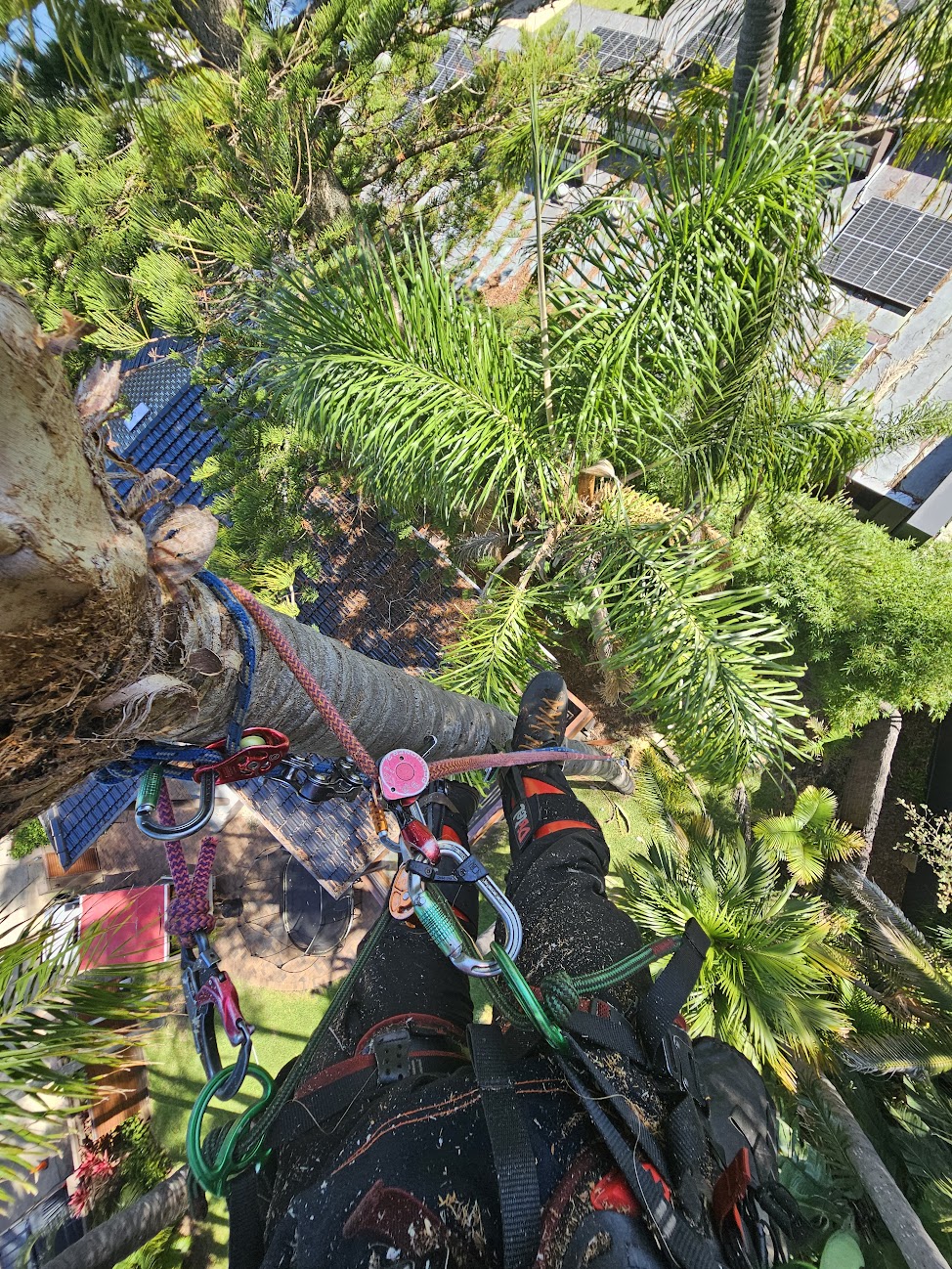
Larger palms need a different approach. The fronds come down first to reduce weight and give better visibility, then the trunk is cut in sections from the top down. The trunk of a mature Cocos palm is surprisingly dense and heavy — this is not a job for a chainsaw and a YouTube tutorial. Each section needs to be controlled on the way down, particularly if there's a fence, roof, pool or garden structure underneath.
One thing worth knowing: the base of a large Cocos palm is often bigger than it looks from a distance. Once the trunk is down you'll usually find a significant root ball and a wide base that sits proud of the soil. Getting that fully out requires stump grinding, and it's worth doing properly rather than leaving a slab of palm trunk at ground level that will take years to rot down.
What Does Cocos Palm Removal Cost?
Prices vary based on size, access and whether stump grinding is included. Rough ranges for the Northern Beaches in 2026:
- Small palm (under 5m): $350 – $600
- Medium palm (5–8m): $600 – $1,100
- Large palm (8–12m+): $1,100 – $2,000
- Stump grinding: $150 – $300 depending on base diameter
Access makes a meaningful difference. A palm in an open front yard costs less to remove than the same palm wedged between a pool fence and a garage at the back of a Bayview property with a narrow side gate. If we need to carry everything out by hand rather than chipping directly into a truck, that adds time and therefore cost.
If you have multiple palms — and plenty of Northern Beaches properties do — it's almost always cheaper to do them together than as separate jobs. The setup, travel and chipper truck are the fixed costs; each additional palm after the first is incrementally cheaper.
What to Plant Instead
Once the Cocos palm is out, you've usually got a decent amount of space and decent light returning to that part of the garden. A few things that work well on the Northern Beaches as replacements:
- Bangalow Palm (Archontophoenix cunninghamiana) — native, much tidier than a Cocos, self-cleaning fronds, no toxic fruit
- Cabbage Tree Palm (Livistona australis) — native, slow-growing, architectural shape
- Tuckeroo (Cupaniopsis anacardioides) — great shade tree, native to coastal NSW, manageable size
- Lilly Pilly — fast-growing, dense screening option if privacy is the goal
If you're near bushland or a reserve, planting something native is a genuinely good outcome from removing an environmental weed. It also tends to go down well with neighbours.
Not ready to remove the palm but want to get the mess under control? Our guide to palm tree pruning on the Northern Beaches covers annual maintenance for Cocos palms — including seed stalk timing and what a professional service actually involves.
Getting the Job Done
Cocos palm removal is one of the more satisfying jobs we do — because the before and after difference is so obvious. The mess disappears, the rats move on, the garden opens up and you can actually see what you're working with again.
If you've got a Cocos palm on the Northern Beaches that you want gone, give Alex a call on 0452 030 077 or request a free quote online. We'll come out, have a look and give you a written quote covering the full job — removal, stump grinding and cleanup.
Ready to get rid of your Cocos palm?
Call Alex on 0452 030 077 or request a free quote online. Free on-site assessments across the Northern Beaches.