General
What is an arborist?
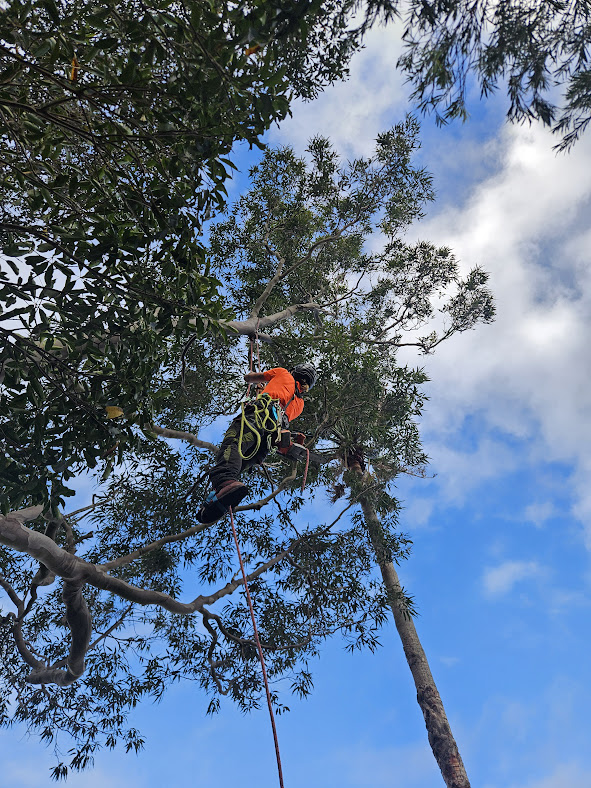
An arborist is a qualified professional trained in the cultivation, management, and study of trees. Unlike a general gardener or handyman, a qualified arborist holds formal arboricultural qualifications — in Australia, this means a Certificate III in Arboriculture (AQF Level 3) at minimum. Arborists assess tree health, identify hazards, carry out pruning to industry standards, manage tree removal safely, and can provide formal arborist reports for council applications or insurance purposes.
What qualifications should an arborist have?
At minimum, a qualified arborist in Australia should hold a Certificate III in Arboriculture (AHC30722 or equivalent, AQF Level 3). This covers tree biology, hazard assessment, pruning to Australian Standard AS 4373, rigging and lowering, and safe chainsaw operation. Alex Price holds a Certificate III in Arboriculture (AQF Level 3), is currently studying towards a Diploma of Arboriculture (AQF Level 5), also holds IRATA Level 1 rope access certification, and has over 10 years of professional experience across the UK and Australia.
Is The Living Canopy fully insured?
Yes. The Living Canopy holds $20 million public liability insurance and full workers compensation cover. We can provide a certificate of currency on request before work commences. Never engage a tree service without verifying their insurance — if an uninsured contractor is injured on your property, the liability can fall to you as the property occupier.
Do you work across all of the Northern Beaches?
Yes. We're based in North Narrabeen and work across the full Northern Beaches LGA — from Manly and Freshwater in the south to Palm Beach and Avalon in the north, and across to Frenchs Forest, Belrose, Terrey Hills, and Oxford Falls. We also service the North Shore and selected inner suburbs. See our full coverage area for details.
How do I get a quote?
Call Alex directly on 0452 030 077 or submit a request online. We visit the site to assess the job in person — we don't quote from photos alone for larger trees, as site access, hidden hazards, and tree condition can significantly affect the scope. All quotes are written and itemised with no hidden extras.
Costs & Quotes
How much does tree removal cost on the Northern Beaches?
Tree removal costs on the Northern Beaches typically range from $500–$800 for a small tree (under 5 metres), $800–$2,000 for a medium tree (5–10 metres), $2,000–$5,000 for a large tree (10–20 metres), and $5,000 or more for very large or complex removals requiring crane access. Key factors affecting price include tree height and trunk diameter, site access, proximity to structures, species, whether crane or EWP equipment is needed, and debris disposal. See our full tree removal cost guide for a detailed breakdown.
How much does tree pruning cost?
Tree pruning generally costs $300–$600 for a small tree, $600–$1,500 for a medium tree, and $1,500–$3,500 or more for large or multi-stem trees requiring rigging. The scope of work — crown reduction, deadwooding, clearance pruning or structural work — also affects the price. We provide written, itemised quotes before any work begins.
How much does stump grinding cost?
Stump grinding typically costs $150–$400 per stump depending on diameter, root complexity, and access. We grind to approximately 200–300 mm below ground level — sufficient for lawn or garden replanting. Multiple stumps on the same job are generally discounted.
What happens to the wood and green waste after the job?
All debris — timber, branches, and green waste — is chipped or loaded and removed from site as part of our standard service. If you'd like to keep the wood for firewood or the garden, let us know when booking. We leave the site clean with a full sweep at the end of every job.
Permits & Regulations
Do I need a council permit to remove a tree on the Northern Beaches?
On the Northern Beaches, most mature trees require development consent from Northern Beaches Council before removal. The general thresholds under DCP Part B13 are: trees 5 metres or more in height, a canopy spread of 5 metres or more, or a trunk diameter of 30 cm or more at 1 metre above ground. Some exemptions apply for dead trees, trees posing immediate danger, or certain invasive species. We assess permit requirements at the quoting stage and can manage the application on your behalf. See our full council permit guide.
Do I need a permit for pruning?
Pruning is generally exempt from council approval unless it involves removing more than 30% of the canopy, removing major structural branches, or the tree is heritage-listed. We check permit requirements for all significant pruning work at the quoting stage.
Do I need a permit for palm tree removal?
Cocos palms (Syagrus romanzoffiana) are exempt from permit requirements on the Northern Beaches as a declared invasive species — they can be removed without council approval. Other palm species, including Canary Island Date Palms, may require a permit if they meet size thresholds. We assess this at the quoting stage.
What are the fines for removing a tree without a permit?
On-the-spot penalty infringement notices start at $3,000 for individuals. If Council pursues the matter through the Land and Environment Court, penalties can reach $1,000,000 under the Biodiversity Conservation Act 2016. Council can also issue restoration orders requiring replanting at your cost. The property owner bears responsibility — not just the contractor — so always check permit requirements before any work proceeds.
Tree Removal
How do I know if a tree needs to be removed?
Warning signs include: significant dead branches or a dead crown, fungal growth (mushrooms or conks) at the base or on the trunk, major cracks or splits in the trunk or major limbs, a lean that has developed or worsened, hollow sections in the trunk, root damage from construction or soil compaction, and previous topping that has created multiple large decay wounds. Not all trees showing these signs need immediate removal, but an arborist assessment is the right first step.
Can you remove a tree close to a house or fence?
Yes — controlled removals close to structures are something we specialise in. For trees with no drop zone, we use rigging and lowering techniques to bring sections down in a controlled manner. For very large or complex situations, we can coordinate crane-assisted removal. We assess access and risk at the quoting stage and carry $20 million public liability for exactly these situations.
Can you do crane-assisted removals?
Yes. For large trees in confined spaces or with no viable drop zone, we can arrange crane-assisted removal. We work with trusted crane operators across the Northern Beaches and coordinate the full scope — rigging, crane operation, and site clearance. See our tree removal service page for more detail.
Tree Pruning
What is the difference between tree lopping and tree pruning?
Tree pruning is the selective removal of branches following Australian Standard AS 4373 — always cutting to a branch union, lateral, or just outside the branch collar. It preserves the tree's structure and long-term health. Tree lopping (or topping) involves cutting the main trunk or major branches back to stubs, causing severe stress, creating large decay entry points, and producing weakly attached regrowth that becomes a future hazard. Lopping is considered poor practice — we carry out proper pruning, not lopping. Read our full guide on tree lopping.
How often should trees be pruned?
Most ornamental and native trees benefit from a structural pruning inspection every 3–5 years. Young trees should be assessed every 2–3 years as early structural pruning shapes the canopy and prevents future problems. Fruit trees typically need annual pruning. Hedges require trimming 1–3 times per year depending on species and finish required.
Can a badly pruned or topped tree be saved?
Sometimes, yes — it depends on the species, how long ago the topping occurred, and how much decay has developed at the cut points. Remediation pruning can remove weakly attached epicormic growth, reduce risk, and help reshape the canopy over time. Where internal decay is advanced or structural integrity is compromised, removal may be the safer option. We assess each tree individually and give you an honest recommendation.
Emergency Work & Arborist Reports
Do you offer emergency tree work?
Yes. We provide emergency tree response across the Northern Beaches for storm-damaged trees, fallen trees, or trees posing an immediate risk to property or safety. Call 0452 030 077 directly for emergencies — we aim to respond same day where possible. If a tree has fallen on a structure, take photos for your insurer before work begins. We can provide a written scope of works to support your insurance claim.
What is an arborist report and when do I need one?
An arborist report is a formal written assessment of a tree's condition, health, risk level, and management recommendations, prepared by a qualified arborist. On the Northern Beaches, arborist reports are commonly required for: Development Applications (DA) where trees are near proposed works, council tree removal applications, property purchase due diligence, insurance claims after storm or damage, and neighbour disputes involving trees. We provide reports compliant with AS 4970. See our arborist reports page for more information.
Still have a question?
Call Alex on 0452 030 077 or send us a message — we're happy to give advice before you commit to anything.