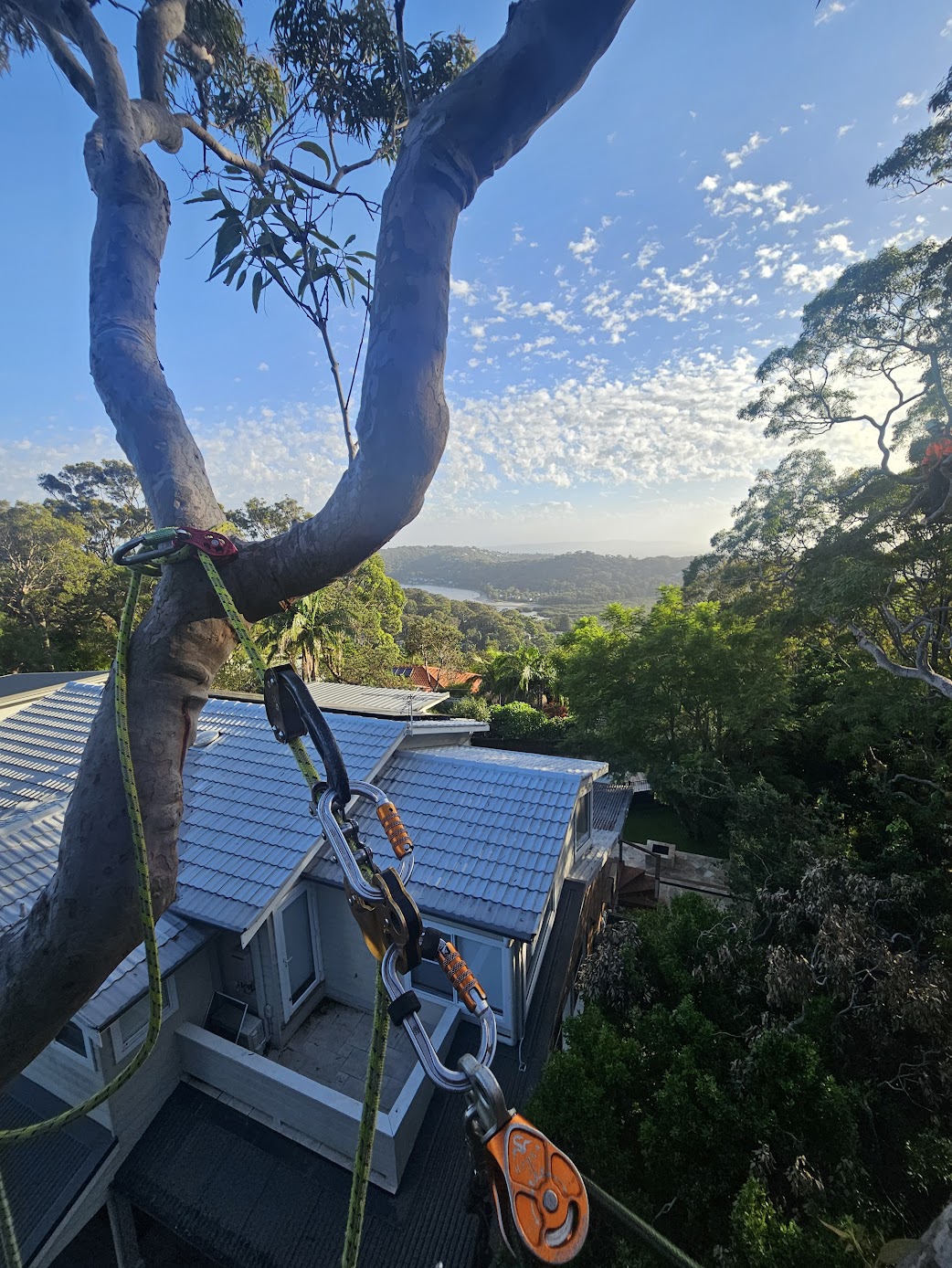
If you live on the Northern Beaches, chances are there's a gum tree somewhere in your view. They lean over our roads, frame our bushland reserves, and shed their bark across our driveways every summer. I'm Alex Price, and I run The Living Canopy out of North Narrabeen. Over more than a decade working with trees across the UK and Australia, I've come to think of our local eucalypts and angophoras not as a problem to be managed, but as the thing that makes this place look and feel the way it does.
I get a lot of calls that start with "I've got this big gum and I'm worried about it." Sometimes that worry is well founded. Often it isn't — or at least, the answer isn't what the homeowner expects. So I wanted to write something honest about what it means to live alongside these trees, how to keep them safe and healthy, and when it's genuinely time to pick up the phone.
The native canopy that makes the Northern Beaches
Drive from Manly up to Palm Beach and you're moving through one of the most distinctive tree landscapes in Sydney. The headland sandstone, the lagoons, the spotted gums on the ridgelines — it's all held together by natives that have evolved to thrive in exactly this soil and salt air.
The stars of the show are the eucalypts, our true gums, with their grey-green canopies and that unmistakable scent after rain. Right alongside them is Angophora costata, the Sydney red gum or smooth-barked apple — those gorgeous pink-orange trunks that twist and lean over the bush tracks at places like Narrabeen Lagoon and West Head. Angophoras aren't technically eucalypts, but most people lump them in with the gums, and they need similar care.
Then there are the giants and the characters: Moreton Bay figs with their buttressed roots and deep shade, banksias feeding the lorikeets and honeyeaters, and paperbarks (melaleucas) thriving in the wet, low-lying ground around our lagoons and wetlands. Together they do an enormous amount of quiet work — they cool our streets, hold our slopes together, soak up stormwater, and provide habitat for everything from possums to powerful owls. A mature hollow-bearing gum can take 100 years or more to form the nesting cavities that wildlife depends on. You can't replace that overnight, which is one of the big reasons so many of these trees are protected by council.
Why heavy lopping makes gums more dangerous, not safer
Here's the thing I most want people to understand, because it gets gums killed every year.
Eucalypts and angophoras are known for summer limb drop — sometimes called sudden limb failure. On a still, hot day, a healthy-looking branch can simply let go. It's not fully understood, but it's a natural behaviour of the genus, and it's part of why people get nervous around big gums.
The instinct is to "lop" the tree — cut it back hard, top it out, take the weight off. I understand the logic, but it's exactly the wrong move. When you top a gum, it doesn't give up. It responds by throwing out masses of fast-growing epicormic shoots from beneath the cut. Those shoots are weakly attached, they grow quickly, and within a few years you have a tree that is heavier, denser and far more likely to shed limbs than the one you started with — plus large pruning wounds that invite decay into the trunk. I've assessed plenty of trees that were lopped a decade ago and are now genuine hazards because of it. If you want to understand the difference, I've written more about why I steer people away from this approach in my tree lopping guide for the Northern Beaches.
Proper care does the opposite. It makes the tree safer and keeps it healthy.
How good pruning actually works on natives
When we prune a gum or an angophora, the goal is to work with the tree's natural form, not fight it. Every cut we make follows the Australian Standard for pruning, AS 4373-2007, which exists precisely to stop the damage that bad lopping causes. In practice, that means a handful of well-understood techniques:
- Crown thinning — selectively removing a small proportion of branches to let wind pass through the canopy and reduce the "sail" effect, without changing the tree's shape.
- Deadwooding — removing dead and hanging branches that could fall. This is often the single most valuable thing we do for safety on a mature gum.
- Weight reduction — carefully shortening over-extended limbs back to a suitable growth point, which lowers the leverage on a heavy branch rather than stubbing it off.
- Clearance pruning — creating sensible separation from your roof, gutters, powerlines or pool, done in a way the tree can actually heal from.
Done well, you shouldn't really be able to tell we've been there, beyond the tree looking a little lighter and tidier. That's the standard I hold us to on every tree pruning job. And every job has an AQF qualified arborist on site making those decisions — not a generic crew with a chainsaw and a quote to fill.
The worries I hear most — and honest answers
"The leaves and bark are everywhere." Yes — gums are messy, especially in summer when they shed bark in long ribbons. I won't pretend otherwise. But leaf and bark litter is a maintenance issue, not a health or safety one, and it's rarely a good reason to remove or hard-prune a tree. A bit of canopy management and good gutter guards usually solve the practical side.
"The limbs hang right over my roof." This is worth taking seriously, and it's exactly what clearance pruning and weight reduction are for. We can usually create proper separation from the house while keeping the tree intact and balanced.
"I'm worried about the roots." Eucalypt roots are mostly shallow and spreading rather than deep, and genuine structural damage to a sound, modern footing is far less common than people fear. Roots lifting paths or paving is usually manageable; if you've got a real concern near footings or drains, that's a case for an assessment rather than a guess.
The honest theme across all of these: most of the time there's a measured response that keeps the tree, and that's almost always cheaper and better for your property's value and shade than removal.
Many of these trees are protected
This is the part people most often don't realise until they're partway down the track. Across the Northern Beaches, most significant trees — and the great majority of mature natives — are protected under council's tree and vegetation controls. Pruning more than light maintenance, and certainly any removal, generally needs council approval before work begins.
That isn't red tape for its own sake; it's what keeps our canopy intact street by street. The good news is you don't have to navigate it alone. I help clients understand what's allowed and what needs consent, and I've put together a plain-English Northern Beaches tree permit guide to get you started. Where council wants supporting documentation, we can provide a formal arborist report assessing the tree's health, structure and any genuine risk.
When to call an arborist
You don't need an expert for a few leaves in the gutter. But it's worth getting a qualified set of eyes on your tree if you notice: large deadwood in the canopy, cracks or splits where big limbs meet the trunk, mushrooms or fungal brackets at the base, a sudden lean, or limbs that have grown out over the house since you last looked. After a big summer storm, a quick assessment can catch problems early — and if something has already come down or is hanging, that's what our emergency tree work is for.
And removal? It's genuinely the last resort. We only recommend tree removal when a tree is dead, irreparably hazardous, or council has approved it for a sound reason. Great arboriculture is about keeping trees standing safely, not clearing them.
Got a gum you're unsure about?
I'm happy to come and take a look — no pressure, no upsell, just an honest assessment from an AQF qualified arborist who'd rather save your tree than remove it.
Get a free quoteFrequently Asked Questions
Is my gum tree protected on the Northern Beaches?
Most mature natives are. As a rule of thumb, anything beyond minor maintenance pruning — and any removal — likely needs council consent. I can tell you quickly whether your tree is covered and what's required.
Will pruning fix summer limb drop?
There's no way to guarantee a healthy gum never sheds a limb — it's natural behaviour. But proper crown thinning and deadwooding to AS 4373-2007 meaningfully reduces the risk, whereas heavy lopping increases it. Lopping is the wrong tool here.
Can you prune a tree right next to my house or pool?
Yes. Clearance and weight-reduction pruning around roofs, gutters and pools is routine work for us. We're fully insured with $20 million public liability plus workers compensation, so it's done safely and properly.
How much does gum tree pruning cost?
It depends entirely on the tree and the work, so I'd rather look before quoting. Quotes are free and there's no obligation.