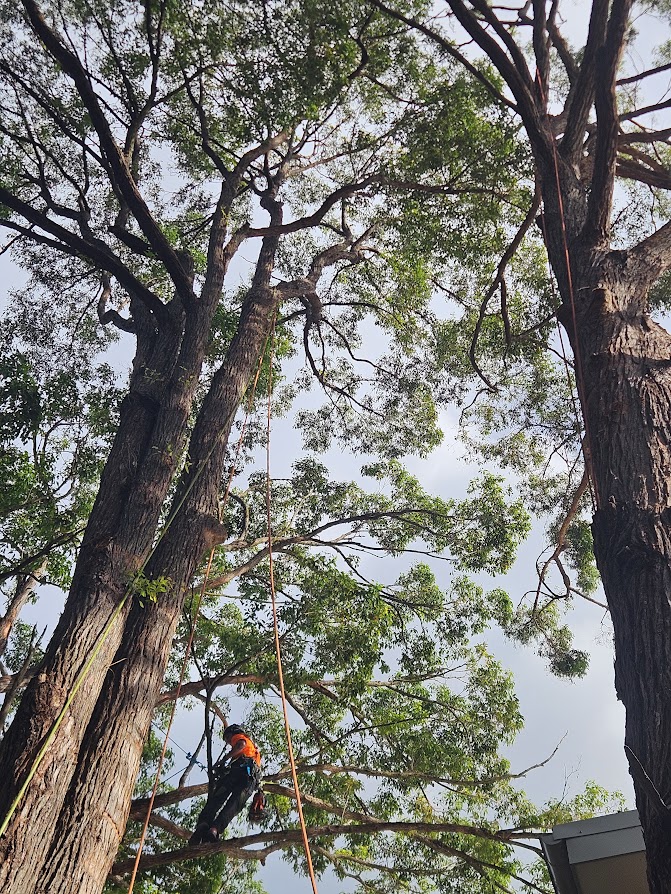
Most trees on the Northern Beaches are healthy, well-adapted to the local conditions, and will stand for decades without any intervention. But trees do fail — sometimes without much warning, and sometimes with significant consequences for the property and people beneath them. The risk is greatest on larger bushland blocks around Belrose, Davidson and Ingleside, where mature eucalypts stand within falling distance of the house.
The challenge is that hazard indicators aren't always obvious to the untrained eye. A tree can look green and leafy while hiding serious structural problems. Conversely, a tree that looks alarming — a lean, some dead branches, a hollow at the base — isn't automatically a danger. Context matters, and so does species knowledge. A eucalypt and a jacaranda respond very differently to the same set of symptoms.
What follows is a practical guide to the most common warning signs, what each one means, and when it warrants a call to a qualified arborist.
1. Large Dead Branches or a Dying Crown
Dead branches are one of the most visible indicators that something is wrong — and one of the most commonly misread. Small amounts of deadwood in the upper canopy are normal, particularly in eucalypts, which naturally self-prune. Large dead branches — especially those over the house, a driveway, or a play area — are a different matter.
A single large dead branch doesn't automatically make a tree dangerous, but it does represent a loading risk: dead wood is brittle and can fail without warning, particularly in high winds or during a storm. What makes it more serious is when:
- Multiple large limbs are dead or dying
- The dead material extends through the crown rather than being confined to a few outer branches
- The deadwood shows signs of decay — soft, punky wood, discolouration, or bracket fungi attached to the branch
General crown dieback — where the whole canopy is thinning or the branch tips are dying back progressively — can indicate root problems, waterlogging, soil compaction, or the early stages of a vascular disease. It warrants investigation rather than immediate removal.
Deadwooding — the selective removal of dead, dying, and diseased wood — is often the appropriate first response. It reduces loading and risk without removing the tree.
2. Fungal Growth at the Base or on the Trunk
Mushrooms or bracket fungi (conks) growing from the base, roots, or trunk of a tree are one of the most reliable indicators of internal decay. These are the fruiting bodies of wood-rotting fungi that have been digesting the tree's structural wood — often for years before the external signs appear.
It's worth understanding what this means structurally. The wood-rotting fungi responsible for the most serious structural damage include white rot species (which digest both lignin and cellulose, leaving the wood soft and spongy) and brown rot species (which destroy cellulose, leaving the wood crumbly and fractured). By the time bracket fungi appear externally, the internal decay has typically been progressing for several years and may extend well beyond the visible fruiting body.
The significance of fungal growth depends heavily on:
- Location: Basal and root-zone fungi are more serious than upper-crown decay, as they affect the structural anchoring of the tree
- Species: Some fungi are relatively superficial (e.g. on sapwood only); others indicate deep structural decay
- Tree species: Angophoras and eucalypts have evolved with internal decay — heartwood hollows are common and don't automatically make the tree unsafe. Context and species knowledge matter
- Extent: Small patches of fungal activity on an otherwise sound tree are different from widespread colonisation
Fungal growth on a tree should always be assessed by a qualified arborist — it may indicate a tree that is still safe and manageable, or one that needs urgent attention.
3. Cracks, Splits, or Seams in the Trunk
Cracks in the trunk come in several forms, and not all are equally serious.
Shear cracks — deep splits that run along the grain of the wood, sometimes with visible separation — are among the most serious indicators of structural failure risk. They typically develop under loading (wind, the weight of the canopy) and can indicate that the wood fibres have already begun to fail.
Included bark in a co-dominant fork is another common failure point. Where two stems of similar diameter emerge from the same point and bark is compressed between them (rather than a clean, open branch union), the stems are joined by compacted bark rather than interlocked wood fibres. This type of union can split suddenly under load — it's one of the most common causes of unexpected tree failure on the Northern Beaches.
Frost cracks and lightning cracks can heal over time and may not indicate ongoing structural weakness, though they should be assessed.
A useful rule of thumb: any crack that has appeared recently, has grown, or runs through more than a third of the trunk diameter at the affected point warrants professional assessment.
4. A Lean That Has Developed or Worsened
Many trees lean — it's a natural response to prevailing light conditions, wind, or competition with neighbouring trees. A lean that has been present since the tree was young and hasn't changed is usually not a concern.
What is a concern is a lean that:
- Has developed suddenly — particularly after heavy rain, when saturated soils reduce root anchoring
- Has progressively worsened over months or seasons
- Is accompanied by soil heaving or cracking at the base on the tension side
- Is directed toward a structure, vehicle, or area of use
Sudden leans are particularly significant after extended wet periods, as waterlogged soil dramatically reduces the mechanical resistance of the root system. If a tree has visibly moved after rain, treat it as an urgent situation.
5. Exposed, Damaged, or Severed Roots
Root damage is one of the most underappreciated causes of tree decline and failure — partly because it's invisible until the effects appear above ground.
Common causes of significant root damage on the Northern Beaches include:
- Excavation or trenching for services, retaining walls, or landscaping — cutting through major structural roots can compromise anchoring significantly
- Soil compaction from vehicles, construction, or persistent foot traffic over the root zone
- Changes to site drainage — both waterlogging and drought stress can cause root decline
- Pool construction — a surprisingly common source of root damage on Northern Beaches properties
- Kerb and gutter works — street trees on the Northern Beaches are regularly affected by footpath and road works
If significant root work has occurred near a tree recently, monitor it for signs of crown dieback over the following 1–3 years. Root damage often manifests as reduced leaf size, early leaf drop, or progressive branch dieback — the crown reflecting the health of the root system below.
6. Bark Falling Away in Large Sections
Some bark shedding is completely normal — angophoras and smooth-barked eucalypts shed continuously, and scribbly gums are designed to shed. This isn't a warning sign.
What's worth investigating is bark that falls away to reveal:
- Wet, stained, or discoloured wood beneath — potentially indicating a canker, vascular disease, or boring insect activity
- Galleries or channels in the sapwood from wood-boring beetles (a significant concern in stressed or recently transplanted trees)
- Large areas of dead cambium (the thin green layer immediately beneath the bark) — loss of cambium means that section of trunk can no longer transport water and nutrients
Large sections of persistent bark attached to dead wood that hasn't shed naturally can also indicate a branch that died some time ago and has dried out — increasing brittleness and drop risk.
7. A History of Heavy Topping or Poor Pruning
A tree that has been heavily topped — major branches cut back to stubs — can look healthy for years while hiding serious structural problems. The epicormic regrowth that emerges from below the cut points can fill out the canopy quickly, but this growth is weakly attached and the cut points themselves are decay entry points.
With time, internal decay progresses down from the topping wounds, and the weakly attached epicormic stems grow larger and heavier. The result is a tree with significantly more loading than before, supported by weaker structural wood, with decay progressing through the anchoring framework. This is why topped trees so often fail catastrophically in storms — 5 or 10 years after the topping event, when the visible evidence has been obscured by regrowth.
If you've purchased a property with trees that were previously topped, or if you're not sure of a tree's history, an arborist assessment is worth commissioning. The AS 4970 arborist report format includes a risk assessment that covers structural history.
8. Hollows, Cavities, or Soft Spots
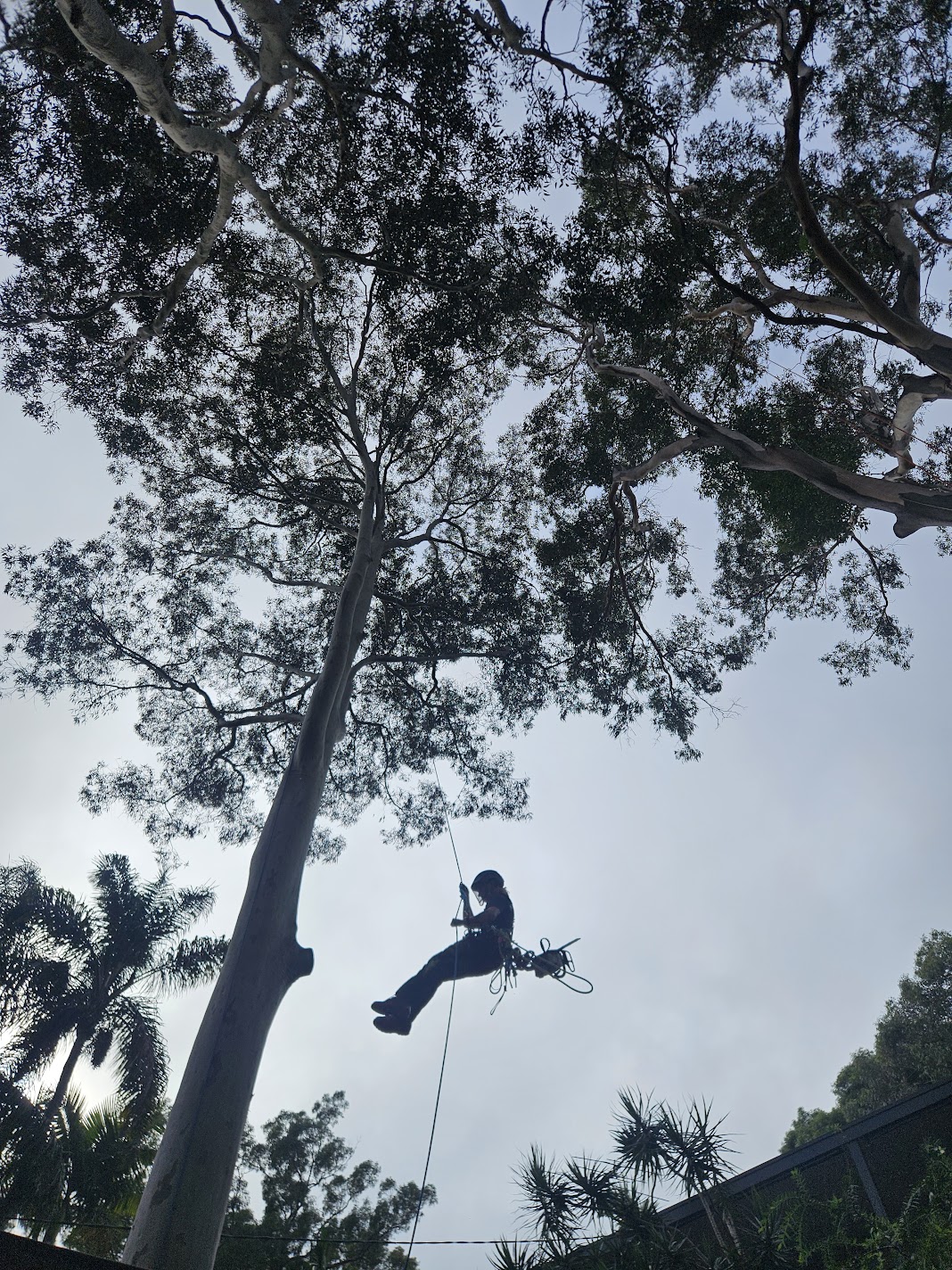
Hollows in eucalypts and angophoras are not automatically dangerous — many of these species evolved with hollow formation as part of their life cycle, and hollow-bearing trees provide critical habitat for wildlife. A mature angophora with a basal hollow may have been standing safely for 150 years and have decades ahead of it.
What matters is the relationship between the hollow and the tree's structural shell — specifically, the thickness of the remaining sound wood. A general rule of thumb used in hazard assessment is the "1:6 rule": if the shell of sound wood around a hollow is less than one-sixth of the diameter of the trunk at that point, the structural integrity may be compromised.
Soft spots — areas where tapping the trunk produces a hollow sound rather than a solid thud — can indicate internal decay that hasn't yet expressed itself externally. Combined with other indicators (fungal growth, crown dieback, crack lines), soft spots help build a picture of the tree's internal condition.
Assessment of hollows and internal condition is something an experienced arborist can do on-site, and in complex cases, sonic tomography (a non-destructive internal mapping technique) can be used to assess the extent of internal decay without drilling.
What To Do If You're Concerned About a Tree
The presence of one of these signs doesn't mean a tree needs to come down immediately. Trees are resilient, and many with visible defects have been standing safely for decades and will continue to do so. The goal of an arborist inspection isn't to find reasons to remove trees — it's to accurately assess risk, identify management options, and give you the information to make an informed decision.
If you notice any of the above signs on a tree that's near your house, a fence, a driveway, or an area where people spend time, the appropriate response is:
- Don't use the area directly beneath the tree for recreational use until it's been assessed, particularly in windy conditions
- Document what you've seen with photos — this helps the arborist before the site visit and supports any insurance documentation if needed
- Contact a qualified arborist for an on-site assessment — this doesn't commit you to any work, it gives you the information to make a decision
- If the situation looks serious — a visible crack that has opened, a tree leaning after rain, a large branch hanging — treat it as urgent and call same day
If the on-site assessment identifies that a formal written report is required — for a council permit application, a neighbour dispute, or insurance purposes — our guide to arborist reports on the Northern Beaches explains the different report types, what to expect, and what they cost.
We carry out tree risk assessments across the Northern Beaches as part of our quoting process and as standalone arborist reports for council, insurance, or due diligence purposes. If you're unsure about a tree on your property, call Alex on 0452 030 077 — an on-site look costs nothing and gives you a clear answer.
Concerned about a tree on your property?
Call Alex on 0452 030 077 or request a free assessment. We'll give you a straight answer.