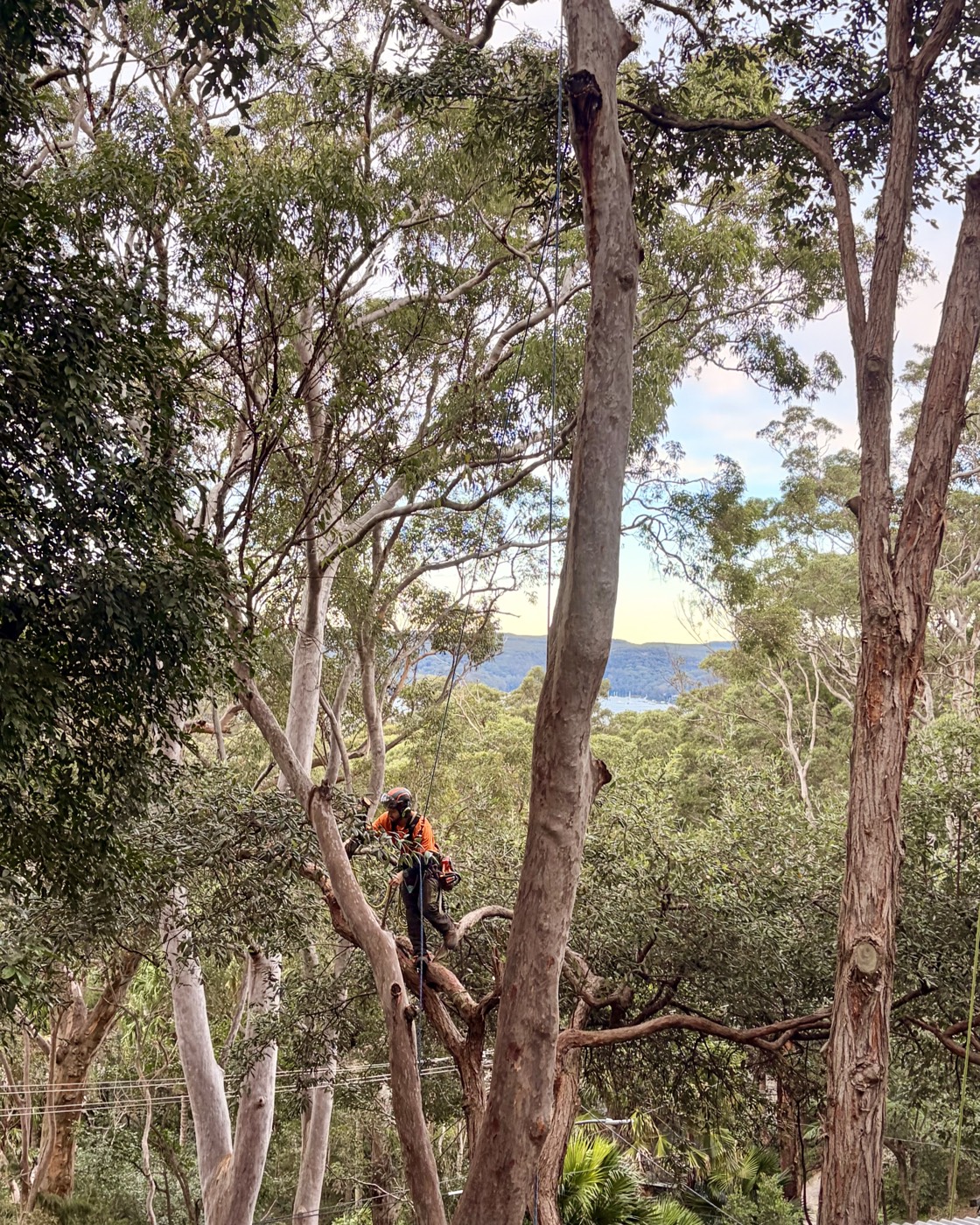
If you own a property on Sydney's Northern Beaches, there is a very good chance you have an Angophora costata — the Sydney Red Gum — somewhere on your block, along your boundary, or overhanging from a neighbour's yard. It's the species that gives the Northern Beaches its distinctive landscape character: those dramatically gnarled, salmon-pink trunks twisting up through the scrub behind Narrabeen Lagoon, framing the ridgelines above Avalon Beach, and lining the back yards of Newport and Mona Vale.
It's also one of the most misunderstood trees in residential arboriculture. Homeowners often don't know whether they can prune it, top it, or remove it — and sometimes take actions that damage the tree, create a greater hazard, or attract significant council fines. This guide covers everything you need to know to manage an Angophora costata on the Northern Beaches safely, legally, and in a way that keeps the tree healthy for the long term.
What Is Angophora Costata?
Angophora costata belongs to the Myrtaceae family and is closely related to the eucalypts — so closely that it was once classified as one. The name "costata" refers to the ribbed seed capsules, but it's the bark that most people remember: smooth, shedding in late spring and summer to reveal a fresh, vivid salmon-orange or cream-pink surface that slowly weathers to grey before the next shed. On a mature tree in good light, the colour display is genuinely beautiful.
On the Northern Beaches, Angophoras dominate the sandy heath and scribbly gum communities that persist on the Hawkesbury Sandstone geology underlying much of the region. Drive through North Narrabeen or Avalon and you'll see them on almost every block — they are the tree we deal with most often on Avalon arborist callouts and across Narrabeen tree work. They reach 15–25 metres at maturity, with a broad, spreading crown and a trunk that is almost never straight — the signature twist and lean of a mature Sydney Red Gum is a natural growth form, not a structural defect.
Leaves are lance-shaped and arranged oppositely on the stem — unusual among the broader eucalypt group, most of which have alternate leaves. White flowers appear in summer (December–January), are highly attractive to birds and native bees, and produce a strong honey fragrance. The tree is an important part of local wildlife habitat, particularly for hollow-dependent species as it ages.
Limb Drop: The Risk That Defines Angophora Management
No discussion of Angophora costata is complete without addressing limb drop — the sudden, unexpected fall of branches from an apparently healthy tree. This is not a myth or an exaggeration. It is a well-documented phenomenon in Australian eucalypts generally, and Angophoras are among the most commonly implicated species.
The mechanism is not fully understood. The leading theory is that on hot, dry, still days, the tree's internal water-conducting system comes under extreme tension — and when a large branch cannot supply enough water to its outermost leaves, the physiological response can include the sudden release of that branch at a natural abscission zone near the base. The result is a heavy branch falling without warning and without wind.
What this means practically:
- Never place a trampoline, outdoor seating area, or car parking directly under the canopy of a mature Angophora — particularly during hot summer days (above 35°C).
- Children playing under an Angophora in January is a genuine safety risk, even if the tree looks perfectly healthy.
- If you're having a summer gathering outdoors, consider whether your seating is under or adjacent to large Angophora canopy.
The risk increases significantly when the tree is under stress — drought, root zone compaction from construction work, recent renovation activity near the base, or disease. A healthy, well-managed Angophora in sandy heathland away from structures carries low risk. A stressed tree overhanging a patio carries high risk.
Warning Signs of Elevated Limb-Drop Risk
When I assess Angophoras for our clients across Newport and surrounding suburbs, these are the features that raise concern:
- Included bark at branch junctions. Rather than the branch collar wrapping cleanly around the base of the branch, the bark is pushed inward — creating a V-shaped, compressed junction rather than a U-shaped one. Included bark junctions are significantly weaker and prone to splitting under load.
- Visible cracks in branch tissue. Any crack running longitudinally along a branch, or across a junction, is a structural red flag.
- Fungal fruiting bodies. Bracket fungi or shelf fungi at the base of a branch or growing from the trunk indicate decay fungus active within the wood. This weakens the branch from the inside out.
- Epicormic growth clusters. Dense bunches of small leafy shoots growing from the surface of branches are often a stress response — the tree trying to compensate for failing foliage further out on the branch.
- Crown thinning or progressive dieback. Branches dying from the tips inward, or a canopy noticeably lighter than previous years, suggests the tree is under pressure that could affect structural integrity.
If any of these are present on branches over a building, car park, or regularly occupied area, get a qualified arborist assessment before the next summer.
Pruning Angophora Costata: What's Appropriate
Angophoras are not low-maintenance trees — but they're also not trees that need constant work. The key is understanding what type of pruning is beneficial versus what causes lasting harm.
What should be done
- Deadwooding. Removing dead branches eliminates falling hazards and reduces entry points for decay fungi. This is generally exempt from council permit requirements and is the most commonly needed maintenance task on mature Angophoras.
- Hazard reduction. Removing or reducing specific branches identified as structurally compromised — included bark junctions, cracked limbs, over-extended branches — reduces risk without harming the tree overall.
- Clearance pruning. Branches growing into buildings, power lines, or causing direct property contact need to be managed. This is best done incrementally, following the natural branch structure, rather than in a single aggressive cut-back.
- Crown lifting. Removing lower branches to increase clearance beneath the canopy. This is appropriate in many residential situations and, if done correctly, does not stress the tree unduly. In Mona Vale and similar areas, we often lift the canopy to improve sight lines and reduce the sense of enclosure without removing substantial live wood.
- Formative pruning of young trees. Getting the structure right early — selecting a single dominant leader, removing co-dominant stems, establishing a clear trunk — makes a much safer mature tree. Young Angophoras on new residential blocks respond very well to early professional guidance.
All pruning work should follow AS 4373-2007 (Pruning of Amenity Trees), the Australian Standard that governs how qualified arborists make cuts, maintain equipment hygiene, and handle the disposal of cut material. Our tree pruning service adheres to this standard on every job.
What should never be done
| Practice | Why it causes harm |
|---|---|
| Topping (cutting the main leader or large branches back to stubs) | Creates large, flat wounds that decay rapidly; triggers a flush of weakly attached epicormic shoots that are prone to future failure; permanently disfigures the tree; rarely approved by Northern Beaches Council |
| Lion-tailing (stripping foliage from interior branches, leaving tufts only at the tips) | Removes the counterbalancing weight of interior foliage, making end-loaded branches more susceptible to wind failure; shifts the tree's centre of gravity; stresses the vascular system |
| Flush cuts (cutting branches flush to the trunk without leaving a collar) | Removes the branch collar — the tree's natural wound-sealing mechanism — dramatically slowing compartmentalisation and opening a direct pathway for decay into the main stem |
| Removing more than 30% of the live canopy at once | Severely stresses the tree; triggers a survival response that often produces large volumes of weakly attached epicormic growth; can cause irreversible decline in older trees |
| Bark damage at the root flare (from lawnmowers, whipper snippers or machinery) | Creates entry points for decay fungi at the most structurally critical part of the tree; once established, butt rot can destroy the structural base of even a large, healthy-looking tree |
Council Permit Requirements for Angophora Work
Under the Northern Beaches Council Development Control Plan, Angophora costata is a protected species once it reaches a certain size — generally 3 metres in height or 100mm trunk diameter measured at 1.4 metres above ground. Once a tree meets these thresholds, any work that goes beyond basic maintenance requires development consent from council before it proceeds.
What typically requires a permit:
- Significant live canopy reduction or crown lifting beyond minor clearance
- Removal of any live branches larger than 100mm diameter at the cut point
- Full tree removal
- Root pruning within the structural root zone
What is generally exempt (but always check):
- Removal of dead wood from within the canopy
- Clearance of branches directly touching a habitable building (where contact is causing documented damage)
- Emergency work following storm damage under council's emergency provisions
There is also a standing exemption for minor pruning. Under the State Environmental Planning Policy (Biodiversity and Conservation) 2021, Chapter 2 (Vegetation in non-rural areas), which Council administers, you can prune up to 10% of a tree's canopy within any 12 calendar month period without a permit, provided the work is carried out in accordance with Australian Standard AS 4373-2007. The 10% figure is a cap, not a target: Council will not allow pruning beyond what a species can safely tolerate, and gives the example that figs pruned by more than 10% are predisposed to sunburn. Removal of deadwood, and of parasitic plants such as mistletoe, is separately exempt in addition to the 10% allowance.
Once the work goes beyond 10% of the canopy, or the tree is a threatened or protected species, heritage listed, or growing in bushland or understorey, a permit is required. For significant trees, Council also requires a report prepared by a Level 5 arborist.
Penalties for illegal tree works can be significant. The maximum penalty available through the Land and Environment Court is up to $1.1 million, though that is the ceiling rather than a typical or automatic fine. Council does prosecute unauthorised works, so it is well worth confirming what is permitted before you start. Read our full Northern Beaches council tree permit guide before undertaking any significant work.
If a permit is needed, a qualified arborist can prepare an arborist's report to support the application — documenting the tree's condition, the proposed work, and the justification for it. This is often a requirement of the consent process for removal applications.
Signs an Angophora Is in Decline
Sydney Red Gums are long-lived and resilient when conditions suit them. But in residential settings, they face pressures that don't exist in bushland — and slow decline is more common than sudden collapse. The triggers we see most often on the Northern Beaches include:
- Root zone compaction. Heavy machinery, vehicles, or years of foot traffic over the root zone compress the soil, reducing oxygen and water availability to the roots. This is one of the most common sources of Angophora stress in suburban settings.
- Construction damage. Trenching for services (water, power, drainage), excavation near the tree, or soil changes associated with renovations and pool installations can sever or suffocate large portions of the root system. Damage may not be apparent for 2–5 years after the event.
- Changed drainage. Sandy Northern Beaches soils drain quickly, but altered surface grades or sealed surfaces can change how water moves through the root zone — either creating pooling that promotes root disease, or redirecting water away from the tree entirely during dry periods.
- Soil disturbance near the root flare. Imported fill placed over the base of the tree raises the soil grade around the trunk, which can suffocate the root crown and create conditions for collar rot.
- Drought stress. During prolonged dry periods, Angophoras in compacted or disturbed root zones struggle to extract sufficient water from the soil, even when the tree was previously healthy.
Early decline symptoms include canopy thinning (lighter-than-normal foliage density), increased deadwood appearing over successive seasons, bark that fails to produce the usual vibrant summer colour, and an increased rate of small branch shedding. If you notice these signs, act early — the options for intervention are much wider when the tree still has significant live crown to work with.
When Removal Becomes the Right Answer
Angophoras are generally worth trying to retain. But there are situations where tree removal is the appropriate outcome:
- The tree has advanced structural decay in the main trunk or major structural roots, confirmed by a qualified assessment (and sometimes resistograph testing), leaving insufficient sound wood to support the remaining crown safely.
- The tree is irremediably damaged at the root zone — typically where construction has severed more than 30% of the structural root system within the critical root zone.
- The tree is leaning significantly toward a structure and the lean is progressive, not a long-standing natural form.
- A combination of disease, pest damage, and structural compromise means the cost and risk of retention is no longer justified compared to removal and replanting.
Removal of a mature Angophora on a Northern Beaches residential block requires a council permit in most cases, and the application process will require documentation of the tree's condition. Where possible, council will prefer pruning to removal — so an honest arborist report that documents the specific structural or health issues is essential to a successful removal application.
If the tree is removed, replanting with another native species suited to the local sandy soil conditions is strongly encouraged — not least because many Northern Beaches properties retain tree-protection obligations under their planning certificates. Our team handles tree removal in Newport, tree pruning and removal in Avalon and arborist work in Narrabeen, and throughout the Northern Beaches LGA.
How to Keep an Angophora Healthy Long-Term
The best management for a Sydney Red Gum is mostly about what you don't do. Beyond that, a few active steps make a real difference:
- Protect the root zone. Mark out the area beneath the canopy (and somewhat beyond the drip line) as a no-access zone for vehicles and machinery. If landscaping work is planned, keep excavation and soil movement away from this area.
- Mulch appropriately. A 75–100mm layer of coarse mulch over the root zone retains soil moisture, moderates temperature, and improves soil biology. Keep it clear of the trunk by at least 300mm to avoid collar rot.
- Water during dry periods. Established Angophoras are drought-tolerant but not drought-proof when they're growing in disturbed or compacted urban soil. A deep, slow soak every 2–3 weeks during prolonged dry periods — directed to the outer root zone, not the base — helps sustain root function under stress.
- Avoid soil disturbance near the trunk. Digging, planting, or applying thick layers of decorative gravel around the base can suffocate root crowns. If changes to the garden near an Angophora are planned, discuss it with an arborist first.
- Get periodic assessments. An inspection every 2–3 years by a qualified arborist — not just a visual look from the ground, but a proper close inspection of the branch structure — is the single best investment in long-term tree safety for a mature Angophora near a house.
Have an Angophora you're concerned about?
We assess Sydney Red Gums across the Northern Beaches — checking structure, limb-drop risk and council permit status. Whether you need a quick inspection or a full arborist report for council, we can help.
Book a free quoteFrequently Asked Questions
Do I need a council permit to prune my Angophora costata on the Northern Beaches?
It depends on the size of the tree and what work you're doing. Under the Northern Beaches Council Development Control Plan, most Angophoras are protected once they reach 3 metres in height or 100mm trunk diameter measured at 1.4 metres above ground. Minor maintenance pruning — removing dead wood, clearing branches away from structures — is generally exempt, but significant live canopy removal or any work that could affect the tree's health typically requires development consent. Check our Northern Beaches tree permit guide before doing any work. Removing a protected Angophora without approval can attract significant penalties, with a maximum of up to $1.1 million available through the Land and Environment Court, so it is well worth confirming the rules before starting any work.
How do I know if my Angophora is at risk of dropping a limb?
Key warning signs include included bark at branch junctions (bark pushed inward, creating a V-shape rather than a U-shape), visible cracks in branches, fungal fruiting bodies on or near branch bases, dense clusters of epicormic growth on large limbs, and canopy dieback progressing from branch tips inward. Angophoras in good health still occasionally drop limbs — the species is known for it — but trees under stress from drought, root damage or disease carry significantly higher risk. The safest approach is a professional visual tree assessment every 2–3 years.
Can I top an Angophora to make it shorter and safer?
No. Topping creates large, open wounds that decay rapidly, triggers a flush of weakly attached epicormic shoots that are more failure-prone than the original growth, permanently disfigures the tree, and is generally not approved by Northern Beaches Council. If a tree is too large for a site, the options are either a properly planned crown reduction by a qualified arborist, or removal and replanting with a more suitable species. See our guide to the common trees on the Northern Beaches for species that suit smaller blocks.
What is the best time of year to prune a Sydney Red Gum?
Autumn and winter are generally best. Pruning outside of summer reduces the immediate limb-drop risk during the work, gives wounds time to compartmentalise before the heat of summer, and avoids disturbing the flowering period (Angophoras flower in December–January and are important for wildlife). Dead wood and hazard branches can be addressed at any time of year — these don't follow the same seasonal logic — but significant live wood removal is best done in the cooler months.
My Angophora is dropping bark and looks stressed — what should I do?
Bark shedding in late spring and summer is completely normal for Angophora costata — it's how the tree renews its smooth surface and the fresh salmon-pink colour is healthy. However, if the bark shedding is accompanied by other symptoms — canopy dieback, weeping sap, fungal brackets at the base, or discoloured timber where bark has fallen away — that warrants a professional inspection. Combined symptoms like these usually point to root zone stress, physical damage, or an early-stage disease issue that is much easier to address when caught early.
How much does it cost to have an Angophora pruned on the Northern Beaches?
Cost varies significantly by tree size, access, and scope of work. A deadwood and safety prune on a medium-sized tree typically ranges from $600 to $1,500; a large tree requiring technical rigging or elevated work platform access can cost considerably more. Permit-required work also incurs a council application fee. The best approach is a written quote from a qualified arborist who has seen the tree — ballpark phone quotes for mature Angophoras are rarely accurate. Call us on 0452 030 077 for a free on-site quote.