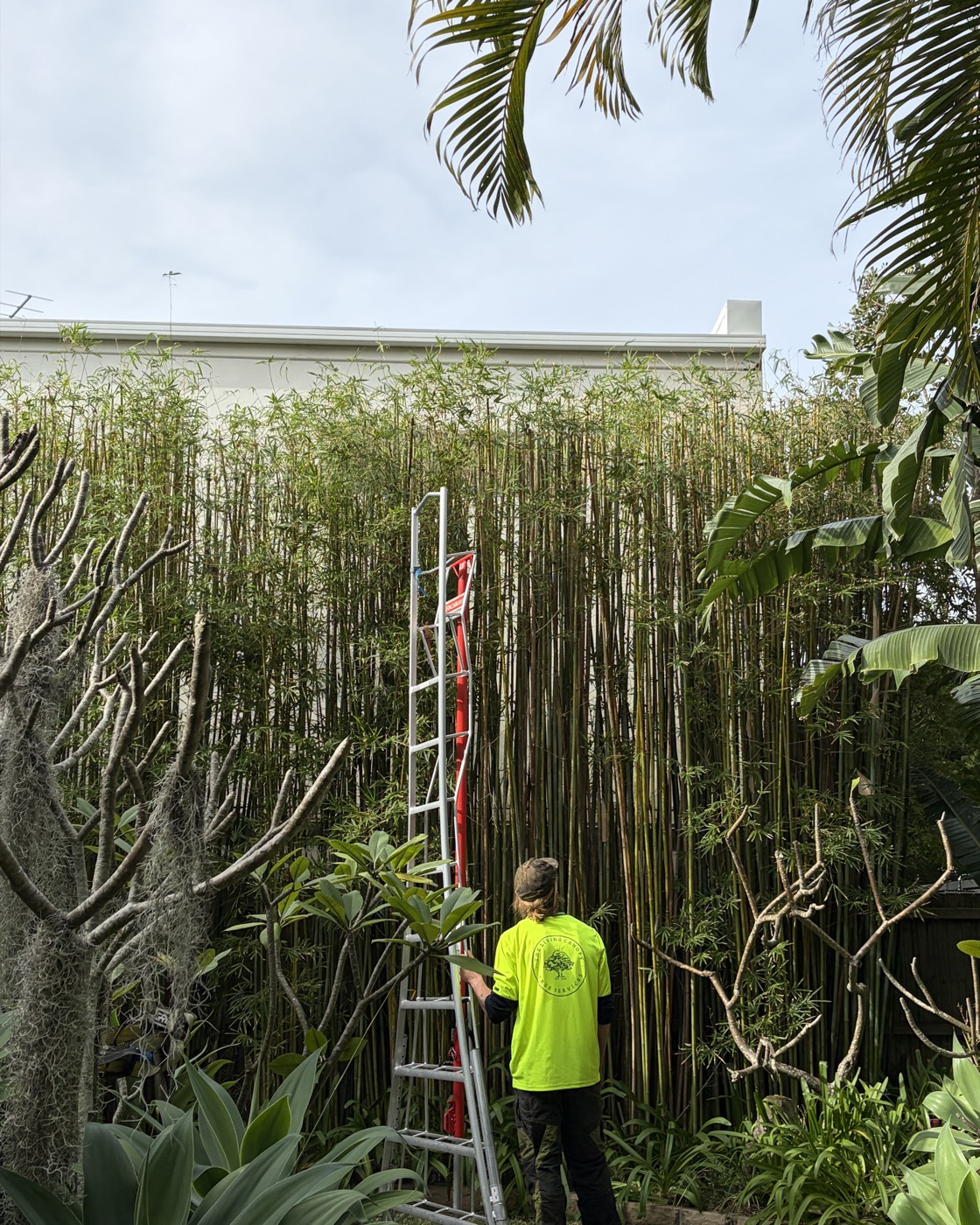
Bamboo removal is one of the most common calls we get from homeowners across Narrabeen, Dee Why, Freshwater and Manly — and usually the person calling has already tried cutting it themselves, sometimes for years, and is increasingly frustrated. That frustration makes sense. Bamboo is almost uniquely deceptive: it looks manageable until you understand how it actually works, at which point the real scale of the problem becomes clear.
The short version is that cutting bamboo canes above ground does virtually nothing to kill it. The plant's energy is underground, in a network of rhizomes that can extend metres in every direction and that will keep producing new shoots as long as any piece of living rhizome remains. This guide explains what actually works, what bamboo removal costs on the Northern Beaches in 2026, and how to make sure it doesn't come back.
Running Bamboo vs Clumping Bamboo — This Changes Everything
Before anything else, you need to know which type of bamboo you're dealing with. The two categories behave completely differently and require different approaches.
Running bamboo (Phyllostachys species — the most common are golden bamboo, black bamboo and arrow bamboo) spreads via horizontal underground rhizomes that can extend 3–10 metres per year in warm conditions. These rhizomes run just below the soil surface and can travel under fences, through garden beds, under concrete paths and even through gaps in walls and drainage infrastructure. Running bamboo planted in one garden regularly appears in a neighbour's garden two or three years later, and it will continue spreading indefinitely if not controlled.
Clumping bamboo (Bambusa species — including the common Gracilis, Oldhamii, and Buddha Belly) produces rhizomes that grow outward slowly, typically 30–60cm per year, staying tightly packed in an expanding clump rather than running. Clumping bamboo is manageable, relatively predictable, and much easier to remove. If you're not sure which type you have, look at the new shoots emerging in spring and summer: if they're appearing 1–3 metres from the main clump, you have running bamboo.
Everything that follows applies primarily to running bamboo because that's where the problem lies. If you have clumping bamboo, removal is a more straightforward physical job — though still more labour-intensive than most plants of similar height.
Why Cutting It Down Doesn't Work
The most common mistake people make with running bamboo is assuming that cutting the canes repeatedly will eventually exhaust the plant. It won't — or at least, not within any timeframe that's useful. Here's why.
Bamboo stores enormous amounts of energy in its rhizome network. When you cut the canes, the plant draws on that stored energy to produce new shoots, often more vigorously than before. Some species can produce new canes at remarkable speed — 30–60cm per day during a growing flush is not unusual for established Phyllostachys. Regular cutting can actually stimulate the rhizome network to spread further as the plant responds to the stress.
The rhizome network also makes physical access very difficult. A mature running bamboo stand may have hundreds of metres of rhizomes spread across an area of 30–50 square metres, most of it too deep and too tangled to easily excavate. This is why complete removal without a professional approach and often chemical assistance is extremely difficult.
Methods That Actually Work
There are two reliable approaches to bamboo removal, and the best results usually combine both.
Physical Excavation
For smaller clumps or clumping bamboo, physical excavation of the rhizome system is the most complete approach. This means cutting all the canes at ground level, then digging out as much of the rhizome network as possible — including the shallow horizontal runners that spread beyond the visible clump. A mattock, crowbar, and often a mini-excavator for larger stands are typically needed. Any rhizome section left in the ground can reshoot, so thoroughness matters.
Rhizome excavation works best in sandy Northern Beaches soils, which are easier to dig than clay-heavy soils further inland. But even in sandy soil, a mature running bamboo stand will have rhizomes that are difficult to fully trace. Expect to find new shoots appearing for 1–2 seasons afterwards from fragments you missed, and plan to treat those as they emerge.
Chemical Treatment
For large running bamboo stands, or where excavation isn't fully practical, chemical treatment using a systemic herbicide (glyphosate-based products) is necessary. The key is the method of application:
- Cut-and-treat: Cut each cane to about 30cm above ground level. Immediately — within a minute of cutting — apply concentrated glyphosate (at least 500ml/L) directly to the cut end of each stem. Speed matters here because bamboo seals its cut surfaces very rapidly; delayed application is far less effective. The chemical travels down into the rhizome via the cut stem.
- Injection method: For thicker canes, the herbicide can be injected directly into the internodes using a drill-and-fill technique. This is particularly effective for very dense stands where cutting every cane would be impractical.
Either way, chemical treatment is not a one-off event. Running bamboo rhizomes are extensive and the herbicide takes time to translocate through the full system. Plan for 2–3 treatment sessions over 12–18 months, treating new shoots as they emerge. Any new shoot that appears after the initial treatment is drawing on rhizome sections that weren't reached — treat each one promptly.
Note: chemical treatment isn't always appropriate in gardens with dense planting, near waterways, or where vegetable patches or children's play areas are close by. In those situations, physical removal combined with a root barrier is the better path.
Root Barriers: The Only Reliable Prevention
If you're removing bamboo because it's spreading into neighbouring properties — or if you want to keep bamboo as a screen without it escaping — a physical root barrier is the only reliable long-term solution.
Root barriers for bamboo need to be:
- Deep enough: Bamboo rhizomes typically run at 20–40cm depth, but in sandy soils can go deeper. Barriers should be installed to at least 60cm, and ideally 90cm.
- Continuous: Any gap is an opportunity. The barrier should be installed in a continuous loop with no joins or gaps, and the top edge should sit 5–10cm above ground level to prevent rhizomes going over the top.
- HDPE material: High-density polyethylene (HDPE) at 2mm or thicker is the standard material — thinner or cheaper alternatives will fail within a few years as rhizome pressure builds.
Installing a root barrier is a separate job from removal and requires digging a trench around the perimeter of the bamboo stand. If you're having bamboo removed, it's worth having the barrier installed at the same time — opening the same ground twice is wasteful.
Does Northern Beaches Council Require a Permit to Remove Bamboo?
In almost all cases, no. Bamboo is a grass, not a tree, and Northern Beaches Council's Development Control Plan provisions for vegetation management apply to trees and other woody perennial species. Bamboo falls outside the definition used in the DCP, which means no permit is required for removal.
There are a few situations where it's worth checking before proceeding:
- If significant trees are growing through or near the bamboo stand and root disturbance from excavation could affect them — in that case, you'd need a council permit for the work affecting those trees.
- If the site has a biodiversity overlay, riparian corridor, or heritage listing — earthworks and vegetation clearing may need separate approval.
- If the bamboo is on a nature strip or public land — that's council's vegetation, not yours to remove unilaterally.
If in doubt, a quick call to Northern Beaches Council's tree management team will clarify your specific situation.
Bamboo and Neighbouring Properties
If your neighbour's bamboo is invading your property, the legal situation in NSW is similar to other encroaching vegetation under the Trees (Disputes Between Neighbours) Act 2006 — you have the right to cut encroaching roots and branches back to the boundary at your own expense, without needing your neighbour's permission. However, you cannot go onto your neighbour's property to address the source. If the encroachment is causing damage or genuine loss (lifting paving, blocking drains, structural impacts), you may have grounds to seek an order through the Land and Environment Court requiring your neighbour to address the source.
In practice, most bamboo disputes are resolved between neighbours. The most common practical outcome is both parties installing a root barrier along the fence line and each managing their own side.
What Bamboo Removal Costs on the Northern Beaches in 2026
Bamboo removal is labour-intensive regardless of method, and the cost reflects that. Unlike tree removal where the height and diameter of the trunk are the main cost drivers, bamboo removal costs depend primarily on how far the rhizomes have spread and what method is required.
| Scenario | Typical range (2026) |
|---|---|
| Small clumping bamboo (contained clump, easy access) | $400 – $700 |
| Medium clumping bamboo or small running bamboo stand (up to 10m²) | $700 – $1,400 |
| Large running bamboo (20–40m², chemical and physical treatment) | $1,500 – $3,500 |
| Follow-up treatment visits (per visit, running bamboo) | $250 – $500 |
| HDPE root barrier installation (per linear metre, installed) | $40 – $80/m |
| Stump grinding of rhizome root mass (after mechanical removal) | $300 – $600 |
These are indicative ranges — a quote for your specific situation may be higher or lower depending on access, the extent of spreading, proximity to other plants, and soil conditions. For stump grinding of rhizome crowns after mechanical removal, the cost depends on the size of the root mass remaining.
Signs Bamboo Is Causing Structural Problems
Most of the time, bamboo removal is primarily a garden and amenity issue. But bamboo rhizomes can cause real structural damage in certain circumstances:
- Lifting paving: Rhizomes running under concrete paths, driveways or paved areas will eventually cause cracking and lifting as they push upward or expand.
- Fence base damage: Rhizomes growing through the base of timber fences will cause the fence to lift, split or lean over time.
- Drainage: Rhizomes that find their way into existing cracks in drainage pipes can cause blockages. This is more common near older pipes.
- Neighbour encroachment: The most common "structural" complaint — running bamboo appearing in a neighbouring garden, under their shed, or through their raised garden beds.
If you're seeing any of these signs, the urgency of removal is higher — every year the rhizome network extends further. Bamboo removal is significantly easier and cheaper when the stand is contained than after years of spreading.
After Removal: What to Watch For
Even after a thorough removal, running bamboo requires monitoring for at least 2 years. Watch for:
- New shoots emerging from the original area — treat immediately with cut-and-treat herbicide application if they appear
- Shoots appearing in adjacent garden beds, under fences or in lawn areas — these are coming from rhizome fragments that were missed
- Any regrowth near roots of adjacent trees or shrubs — don't use herbicide here; physical removal is better around valued plants
The key principle is: respond quickly to any new growth. A single untreated shoot that's allowed to establish will begin regenerating the rhizome network. The first spring after removal is the critical season — if you've had no regrowth by the end of the second spring, you can be confident the job is done.
Bamboo taking over? We can help.
We remove bamboo across the Northern Beaches — cutting, treatment, root barrier installation, and follow-up visits. Call for a free on-site quote.
Call 0452 030 077Frequently Asked Questions
Do I need a council permit to remove bamboo on the Northern Beaches?
In most cases, no. Bamboo is a grass, not a tree, and Northern Beaches Council's DCP provisions for vegetation management apply to trees and woody perennial species — bamboo is generally outside its scope. However, if significant trees are growing through or near the bamboo, or the site has a heritage or biodiversity overlay, check with council first. Nature strip bamboo may also be council's responsibility.
How much does bamboo removal cost on the Northern Beaches in 2026?
A small contained clumping bamboo costs around $400–700 to remove. A large running bamboo stand that has spread across 20–40 square metres typically costs $1,500–3,500 for the initial treatment, with follow-up visits at $250–500 each over 12–18 months. Root barrier installation adds $40–80 per linear metre of barrier installed.
What is the difference between running bamboo and clumping bamboo?
Running bamboo (Phyllostachys species) spreads via underground rhizomes that extend 3–10 metres per year in all directions — it is genuinely invasive. Clumping bamboo (Bambusa species) expands slowly in a contained clump, spreading only 30–60cm per year. Running bamboo is far harder to control and remove, and is what causes most garden disputes on the Northern Beaches.
Will cutting bamboo at ground level kill it?
No. Cutting canes above ground does not kill bamboo — the plant draws on energy stored in its underground rhizome network and will regrow, often more vigorously. Effective removal requires either physical excavation of the rhizome system, chemical treatment applied directly to cut cane ends immediately after cutting, or both. This is why years of DIY cutting rarely solve the problem.
Can bamboo damage fences, structures or pipes?
Yes. Running bamboo rhizomes can lift and crack paving, push through timber fence bases, travel under driveways, and in some cases enter existing cracks in drainage pipes. If you're seeing lifted paving or fence damage near bamboo, early removal is the most cost-effective response — the longer it spreads, the more extensive the remediation.
How long does professional bamboo removal take?
The initial removal of a mid-sized stand takes half a day to a full day. Complete eradication of running bamboo usually requires 2–3 follow-up visits over 12–18 months to treat new growth from surviving rhizome fragments. Clumping bamboo is usually fully resolved in a single visit.