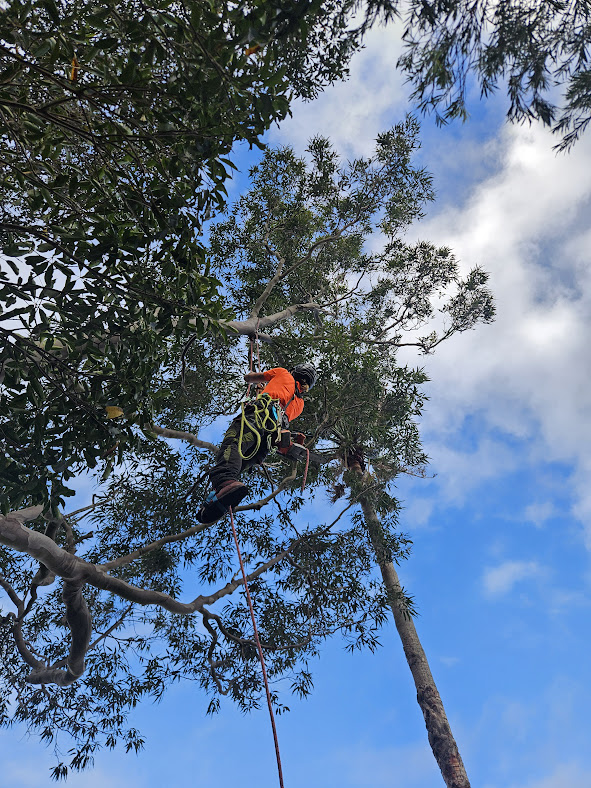
If you live on the Northern Beaches and look up at the street outside your house, there's a reasonable chance you'll see overhead powerlines running through the canopy of a eucalypt, a camphor laurel, or a liquidambar that has quietly grown toward them over the years. In older suburbs — Manly, Fairlight, Freshwater, Dee Why, Collaroy, Narrabeen and Brookvale — overhead powerlines are simply part of the streetscape, and trees near powerlines are a situation many homeowners will face at some point.
The problem is that most people don't know who is actually responsible for managing this, what the safety rules are, or what happens if they try to deal with it themselves. The answers matter: trees and branches can conduct electricity even when dry, and working near live overhead lines is one of the most common causes of serious electrical injury in Australia.
This guide covers what Northern Beaches homeowners need to know about trees near power lines — who is responsible, what Ausgrid's role is, when you need a qualified arborist, and what the NSW safety regulations actually require.
Who Is the Electricity Distributor on the Northern Beaches?
First, a point of clarification that often causes confusion: the electricity distributor responsible for the powerline network on the Northern Beaches is Ausgrid — not Endeavour Energy, not Essential Energy. Ausgrid operates the network across most of metropolitan Sydney, including the entire Northern Beaches area from Manly to Palm Beach and across to the Pittwater side.
This matters because the rules, the contact process, and the contractor program for vegetation management all sit with Ausgrid. When you need to report branches near powerlines or request trimming within the clearance zone, Ausgrid is who you call.
Who Is Responsible for Trees Near Power Lines?
Responsibility for trees near powerlines on the Northern Beaches sits with two parties depending on the location and ownership of the tree and lines involved.
When it's your responsibility
If a tree is growing on your property and branches are encroaching on or growing toward the street powerlines, the obligation to maintain minimum clearances sits with you as the property owner. Ausgrid's network is a public asset and you are required to keep the vegetation from your land clear of it. This is a legal obligation, not just good practice.
If you don't act, Ausgrid can issue a defect notice and arrange for clearance work to be done — with costs potentially passed on to you. In bushfire-prone zones (parts of the Northern Beaches are designated as bushfire-prone land), inspections occur annually and the threshold for enforcement is lower.
When Ausgrid is responsible
If the overhanging tree is on public land — a street tree, a reserve tree, or council-managed vegetation — Northern Beaches Council or Ausgrid is responsible for managing the clearance, not you. You can still contact Ausgrid to report the issue and request they attend.
The shared complexity
In practice, many Northern Beaches situations are less clear-cut. Trees grow across property boundaries. Street trees have root systems in nature strips and canopies that extend over private land. Mature eucalypts established before subdivisions were built have never been anyone's particular responsibility. In these cases, the starting point is always to contact Ausgrid and describe the situation — they'll confirm responsibility and advise on next steps.
What Ausgrid Can and Cannot Do For You
Ausgrid runs a proactive vegetation management program and engages specialist contractors (TreeServe, among others, covers the Northern Sydney and Northern Beaches region) to carry out clearance work near their network. You can request vegetation trimming near powerlines via the Ausgrid website, and for work within the immediate clearance zone, this is carried out without a direct cost to you.
However, there are important limitations to understand:
- Ausgrid's contractors trim only for clearance, not for tree health. The cuts made to achieve minimum clearance distances are determined by safety requirements, not by arboricultural principles. The result is often a heavily one-sided or poorly structured tree that may look worse than before, and in some species this structural imbalance can increase long-term risk.
- Ausgrid's program does not extend to the whole tree. They will clear the powerlines — and only the powerlines. If the rest of the tree also needs pruning, deadwooding, or remedial work, that's not within their scope.
- Timing is not guaranteed. Proactive trimming programs run on a cycle and your specific tree may not be scheduled for treatment for some time. If you're concerned about an immediate risk, report it as urgent rather than as a general request.
- Work within the 3-metre approach distance requires Ausgrid accreditation. Only Ausgrid-contracted or Ausgrid-accredited workers can legally carry out vegetation work within 3 metres of the network lines. A standard arborist — however qualified — cannot legally work within that zone without this specific accreditation.
The practical conclusion: Ausgrid handles the safety-critical clearance. A qualified arborist handles everything else — the health, structure and appearance of the tree outside the clearance zone, and the planning of how to manage the tree's growth over time to minimise future conflict with the lines.
What NSW Safety Law Says
The SafeWork NSW Code of Practice for Work Near Overhead Powerlines sets out the legal minimum approach distances that must be maintained during tree work. These are not guidelines — they are mandatory requirements under WHS legislation.
Key points for Northern Beaches homeowners:
- Trees and branches can conduct electricity, even when dry. Wet conditions increase the risk but are not required for conduction to occur.
- Any tree work that involves a reasonable possibility of the worker, their equipment, or cut material coming within the prescribed approach distances of live overhead lines must be carried out by a competent person trained in powerline awareness — or the lines must be de-energised first.
- For standard residential low-voltage lines, the approach distance is 1 metre for uninsulated lines and 0.5 metres for aerial bundled cable (ABC). Work within the 3-metre zone around these lines requires Ausgrid accreditation.
- For high-voltage transmission lines, approach distances are significantly greater.
The simplest way to understand this: if the tree you need to prune is anywhere near overhead powerlines, the job needs a risk assessment by a qualified professional before any cutting starts. Our tree pruning service always includes a powerline proximity check as part of the site assessment.
Do You Still Need a Council Permit?
This is a question we get regularly, and the answer surprises many homeowners: yes, in most cases, you still need Northern Beaches Council approval before pruning a significant tree, even if it is growing into powerlines.
Northern Beaches Council's Development Control Plan (DCP 2013) protects trees that meet certain size thresholds — generally 3 metres or more in height, or a trunk diameter of 150mm or more measured at 1 metre above ground. If your tree meets these criteria, the council's tree management rules apply regardless of whether powerlines are involved.
There is a DCP exemption for immediate danger — where a tree poses an imminent risk of injury or serious property damage, emergency work can proceed without a permit. But branches growing toward powerlines generally don't meet the threshold of "immediate danger" in themselves. If you're planning routine powerline clearance work, allow time to apply for a permit first.
Our guide to Northern Beaches Council tree permits explains the process in detail. For trees near powerlines, a qualified arborist can prepare a supporting arborist report that addresses both the powerline risk and the proposed pruning methodology — which makes council assessment more straightforward.
Which Suburbs on the Northern Beaches Are Most Affected?
Not all Northern Beaches suburbs face this issue equally. The prevalence of overhead powerlines — and therefore the risk of tree-powerline conflict — correlates largely with when a suburb was developed.
| Suburb type | Powerline situation | Examples |
|---|---|---|
| Older established suburbs | Predominantly overhead lines; mature street trees; high conflict potential | Manly, Fairlight, Freshwater, Brookvale, Dee Why, Collaroy, Narrabeen |
| Mid-century suburbs | Mix of overhead and underground; depends on street | Cromer, Beacon Hill, Warriewood, Elanora Heights |
| Newer developments and upgraded streets | Underground cabling; overhead lines minimal or absent | Parts of Newport, Mona Vale, Oxford Falls, newer estates |
If you're in one of the older established suburbs and you have mature trees on or near your property boundary, it's worth proactively assessing whether any are tracking toward the overhead lines — especially fast-growing species. Prevention is significantly easier and cheaper than crisis management after a storm.
Trees to Avoid Planting Near Power Lines
If you're planning new plantings on the Northern Beaches, the choice of species matters enormously if powerlines are in the vicinity. The general rule: any tree that will reach a height of more than 3 metres at maturity is a potential powerline conflict in the making if planted within 5 metres of the line. This rules out most medium and large trees entirely.
Species that commonly cause powerline conflict on the Northern Beaches include:
- Sydney Blue Gum and Grey Gum — commonly planted as street trees in older suburban areas; now very large and in regular contact with powerlines across suburbs like Collaroy and Narrabeen
- Camphor laurel — a fast-growing introduced species that spreads quickly and has a wide canopy
- Liquidambar — popular garden tree that outgrows powerline clearances within a decade
- Port Jackson Fig — large canopy, lateral spread, frequently in conflict with both overhead lines and underground services
- Brushbox — common street tree in older areas; grows to 20–30 metres and has a broad crown
Suitable alternatives for gardens with overhead powerlines: Lilly Pilly cultivars (pruned to stay low), Callistemon (bottlebrush), Westringia, Banksia integrifolia (coastal banksia) managed from planting to remain below the powerline corridor, or any of the compact ornamentals that won't exceed 2–3 metres at maturity.
What Powerline Pruning Actually Involves
When we're engaged for tree pruning on the Northern Beaches and the tree is near powerlines, the job has some specific requirements compared to standard pruning work.
The first step is always a site assessment to confirm approach distances and determine whether any part of the work falls within the 3-metre zone. If it does, that portion of the work must either be coordinated with Ausgrid or deferred to an Ausgrid-accredited operator. What we can do as qualified arborists is manage the broader pruning strategy for the tree — crown reduction, directional pruning, and structural work that improves the tree's long-term compatibility with its surroundings and reduces the rate at which growth re-encroaches on the lines.
Good directional pruning, carried out according to AS 4373-2007, can dramatically slow the rate at which a tree grows toward powerlines, spacing out the need for clearance interventions and reducing the total amount of material removed over time. It's a much better long-term outcome than repeated heavy-handed clearance cuts by a network contractor.
When It Becomes an Emergency
During and after storms — which on the Northern Beaches are a fact of life from November through to March — the risk of branch contact with powerlines increases significantly. Strong southerlies and nor-easters load tree canopies with wind force and, combined with the salt-spray damage that weakens leaf attachment and branch junctions, can bring branches down onto powerlines without warning.
If after a storm you see a branch in contact with powerlines, or a tree has fallen and brought lines down:
- Do not approach or touch the lines or the tree. Treat all lines as live.
- Keep people and vehicles well away — a minimum of 8 metres from any downed line.
- Call Ausgrid's 24-hour emergency number: 13 13 88.
- Once Ausgrid has attended and confirmed the lines are safe, call an emergency arborist to deal with any remaining hazardous material in the tree.
Our guide to storm damage and fallen trees covers the full process, including insurance and council responsibilities, in detail.
Proactive Management: The Smartest Approach
The homeowners who end up in crisis mode — dealing with a tree that has grown into powerlines, emergency pruning in storm conditions, or an Ausgrid defect notice — are almost always those who left the situation until it became urgent. Trees grow slowly enough that the problem seems manageable for years, until suddenly it isn't.
If you have trees near powerlines on your Northern Beaches property, the most sensible approach is to have an arborist assess them before there's a problem. We can tell you how much clearance you currently have, which direction growth is likely to proceed, whether proactive pruning would help, and whether the tree's long-term position near the powerline makes it worth managing or worth removing and replanting with a more appropriate species.
A short conversation now is worth considerably more than an emergency call in the middle of a summer storm.
Trees near powerlines on your property?
We carry out powerline clearance assessments and pruning across the Northern Beaches. Call us for an honest assessment before the situation becomes urgent.
Book a free assessmentFrequently Asked Questions
Can I trim tree branches near power lines myself?
No. Any tree work within the prescribed approach distances of live overhead powerlines — generally 3 metres for low-voltage lines — must be carried out by workers accredited under the SafeWork NSW Code of Practice for Work Near Overhead Powerlines. Trees and branches can conduct electricity even when dry. Attempting this work yourself risks electrocution and is illegal. Always engage a qualified arborist who is trained and accredited for powerline clearance work.
Who is responsible for tree branches touching power lines in NSW?
If the tree is growing from your property and branches are encroaching on street powerlines, the responsibility to maintain clearances sits with you as the property owner. Ausgrid (the electricity distributor for the Northern Beaches) can trim vegetation in the no-go zone within 3 metres of their network lines via a request on their website. For any trimming work outside that zone, or work to improve the tree's health and structure, you'll need to engage a qualified arborist.
Does Ausgrid trim trees near power lines for free?
Ausgrid trims trees near their network powerlines via contracted specialists, and this is covered through electricity tariffs rather than a direct charge. However, Ausgrid's contractors trim only to maintain safety clearances — not for tree health or appearance. The result is often heavy one-sided cuts. If the tree matters to you, engaging an arborist to manage the broader pruning work outside the clearance zone gives you far more control over the outcome.
Do I need a council permit to prune a tree that is growing near power lines?
In most cases, yes. Northern Beaches Council's DCP 2013 still applies even if a tree is growing near powerlines. If the tree meets the DCP size threshold, you'll need approval before significant pruning takes place. There is an exemption for genuine imminent danger, but routine clearance work usually doesn't qualify. A qualified arborist can advise on whether your situation requires a permit and help with the application.
What should I do if a tree branch falls on power lines during a storm?
Treat any downed or damaged powerline as live and dangerous — stay at least 8 metres back and keep others away. Call Ausgrid's emergency line on 13 13 88 immediately. Do not approach until Ausgrid has confirmed the lines are safe. Then call an emergency arborist to deal with any remaining hazardous material in the tree before the next storm event.
How close can a tree be to power lines before it is a problem?
Ausgrid's minimum clearance varies by line type. For uninsulated low-voltage lines the minimum is 1 metre; for aerial bundled cable (ABC) it is 0.5 metres. Any work to achieve these clearances within 3 metres of network lines requires Ausgrid-accredited contractors. If a tree on your property is growing toward powerlines, don't wait for contact — get an arborist assessment now and plan ahead.