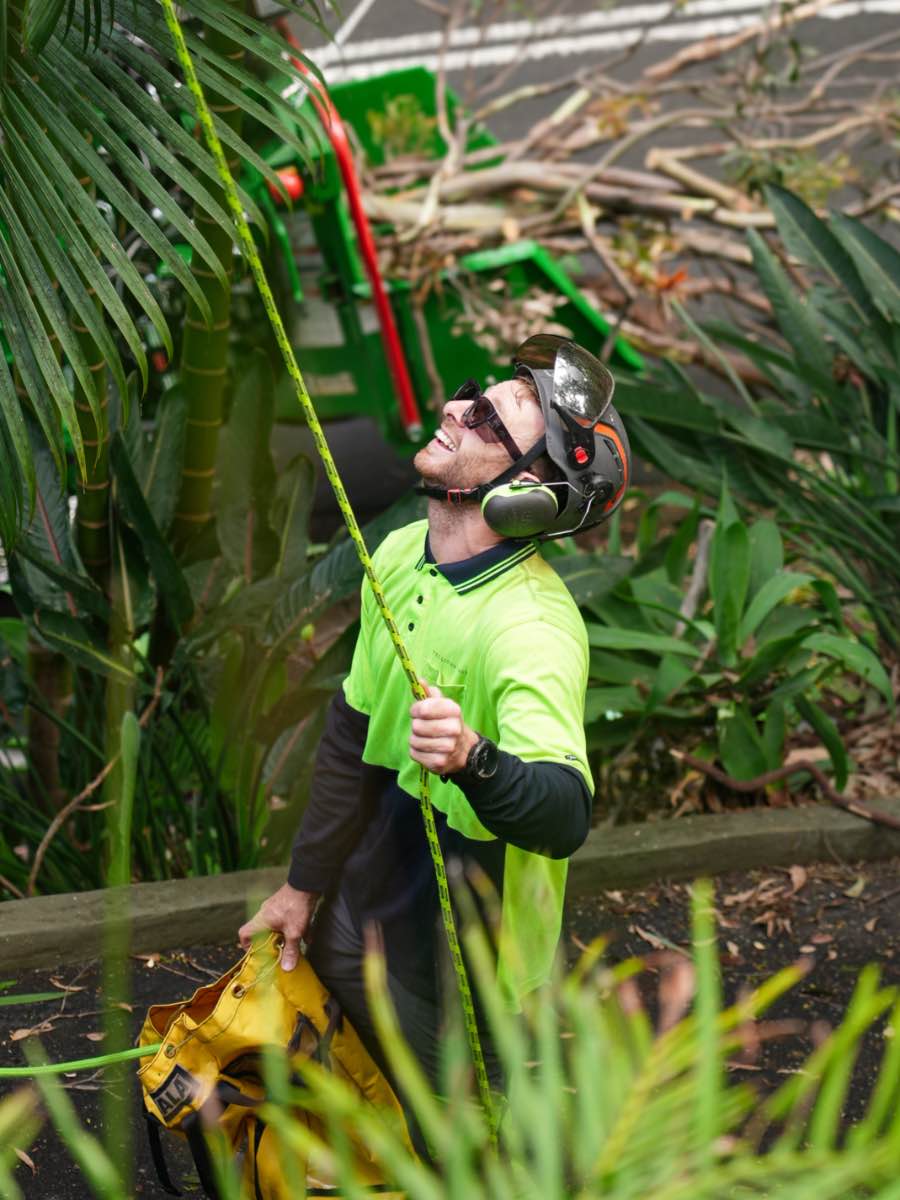
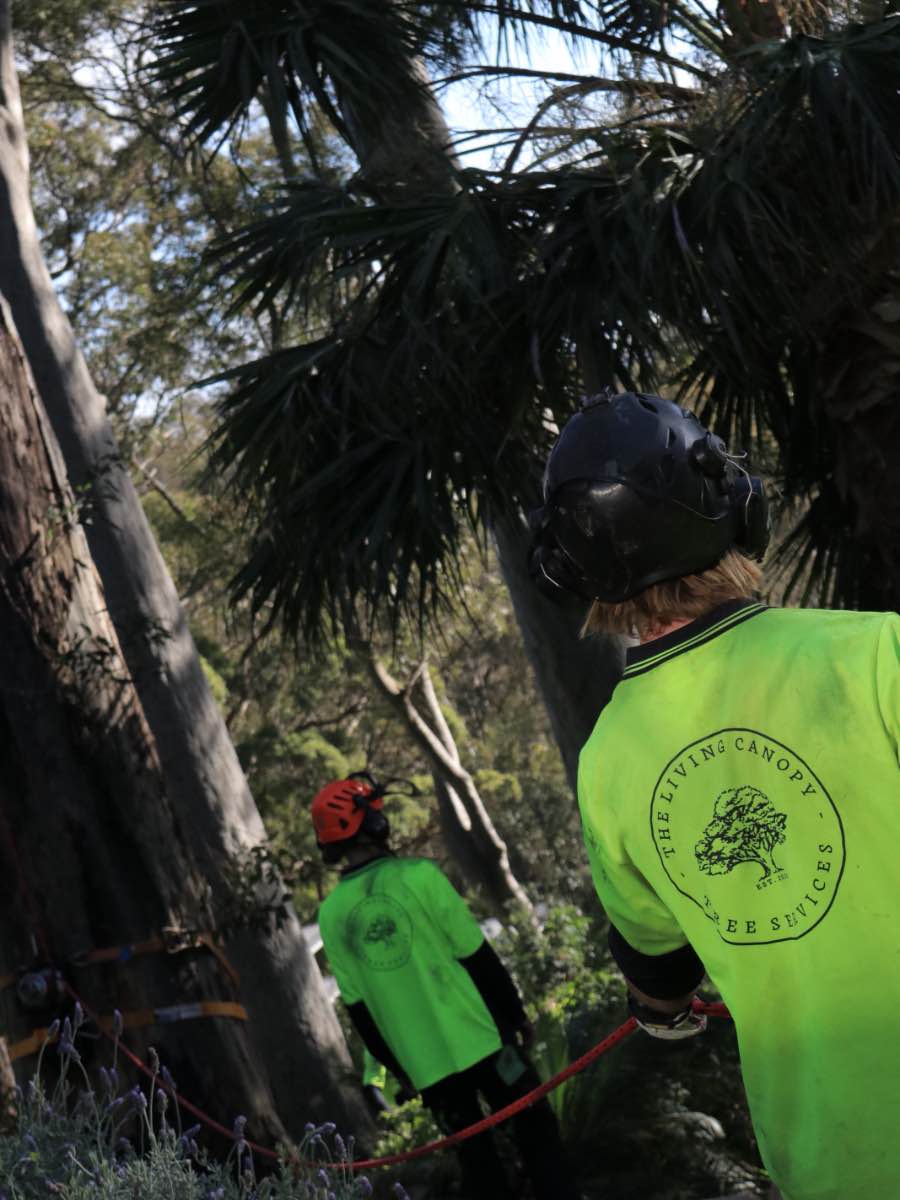
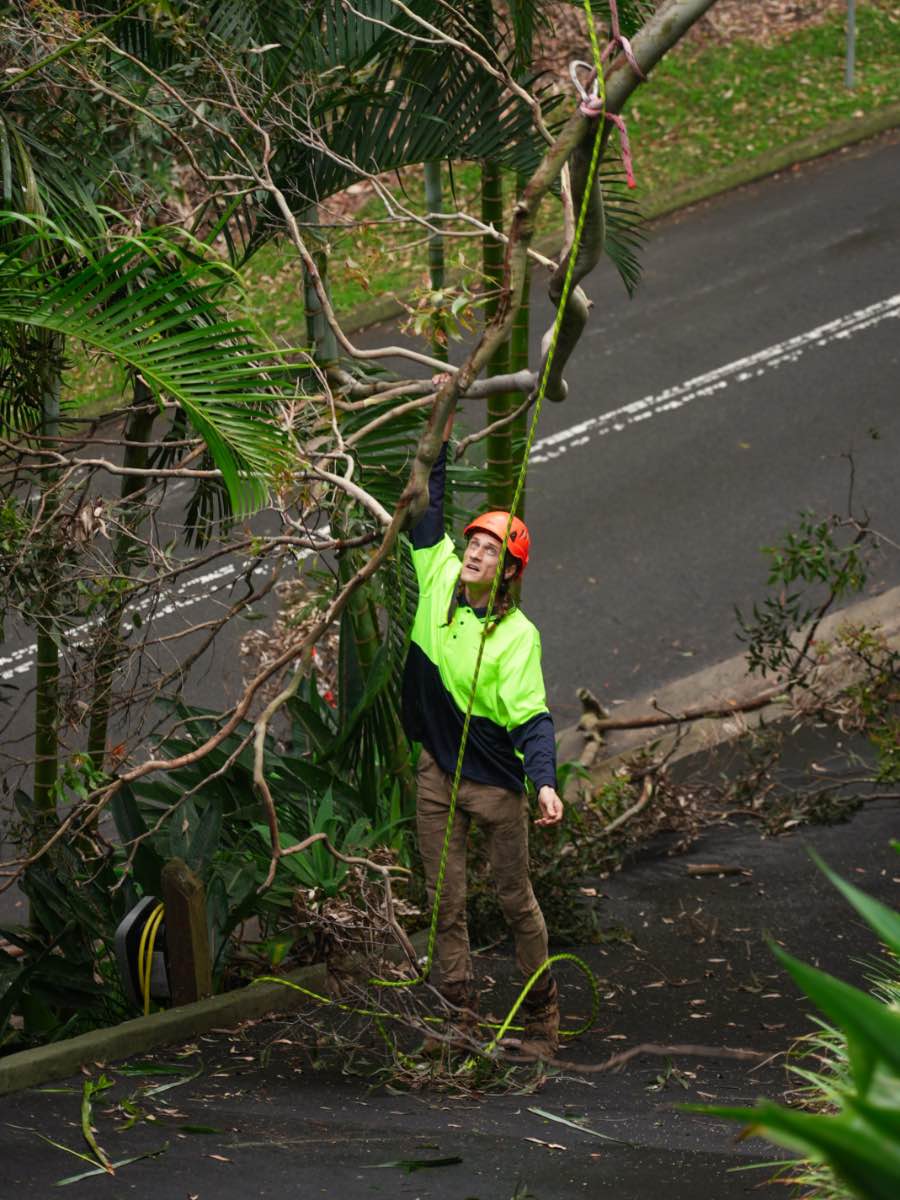
Our crew at work
Looking up before we cut anything
Sydney Red Gums along the point, palms and old gardens behind Military Road, and a soil-borne disease that North Sydney Council says is killing some of the red gums. Alex looks at every Cremorne tree himself and tells you honestly whether it can be kept.
Cremorne runs south from Military Road, between Neutral Bay and Mosman, and narrows into Cremorne Point with Mosman Bay on one side and Shell Cove on the other. Along the foreshore, Cremorne Point Reserve is a thin strip of lawn, planted trees, old gardens and bushland. North Sydney Council's bushwalk guide describes the bush at Robertsons Point as Angophora costata (Sydney Red Gum) canopy over She-Oak, Banksia integrifolia (Coastal Banksia) and heath, with Scribbly Gum recorded there as locally rare. The Lex and Ruby Graham Gardens, started in 1957, are protected by the National Trust.
The same red gums grow in private gardens across the suburb, along with palms, Jacarandas and big exotic trees planted over the last century. Many of these trees are older than the houses around them. When one starts to look unwell, the instinct is often to take it down. We'd rather work out what's wrong first.
The wildlife matters too. Council's guide notes Tawny Frogmouths nesting at Cremorne Point every year, Ringtail Possums are common, and the Powerful Owl has been seen there. Old red gums with hollows and dead limbs are part of that habitat. North Sydney Council's dead-tree exemption only applies where the tree isn't needed as habitat for native animals, so we check for hollows and nests before any dead tree comes down.
The ground is Hawkesbury Sandstone with poor sandy soil, which council notes across the whole area. Trees here root shallow and wide, often over rock. That affects how they hold up in storms, how they respond to digging nearby, and how deep a stump can be ground.
North Sydney Council's bushwalk guide puts it plainly: around Cremorne Point Reserve, some of the Sydney Red Gums are dying because of Phytophthora in the soil. Council set up a program in 2001 to protect and restore the remnant canopy. The guide says the red gums are still being affected, and that recently planted Angophoras have failed to thrive, so council's bushland team now plants other local species that are less susceptible.
If you have a red gum in a garden near the point and it has been going backwards for a season or two, get it looked at early. A slow decline gives you time to do something about it. Once a tree has died, there's nothing left to save.
You can see more sky through the canopy than you used to, and the leaves look smaller or paler. Compare it with a photo from a year or two ago if you have one.
The ends of branches go bare and dead first, working back towards the trunk. In a healthy red gum, a dead branch here and there is normal. Dieback across the whole crown isn't.
Red gums shed limbs, but a tree that drops more each year, or sprouts clusters of new shoots straight off the trunk and main branches, is under stress.
Damaged or weeping bark near ground level, soil that stays wet around the trunk, or recent digging, paving or trenching across the root zone.
None of these signs proves Phytophthora. Drought, root damage from building work, changes to drainage and insect attack can all look much the same. What they do tell you is that the tree needs looking at. Confirming Phytophthora takes laboratory testing of soil or root samples, which an independent consulting arborist (AQF Level 5) can arrange, and we can point you to one.
In the meantime, there's often a lot that can be done for the tree. Taking out deadwood, which needs no permit in North Sydney, lowers the risk of limbs dropping on the house or path while the tree is kept. Keeping heavy machinery, new paving and trenching away from the root zone helps a stressed tree hold on. Because the disease lives in the soil, don't move soil or mulch from around a sick tree to other parts of the garden.
If the tree has died, or is failing and can't be made safe, we'll tell you, and explain which council rules apply. If you're replanting, think about what council has learned at the point: young Angophoras there haven't done well, so it's worth choosing a replacement with care.
Cremorne and Cremorne Point are in North Sydney Council. A permit is needed to remove or prune a tree or other vegetation on private land that is more than 5 metres high, has a crown more than 5 metres wide, or has a trunk circumference of more than 500 mm measured at ground level. A mature red gum passes all three. Camphor Laurel and Celtis are only covered above 10 metres.
No permit is needed to remove a tree that a qualified arborist (minimum AQF 3) has confirmed in writing is dead, where it isn't needed as habitat for native animals. Deadwood can be pruned out of any tree. Maintenance pruning is allowed for branches no more than 100 mm in diameter, removing less than 10% of the crown, where the branches join the trunk no more than 2.4 metres above the ground or are within 1 metre of a building. All pruning must follow AS 4373.
Exempt species include Cocos Palm, Indian Coral Tree, Rubber Tree, Umbrella Tree, Tree of Heaven, Willow, African Olive, Privet and bamboo, and Camphor Laurel and Chinese Hackberry under 10 metres. On a heritage-listed property, approval may be needed regardless of size for some of them, as well as for Bangalow and Kentia palms.
From 1 July 2026 there's a $90 (incl. GST) non-refundable lodgement fee, and council aims to assess within 12 business days. Council may ask for a report from an AQF Level 5 arborist. Fines for unauthorised tree work can be up to $1.1 million, and can apply to whoever ordered the work as well as whoever did it.
Source: North Sydney Council, trees on private land. Red gum decline: North Sydney Council, Harbour Foreshore Bushwalk Guide. Checked October 2026.
A Sydney Red Gum stump is rarely a neat round disc. The base flares out, roots wrap over the sandstone, and on the point the rock is often only a short way down. Where the stump sits on shelf rock, we can only grind as deep as the rock allows. We'll tell you that at the quote, so you know what to expect before planning a new garden bed or lawn there.
The machine is our own Bandit SG40. Its tracks measure 74 cm, narrow enough for a standard side gate and the slim paths that run beside many Cremorne houses. If we're removing the tree, we can grind the stump straight after, in the one visit. We're just as happy to come out for one old stump.
If the tree died with suspected Phytophthora, keep the grindings where they are rather than spreading them as mulch through the rest of the garden. More about stump grinding
Health checks on old red gums. Alex looks over the crown, trunk and base and tells you whether the tree is sound, stressed or failing, and what to do about it. If you need a formal report, we'll point you to an independent consulting arborist.
Deadwooding. Removing dead limbs over roofs, paths and pools is the simplest way to make a big tree safer, and it needs no council permit. Tree pruning
Pruning near the house. Small branches within 1 metre of the building, gutters included, can be cut back within council's maintenance limits. More than that needs a permit, and we'll say so at the quote.
Palms. Cremorne gardens have plenty of them. Dead fronds and seed pods come off without a permit, and Cocos palms are an exempt species if you want one gone. Palm tree pruning
Removing dead or failing trees. Once a dead tree has been confirmed in writing and checked for habitat, or a permit is in place, we take it down in sections on ropes. Tree removal
After a storm. Shallow-rooted trees on sandstone can come down in strong wind. If one has landed on the house, the car or the fence, ring Alex on 0452 030 077. Emergency tree work
Real Google reviews from our customers.
"Alex provided expert advice on our large gum, and delivered a professional service at a fair and reasonable price. And all done super efficiently within a week. Highly recommended."
"Alex is super knowledgeable and helpful when dealing with unruly trees, and what can and can't be done re. northern beaches council rules and regulations. Responded quickly, came over in person, had a look, and the job was done with all clean-up as well!…"
"Highly recommended, very friendly and they did an awesome job, going above and beyond for me. Much appreciated. Thank you Alex and the crew"
Our Sydney Red Gum is thinning out. Is it Phytophthora?
It might be, but thinning has other causes too, including drought, root damage from building work and drainage changes. North Sydney Council has recorded some Sydney Red Gums around Cremorne Point Reserve dying from Phytophthora in the soil. Confirming it needs laboratory testing of soil or root samples, which an independent consulting arborist (AQF Level 5) can arrange. We can look at the tree first and point you to one if testing makes sense.
Can a dead red gum be removed without a permit?
Yes, if a qualified arborist (minimum AQF 3) confirms in writing that it's dead and it isn't needed as habitat for native animals. Old red gums often have hollows, and Cremorne Point has nesting Tawny Frogmouths and common Ringtail Possums, so we check for hollows and nests first. If the tree is still alive, it needs a permit.
Can I prune a red gum to open up a harbour view?
Only within the maintenance pruning exemption, unless you have a permit. That allows branches no more than 100 mm in diameter, less than 10% of the crown, and only where they join the trunk no more than 2.4 metres above the ground or are within 1 metre of a building. Pruning for a view usually goes beyond that, so it needs an application. Deadwood can always come out. We prune to AS 4373 and don't lop or top trees.
What does a North Sydney Council tree permit cost?
From 1 July 2026 there's a $90 (incl. GST) non-refundable lodgement fee. Council aims to assess applications within 12 business days and may ask for a report from an AQF Level 5 arborist. Fines for unauthorised work can be up to $1.1 million.
We work across Cremorne and the North Shore regularly. Call us directly or send an enquiry — we'll come out, assess the trees and give you a straight, honest price.
0452 030 077