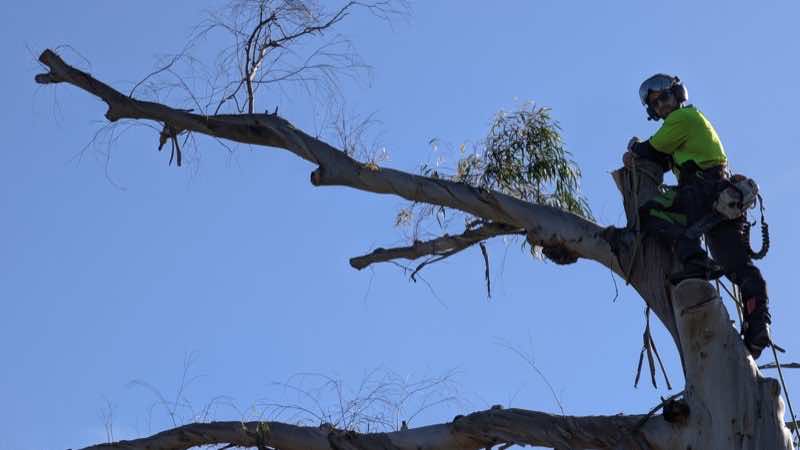
A dead tree in the backyard raises three immediate questions: do you need a council permit, is it a hazard right now, and what is it going to cost? The answers are less obvious than most people expect — particularly on the Northern Beaches, where a large proportion of established trees are native eucalypts, angophoras, and banksias that carry specific legal protections even in death. This guide covers the full picture: how to confirm a tree is actually dead, what Northern Beaches Council requires before you remove it, when urgency applies, and what the job involves and costs in 2026.
Is Your Tree Actually Dead, or Just Stressed?
The first question before any removal — permit application or otherwise — is whether the tree is truly dead. Eucalypts and many other Australian native species are remarkably resilient, and what looks like death is sometimes severe stress, drought response, or the aftermath of a fungal infection that the tree may recover from over one or two growing seasons.
Signs that point toward true death rather than stress:
- No new growth by mid-spring. In Sydney's climate, any living tree should show new growth — at least epicormic (water) shoots on the trunk — by September to October. A tree with no growth by this point after an extended dormancy is almost certainly dead.
- Bark separating from the trunk. When bark sloughs away in large sections and the cambium layer beneath is dry and grey rather than green or white, the vascular system has failed. Live trees show green or cream when you scratch bark away.
- Dry, crumbly wood at the core. A small drill hole or a cut into the wood should show moist, living wood in a healthy tree. Bone-dry, friable wood throughout indicates death.
- Advanced fungal growth. Bracket fungi, shelf fungi, or heavy mushroom growth at the base or on the main trunk of a previously healthy tree signals advanced internal decay — often the tree is already dead or dying from the inside out.
- Root failure or heave. If you notice the root zone lifting on one side or the tree leaning when it didn't before, the root system may have failed, which often precedes complete death.
A tree that looks dead after a single harsh summer may simply be stressed. A tree with no foliage and separating bark after two full growing seasons is a different situation. If you are unsure, an arborist assessment in late October — when growth should be at its most evident — is the most reliable way to confirm status before you invest in a permit application or removal.
Does a Dead Tree Need a Council Permit on the Northern Beaches?
Northern Beaches Council's Development Control Plan (DCP 2013) includes a dead tree exemption, but it is not automatic and it is not unlimited. Understanding the conditions matters — a removal that doesn't meet them can still result in a penalty notice.
The exemption applies when:
- The tree is confirmed dead by a written certificate from an AQF Level 5 (or above) qualified arborist.
- The tree is not listed on the Significant Tree Register or identified in any heritage overlay.
- The tree is not in a biodiversity or ecological vegetation overlay on the council's mapping.
- Removal does not require any earthworks or construction works that would separately require consent.
The exemption does NOT apply when:
- The species is in a sensitive ecological community — some spotted gum and ironbark communities on the Northern Beaches are mapped under the Biodiversity Conservation Act.
- The tree is a hollow-bearing tree, regardless of whether it is dead (see habitat section below).
- There is any dispute about whether the tree is actually dead — council can require a permit even for apparently dead trees if they have reason to question the assessment.
The written certificate from the arborist is essential. It is both your evidence that the exemption applies and your legal protection if the removal is later questioned. See our full guide to Northern Beaches council permit rules for tree removal for more detail on when consent is and isn't required.
Could Your Dead Tree Be a Habitat Tree?
This is the angle that surprises most Northern Beaches homeowners: a tree that is fully dead may still require extra consideration before removal, because dead wood is some of the most valuable habitat in Australian urban bush.
The Northern Beaches supports significant populations of hollow-nesting birds (gang-gang cockatoos, eastern rosellas, owls) and microbats, all of which depend on tree hollows that only develop in trees over 80–100 years old. Dead trees — particularly dead eucalypts and angophoras — often have more and larger hollows than their live equivalents. A dead spotted gum in Narrabeen or a dead angophora in Avalon may be the only hollow-bearing tree in 50 metres in any direction.
Northern Beaches Council's biodiversity mapping, together with the Biodiversity Conservation Act 2016, means that hollow-bearing trees — dead or alive — may be assessed differently. If a tree has hollows visible from the ground, a full habitat tree assessment is worth completing before removal, even under the dead tree exemption. An arborist report that addresses the hollow question specifically also gives you documented due diligence.
How Long Can You Wait Before Removing a Dead Tree?
The honest answer is: it depends on the species, the tree's size, and where it sits relative to structures and people — and for eucalypts in particular, the timeline is less predictable than most homeowners expect.
Eucalypts and angophoras — immediate attention warranted. These species are notorious for "widow maker" limb failures — large, apparently solid dead limbs that drop without warning, often without any visible precursor. The mechanisms that cause eucalypt limb failure (a combination of wood structure, moisture variation, and heat response) mean that a dead limb can remain in place for months and then fall on a still day. Any large dead eucalyptus overhanging a structure, driveway, path, or area where people walk should be treated as an active hazard. See our guide to signs a tree is dangerous for more detail on the specific indicators that warrant urgent action.
Other hardwood natives — medium urgency. Turpentines, brush box, and tallowwoods retain structural integrity for longer than eucalypts because their wood structure is denser and more uniform. A dead hardwood in an open position away from structures may be stable for two to four years before rapid deterioration. In a hazardous position, treat it as urgent regardless.
Exotic and softwood species — faster deterioration. Jacarandas, liquidambars, conifers, and willows lose structural integrity relatively quickly after death. If an exotic tree dies, the window before the wood becomes unstable is shorter — typically one to two growing seasons.
If the tree is in a position where it could fall on a structure, a pool, a power line, or a neighbouring property, the question is not "how long can I wait" — it is "how do I get this booked as quickly as possible." Contact us for emergency tree work if the hazard is immediate.
What Removing a Dead Tree Involves
Dead tree removal uses the same fundamental techniques as live tree removal — climbing, rigging, sectional dismantling — but with significantly different risk considerations, because dead wood behaves unpredictably in ways that live wood does not.
The climbing question. A climbing arborist assesses whether the tree is safe to ascend before any work begins. A dead tree with a sound trunk and intact limb attachments may be climable with additional precautions — but many dead trees have compromised anchor points, and an arborist will make this assessment conservatively. When climbing is not safe, an EWP (elevated work platform, also called a cherry picker) is used instead. This adds cost and requires vehicle access, but it's the right call when the tree can't be safely climbed.
Rigging in brittle wood. Rigging systems work by attaching a rope to a living anchor point above the section being cut, then controlling the section's descent as it is cut free. In dead wood, the anchor point may be less reliable — a dead limb that looks intact may have internal decay that reduces its load capacity. Experienced arborists on dead tree jobs use more conservative rigging setups, shorter sections, and more anchor redundancy than on comparable live tree jobs.
Different chipping behaviour. Dead wood does not chip cleanly. The fibres are dry and stringy rather than fresh and consistent, which loads the chipper differently and can increase fuel consumption and wear. If the dead wood has advanced fungal decay, it may not be suitable for mulch — the crew will discuss timber handling with you before the job.
Root zone considerations. The roots of a dead tree are also decomposing. On properties where the tree is close to a structure, retaining wall, or underground service, the arborist may recommend leaving the root system to decompose naturally rather than immediately grinding the stump — removing the stump while the roots are still providing some structural support to the adjacent soil can cause settlement. This is a site-specific call and worth discussing in the quote.
For a full breakdown of the tree removal process from assessment to site clearance, see our service page.
What Dead Tree Removal Costs in 2026
Dead tree removal is priced similarly to live tree removal of the same size. The species, height, canopy spread, access, and proximity to structures all affect the quote, and a dead tree may carry a small premium over an equivalent live tree if the rigging complexity is higher or an EWP is required.
| Tree size | Typical cost range | Notes |
|---|---|---|
| Small (under 5m) | $400–$700 | Straightforward access, no structures nearby |
| Medium (5–10m) | $700–$1,500 | Standard rigging; EWP if unsafe to climb |
| Large (10–20m) | $1,500–$3,500 | Advanced rigging; crane may be required |
| Large + difficult access or crane | $3,500–$8,000+ | Steep block, narrow access, or street crane job |
| EWP surcharge (if required) | +$600–$1,200 | When tree can't safely be climbed |
| Arborist death certificate | $0–$250 | Often included in the site inspection; ask upfront |
For a full breakdown of what drives tree removal pricing on the Northern Beaches, see our tree removal cost guide for 2026. Get a written quote that specifically names the dead-tree considerations — arborist certification, rigging approach, EWP or no EWP, and timber handling — so you can compare quotes on like-for-like terms.
We work across the Northern Beaches and regularly remove dead eucalypts, angophoras, and exotic species from residential properties in Narrabeen, Mona Vale, Avalon, Newport, and surrounding suburbs. Call us for a site inspection and written quote.
Dead tree on your property?
We'll confirm whether it's dead, document it for council, and give you a written quote for removal. Call or send us photos to get started.
Book a free site inspectionFrequently Asked Questions
Do I need a permit to remove a dead tree on the Northern Beaches?
Dead trees are generally exempt from Northern Beaches development consent, but you need a written certificate from an AQF Level 5 qualified arborist confirming the tree is dead before you remove it. Significant, heritage, and hollow-bearing trees may still require consent regardless of condition. Always verify with council or confirm through an arborist assessment before proceeding.
How can I tell if my tree is dead rather than just stressed or dormant?
True death signs: no new growth by mid-spring, bark separating from the trunk across large areas, dry and crumbly wood under the bark (live wood shows green when scratched), and advanced fungal growth at the base. A stressed tree usually shows green under the bark and will produce epicormic shoots. Mid-October is the most reliable time to assess, when any living tree should be showing growth.
Can I remove a dead tree myself on the Northern Beaches?
Legally yes, if you have the arborist certificate and the tree isn't in a restricted category. Practically, dead tree removal is high risk — dead wood is brittle and unpredictable, and sections can fail without warning during cutting. For any dead tree over about 3m tall, professional removal is strongly recommended, and essential for trees near structures, power lines, or neighbouring properties.
How long does a dead tree take to become a hazard?
For eucalypts and angophoras, hazard develops immediately after death — these species drop large dead limbs without warning at any stage. Any large dead eucalyptus near a structure or area where people walk should be treated as urgent. Other hardwood species may remain structurally sound for two to four years; exotic species deteriorate faster. Position matters most — if it can fall on something important, urgency is immediate.
What does dead tree removal cost on the Northern Beaches in 2026?
Similar to live tree removal: approximately $400–$700 for small trees, $700–$1,500 for medium, $1,500–$3,500 for large, and $3,500–$8,000+ for large trees requiring crane work or difficult access. An EWP surcharge of $600–$1,200 applies if the tree can't safely be climbed. Arborist certification of death is typically included in the site inspection or quoted at $0–$250.
Does home insurance cover dead tree removal?
No — home insurance covers sudden accidental damage to structures, not preventive tree removal. If a dead tree falls and damages an insured structure, that damage claim may be accepted. But if the assessor finds the tree was clearly dead for an extended period, the claim may be declined as foreseeable damage. Removing a dead tree promptly is the better position from both a safety and insurance perspective.