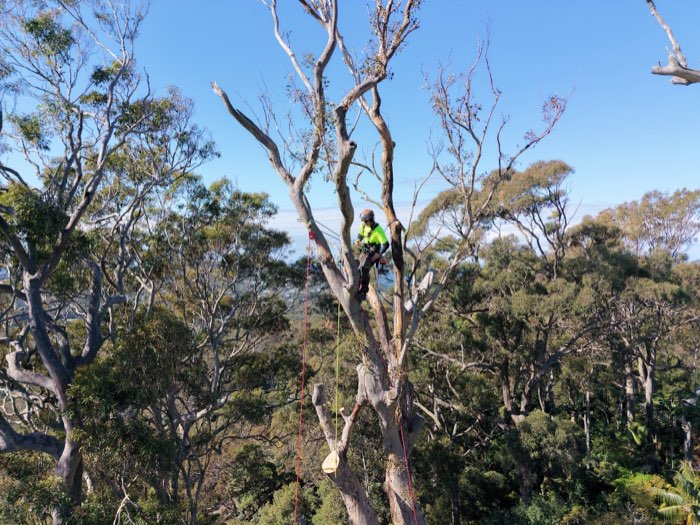
There is a dead gum standing at the back of a lot of Northern Beaches properties. It has been there for years, it has stopped putting out leaves, and sooner or later somebody says the obvious thing: it is dead, so you can just take it down. No permit, no paperwork.
That belief is half right, and the half that gets left out is the expensive half.
Northern Beaches Council does exempt dead trees from the usual approval process. But read the exemption as it is actually written and it has two conditions joined by a very small word. A tree can be removed without approval where it is dead, and not required as the habitat of native animals. Both halves have to be true. Dead on its own is not enough.
This guide covers what that means in practice on the Northern Beaches: what a hollow actually is, why the old dead tree in the corner is often the most ecologically valuable thing on the block, what the law says, and why removal is frequently not the only option even when a tree is genuinely finished.
The Exemption Most People Only Half-Remember
Trees and vegetation on the Northern Beaches, including on private land, are protected under the State Environmental Planning Policy (Biodiversity and Conservation) 2021. Chapter 2 of that policy covers vegetation in non-rural areas, and it is what puts tree removal in Council's hands in the first place. Council's Development Control Plan then sets out which trees are covered and which works are exempt.
Three exemptions come up constantly on the Northern Beaches:
- Trees under 5 metres in height do not require a permit.
- Reasonable pruning of up to 10% of a tree's canopy within 12 calendar months does not require a permit.
- Dead trees do not require a permit — provided they are not required as the habitat of native animals.
The third one is where people come unstuck. It is not a blanket exemption for anything without leaves on it. The moment a dead tree is providing shelter to native wildlife, it stops being exempt and goes back to needing approval like any other protected tree. Council also recommends taking photographic evidence before removing a tree you believe is exempt, which is sensible advice — if the exemption is ever questioned, the photographs are what you have.
None of this means you will be refused. Plenty of hollow-bearing trees are approved for removal every year where the risk genuinely warrants it. It means the decision is Council's to make rather than yours to assume. Our Northern Beaches tree permit guide walks through how the application itself works.
What Actually Counts as a Hollow
A hollow is a cavity that forms in the trunk or branches of a tree — and importantly, it forms in living and dead trees alike. Hollows are a characteristic of older, mature to senescent native trees, overwhelmingly eucalypts, angophoras and their relatives.
Not every hole is a hollow. What matters is whether there is a usable chamber behind the entrance: depth, a protected cavity, and an opening sized to suit something. The features worth looking for include:
- Entrance holes in the trunk or in the upper side of large limbs, often where a branch has torn out years ago
- Spouts — hollow branch stubs, open at the end, angled upward
- Vertical fissures and decay pockets running down the trunk
- Cavities behind loose or decorticating bark, which microbats use even when they are only a couple of centimetres deep
- Staining, rub marks or chewed edges around an opening, which usually means something is going in and out
A standing dead tree — a stag, in arborist language — is very often the single highest-value habitat feature on a suburban block. It has lost the canopy that made it a landscape tree, which is exactly why people stop valuing it, but the decay that killed it is the same process that created the cavities.
Hollows Take Far Longer to Form Than People Expect
This is the part that changes how most homeowners think about it. Hollows only begin to form in trees more than about 120 years old.
Australia has no woodpeckers. Nothing here excavates a nesting cavity in sound timber. Our hollows are made slowly, by fungal decay and termites working into the wound left when a limb tears off, and then by decades of weather opening that pocket out. It is a process measured in human lifetimes.
The practical consequence is blunt: nothing you plant today will replace a hollow you remove this year. Not in your ownership of the property, and realistically not in your lifetime. Across the Northern Beaches, where bushland blocks have been progressively developed and mature trees removed one at a time, hollow-bearing trees are getting harder to come by — and every one that goes takes decades of shelter with it.
What Lives in Them
Across Northern Beaches bushland and the gardens that back onto it, hollows are used by rainbow lorikeets, sulphur-crested cockatoos, kookaburras and pardalotes; by brushtail and ringtail possums and by sugar gliders; and by microbats, which roost in cavities and under loose bark and are easy to miss entirely. Powerful Owls, which need very large hollows and are listed as vulnerable in NSW, are recorded across the bushland corridors of the peninsula.
All native birds, reptiles, amphibians and mammals in New South Wales — with the single exception of the dingo — are protected under the Biodiversity Conservation Act 2016. That protection applies to the animal regardless of whose tree it is sitting in.
What Happens If You Get It Wrong
Unauthorised clearing is enforced on the Northern Beaches, and the figures are not trivial. Councils can issue penalty infringement notices for unauthorised clearing under the Environmental Planning and Assessment Act 1979, and more serious matters can be prosecuted in the Land and Environment Court, where the maximum penalties under that Act run to $220,000 for an individual and $1.1 million for a corporation.
Those are maximums, not typical outcomes, and the figures shift depending on which Act a matter is charged under — offences involving protected animals fall under the Biodiversity Conservation Act 2016 and carry their own separate scale. The point is not the specific number. It is that the contractor who tells you a dead tree is always fine to remove is not the person who wears the consequence if it was not.
Worth noting too: engaging someone to do the work does not transfer the responsibility away from you as the property owner. This is one of several reasons we wrote about why the cheapest quote often costs more.
Nesting Season and Why Timing Matters
Most local birds nest through spring and summer — broadly August to January — and some species begin earlier. Possums and gliders breed over an overlapping period. If you are reading this in spring, you are in the middle of it.
Where tree work is not urgent, the simplest way to avoid the problem is to schedule outside that window. Autumn and early winter are usually the cleanest time to do significant work on a hollow-bearing tree, which also happens to line up with the timing advice in our guide to winter tree pruning.
Where work genuinely cannot wait, the answer is not to press on regardless. Hollows should be inspected before the saw comes out, and the job staged around what is found — working the tree in sections, leaving occupied limbs until last, or in some cases stopping and coming back. A qualified arborist should be raising this with you before the quote is signed, not after something falls out of a hollow.
You Usually Do Not Have to Choose Between Safety and Habitat
This is the most useful thing in the whole article, so it is worth stating plainly: the choice is rarely remove it or live with it.
Most of the risk in a declining tree sits in the outer canopy and the upper limbs — the lighter material most likely to fail, at the height where failure matters. The hollows, meanwhile, are usually in the sound structural framework lower down. Those two facts point at an obvious middle path: take the weight and the risk out, retain the sound structure, and keep the tree standing as habitat.
That is what a habitat tree is. A tree kept standing in a safe, reduced form specifically so wildlife can keep using it. It is frequently the outcome Council prefers, because it holds onto biodiversity that is extremely slow to replace — Council takes exactly this approach on public land, removing only the minimum needed to make a tree safe while retaining habitat value, including leaving hollow stumps standing for nesting birds.
What This Looked Like at Avalon Beach
A mature Corymbia maculata (spotted gum) in Avalon Beach went into rapid decline after a lightning strike, with scarring running from the upper canopy right down to ground level and very little live canopy left. As a landscape tree it was finished. The straightforward answer would have been to take it down.
Instead we reduced it into a habitat tree. The main framework of sound limbs was still there; what needed to go was the lighter outer canopy where the failure risk sat. We worked the job alongside consulting arborist David at Impact Vegetation, because deciding what to keep and what to take off a declining tree is a judgement call that benefits from more than one qualified set of eyes.
The tree already had a natural hollow. We removed it carefully, kept it intact, and reinstated it securely within the new habitat structure — so the hollow the tree had spent decades forming stayed with the tree. We then installed additional artificial hollows, sized and placed to suit a range of different animals.
You can see the full Avalon Beach habitat tree job with photographs, including the drone and rigging shots.
How to Work Out Whether Your Tree Has Hollows
You can do a reasonable first pass from the ground:
- Take binoculars and look at the trunk and the upper sides of large limbs, not just the silhouette
- Look for openings roughly 3 cm across and up — anything from microbat size upward
- Check for staining below an opening, or worn and chewed edges around it
- Stand outside at dusk and watch for movement leaving the tree; lorikeets and cockatoos are noisy about it, gliders and microbats are not
- Listen at first light
What you should not do is climb it to find out. A declining tree is exactly the kind that fails under load, and a hollow trunk gives no reliable indication of remaining wall thickness from the outside. If it matters enough to check, it matters enough to have someone assess it properly — which is also the point at which the wider structural warning signs get looked at.
Where This Leaves You
If you have a dead or declining tree on your Northern Beaches property, the sequence that keeps you out of trouble is short. Establish whether it has hollows. If it does, assume you need approval rather than assuming you do not. Ask whether reduction to a habitat stem would resolve the safety concern, because it often does. And if the work is not urgent, do it outside nesting season.
A tree that looks finished can still have a great deal left to offer. On the Northern Beaches, where hollow-bearing trees are getting scarcer every year, that is worth a conversation before the chainsaw comes out.
Frequently Asked Questions
Can I remove a dead tree on the Northern Beaches without a permit?
Sometimes, but not automatically. Council's exemption for private land applies to a tree that is dead and not required as the habitat of native animals. Both halves have to be true. A dead tree with hollows that wildlife is using does not meet the exemption, and removing it without approval is unauthorised clearing. Council recommends taking photographic evidence before any removal you believe is exempt.
Do I need a permit to remove a dead tree that has hollows in it?
In most cases yes. Once a dead tree is providing habitat, the exemption no longer applies and you need Council approval like any other protected tree. That does not mean approval will be refused, but it does mean the decision is Council's rather than yours. An arborist can assess whether the hollows are active and put the application together.
What if the dead tree is genuinely dangerous?
There is an exemption for trees presenting an imminent risk, but it is narrower than most people assume and ordinary decline does not qualify. Get a qualified arborist to assess and document it. In many cases the tree can be made safe by reducing it rather than removing it, which resolves the hazard without triggering the habitat problem at all.
When is nesting season on the Northern Beaches?
Most local birds nest through spring and summer, broadly August to January, and some species start earlier. Possums and gliders breed across an overlapping period. If tree work is not urgent, scheduling outside that window is the simplest way to avoid disturbing an active hollow. Where work cannot wait, the hollows should be inspected first and the job staged around what is found.
Can nest boxes replace a hollow that is lost?
They help, but they are a substitute rather than a replacement. Natural hollows only begin to form in trees more than about 120 years old, and they hold temperature far more steadily than a timber box. Nest boxes also need checking and maintaining over time. Retaining the original hollow, or reinstating it into a reduced habitat stem, is a much better outcome where the tree allows it.