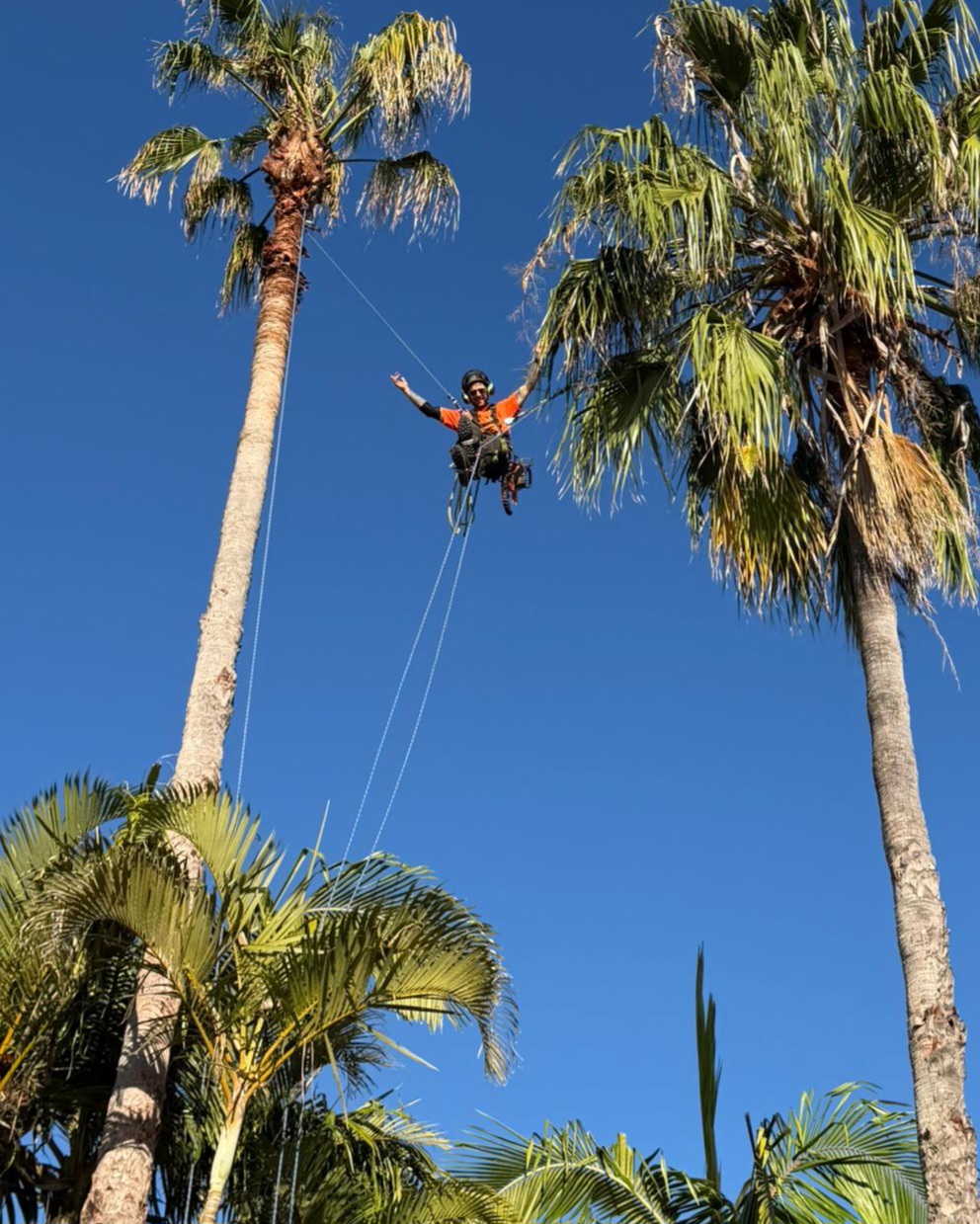
Palms are a fixture of the Northern Beaches landscape — from the Cocos palm spilling seed clusters over the back fence to the Bangalow standing tall by the pool, the Kentia in the courtyard and the Canary Island Date palm framing a front gate. They look after themselves most of the year, which is part of their appeal. But palm tree pruning on the Northern Beaches is something that trips up a lot of homeowners: done wrong, it stresses the palm and creates hazards; done right and on schedule, it keeps the tree healthy and the property tidy with minimal disruption.
This guide covers which species you're most likely to have, how often each needs attention, what professional pruning actually involves, when a Northern Beaches Council permit applies (and when it doesn't), the DIY vs arborist question, and what the job costs in 2026.
The Palms You're Most Likely to Have
The approach, permit status and cost of palm pruning all vary by species, so it's worth identifying what you're dealing with before anything else.
| Species | Common name | Typical height | Council permit to prune? |
|---|---|---|---|
| Syagrus romanzoffiana | Cocos palm | 8–15 m | No — exempt species |
| Archontophoenix cunninghamiana | Bangalow palm | 10–20 m | Generally no for routine pruning |
| Howea forsteriana | Kentia palm | 6–12 m | Depends on size — check DCP thresholds |
| Phoenix canariensis | Canary Island Date palm | 8–20 m | Yes if over DCP size thresholds |
| Livistona australis | Cabbage tree palm | 15–25 m | Usually yes — check council first |
The Cocos palm is by far the most common on the Northern Beaches — and the one most homeowners want dealt with. Messy seed clusters, attracted rats and possums, constant frond drop onto roofs and gutters. Fortunately, it's also the species with the clearest permit status: Cocos palms are exempt from Northern Beaches Council permits for both pruning and removal.
The Green Frond Myth: The Most Common Palm Pruning Mistake
The most widespread mistake homeowners make — or instruct someone to make — is removing green fronds to make the palm look cleaner. It seems like tidying up, but it works against the tree.
Green fronds are working leaves. They're photosynthesising and sending energy to the palm. A palm that loses its green fronds has fewer resources for new growth. Repeated removal over several seasons stresses the palm, progressively thins the canopy, and can reduce the structural integrity of the crown over time. Some species, including the Canary Island Date palm, are more tolerant than others — but none benefit from it.
The correct approach is to remove only:
- Brown, dead or dying fronds
- Flower stalks and seed clusters — particularly important for Cocos palms, where this is the primary source of mess
- Petiole stubs (the remaining bases after fronds have shed naturally) where they need tidying
A useful rule of thumb: never prune above the 9 o'clock to 3 o'clock line — imagining a horizontal line through the middle of the canopy when viewed from the side. Anything below that line and brown can come out. Anything green stays, regardless of where it sits.
What Professional Palm Tree Pruning Involves
When you book our palm tree pruning service on the Northern Beaches, here's what actually happens on the day:
Assessment First
Before any climbing or elevated work platform (EWP) work, the arborist assesses the palm's condition, notes seed clusters and flower stalks, checks for signs of disease or pest damage in the crown, and identifies any access issues — overhanging roofs, pool areas, power lines.
Frond Removal
Dead and dying fronds are cut cleanly close to the trunk without leaving long stubs that create pest habitat. For Cocos palms specifically, immature seed clusters are typically removed as a priority — these are the main source of mess and possum and rat attraction on Northern Beaches properties.
Seed Stalk Removal
On Cocos palms, timing the removal of flower and seed stalks before the seeds fully form makes a significant difference to how quickly the palm re-mesties. Catching them early is more effective than cleaning up after fully developed seed clusters have dropped.
Trunk Cleaning (Husking)
On Phoenix (Canary Island Date) palms and some others, old petiole bases — called "boots" — remain attached to the trunk after fronds die. These create fire risk and harbour pests. Removing them, a process called husking, requires both skill and serious care: Phoenix canariensis has spines up to 20 cm long that can cause deep puncture wounds. This is specialist work.
Debris Management
Palm fronds are bulky and heavy. All material — fronds, seed clusters, trunk scales — leaves the site with the crew. You shouldn't need to deal with it.
When and How Often to Prune
Frequency depends on the species and what's driving the decision.
Cocos palms benefit from annual maintenance, ideally in late summer to early autumn (February to April). This timing catches seed stalks before they ripen and drop — the main source of mess, possum attraction and gutter blockage. Properties with multiple Cocos palms overhanging roofs or pools sometimes opt for twice-yearly visits.
Bangalow palms are generally lower maintenance. They shed old fronds naturally and don't produce the pest-attracting seed clusters that Cocos do. A tidy-up every two to three years is typically sufficient unless aesthetics call for more.
Kentia palms are slow-growing and relatively tidy. Annual or biennial removal of brown fronds is all most need.
Canary Island Date palms benefit from annual husking and frond management. Given the spines involved, this is not a job to defer — accumulated boots create increasing fire and pest risk, and the job gets bigger each year it's skipped.
Council Permit Rules: Which Palms Need One?
Northern Beaches Council's Development Control Plan applies standard size thresholds to most protected trees: a trunk diameter over 30 cm measured 1 m from the ground, a height over 5 m, or a canopy spread over 5 m generally triggers the permit requirement. But species matter as much as size.
Cocos palm (Syagrus romanzoffiana): Exempt. No permit required for pruning or removal, regardless of size. This is Northern Beaches Council's formal position under its current DCP.
All other species: The standard size thresholds apply. If your Bangalow, Kentia, Date palm or Cabbage tree palm exceeds those thresholds, check with council or ask your arborist before proceeding. Routine pruning that removes less than 10% of the live canopy within 12 months is generally treated differently from significant tree work — but confirming that interpretation with council for your specific tree is worthwhile before assuming.
For the full permit framework and an interactive map to check your property's overlay, see our Northern Beaches tree permit guide. The council permit process guide covers how to apply if you do need approval.
If you're looking at removing a Cocos palm entirely rather than maintaining it, our guide to Cocos palm removal on the Northern Beaches covers what's involved and what it costs.
DIY or Call an Arborist?
For short palms — under about 3–4 metres where you can reach from the ground with a pole saw — removing dead fronds yourself is reasonable, provided you're sticking to dead material only and staying below the 9–3 line. Wear eye protection: falling debris from palm canopy is a genuine hazard even from low heights.
Beyond that height, the calculation changes quickly. Reasons to call a qualified arborist for palm tree pruning on the Northern Beaches:
Heights are real hazards. Most mature Cocos and Bangalow palms on Northern Beaches properties are 8–15 metres tall. Working at height with a chainsaw or reciprocating saw requires rope access technique or an EWP — not a domestic ladder.
Falling fronds. A dead palm frond can weigh several kilograms and falls without warning. Controlling descent and clearing the drop zone below is part of what professional rigging technique handles. Over a pool, roof or driveway, an uncontrolled frond can cause real damage.
Phoenix palm spines. Canary Island Date palms have spines up to 20 cm long at the petiole base. They cause puncture wounds that can lead to serious infection. Husking a Phoenix without proper protective gear is how people end up in emergency.
Cocos seed clusters near structures. Mature seed clusters can weigh 15–20 kg. Removing them cleanly over a roof, pool or driveway takes controlled rigging, not just cutting and hoping for the best.
We carry out professional palm tree pruning across the Northern Beaches, working on all species and heights from Dee Why and Manly through to Narrabeen and Palm Beach. Our arborists at Dee Why and Narrabeen are familiar with the dense Cocos canopy that characterises a lot of properties along the lagoon edge and beachside streets in this area.
What Does Palm Tree Pruning Cost in 2026?
Palm pruning pricing on the Northern Beaches varies by species, height and what's involved:
| Situation | Typical price range |
|---|---|
| Small palm under 5 m (frond removal only) | $150–$250 |
| Standard Cocos palm, 8–12 m | $250–$450 |
| Large Cocos palm, 12–15 m+ | $400–$700 |
| Bangalow palm, routine maintenance | $200–$400 |
| Phoenix Date palm (husking + fronds) | $350–$650 |
| Multiple palms, same visit | Per-palm rate reduces significantly |
The per-palm rate almost always drops when multiple palms are done in a single visit — the mobilisation cost is shared and the crew is already there. If you have several Cocos palms due for their annual clean-up, booking them together is meaningfully more cost-effective than separate visits.
Tight access, palms overhanging pools or rooflines, and situations requiring an EWP will affect pricing. The most accurate number for your specific palms comes from a free on-site quote rather than a phone estimate.
Palm tree maintenance across the Northern Beaches
We prune all palm species — Cocos, Bangalow, Kentia, Date palms and more. Free on-site quotes, fully insured, AQF qualified. Call 0452 030 077 or book online.
Get a free quoteFrequently Asked Questions
Do I need a council permit to prune a palm tree on the Northern Beaches?
Cocos palms are an exempt species under Northern Beaches Council's DCP — no permit required to prune or remove them, regardless of size. All other palm species are subject to the standard size thresholds: trunk diameter over 30 cm at 1 m height, height over 5 m, or canopy spread over 5 m generally requires a permit. If you're unsure about your specific species or size, check with council or ask a qualified arborist before starting.
How often should I prune my Cocos palm?
Most Cocos palms on the Northern Beaches benefit from annual maintenance, ideally in late summer to early autumn (February–April). This catches seed stalks before they ripen and drop, which is the main source of mess, possum attraction and gutter blockage. Properties with multiple Cocos palms overhanging roofs or pools sometimes choose twice-yearly visits. Bangalow palms need less attention — every two to three years is typically sufficient.
Can I prune my own palm trees?
For short palms under about 3–4 metres where you can work safely from the ground with a pole saw, removing dead fronds is manageable. Beyond that height, the risks increase significantly: mature Cocos and Bangalow palms are commonly 8–15 m tall, heavy fronds fall without warning, and Phoenix Date palms have 20 cm spines that cause serious puncture injuries. Height work with cutting tools is specialist work — calling a qualified arborist is the safer choice.
How much does palm tree pruning cost on the Northern Beaches in 2026?
Typical pricing: small palms under 5 m run $150–$250; a standard Cocos palm at 8–12 m runs $250–$450; large Cocos at 12–15 m+ runs $400–$700; Bangalow palm routine maintenance $200–$400; Phoenix Date palm (husking and fronds) $350–$650. Multiple palms on the same property in one visit attract a lower per-palm rate. A free on-site quote gives the most accurate figure for your specific trees.
Is it bad to remove green fronds from a palm tree?
Yes. Green fronds are still photosynthesising and feeding the palm — removing them deprives the tree of energy and stresses it over time. Only brown, dead or dying fronds should be removed, along with flower and seed stalks and old petiole stubs. Never prune above the horizontal 9 o'clock to 3 o'clock line when looking at the canopy from the side: anything below that line and brown can come out, anything green stays.
What is husking a palm tree?
Husking is the removal of old petiole bases ("boots") that remain on the trunk after fronds die naturally. It's most commonly done on Phoenix (Canary Island Date) palms, where accumulated boots create fire risk and pest habitat. Phoenix canariensis has spines up to 20 cm long that can cause serious puncture injuries, so husking is specialist work best done by a qualified arborist with appropriate protective gear.