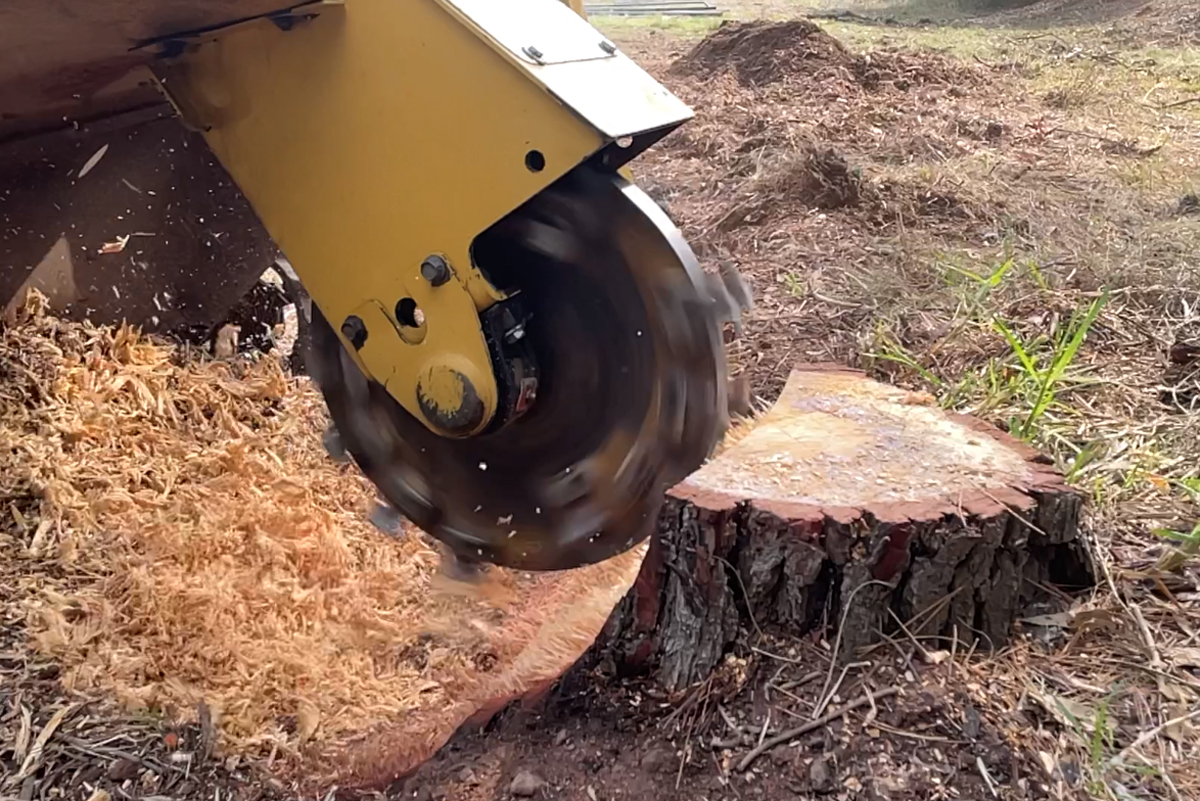
Stump grinding is one of those jobs that looks deceptively simple from the outside. You hire someone with a machine, they chew through the stump, you get your garden back. But if you've ever tried to get a straight answer on how long it'll actually take — or why two quotes for the same-sized stump can vary by hours — you'll know that the reality is more nuanced than it first appears.
The honest answer: most stumps on the Northern Beaches take between 30 and 90 minutes to grind. But that range obscures a lot. A small, accessible, softwood stump might be done in 15 minutes. A large Angophora or Sydney Blue Gum stump with a wide root flare on a steeply sloped block can take three hours or more — and that's before factoring in access difficulties or the depth of grinding required.
This guide covers every factor that affects stump grinding duration, why Northern Beaches conditions create specific considerations not seen in other parts of Sydney, and exactly what to expect on the day. If you want to understand what you're getting before you call for a quote, read on.
The Quick Answer: Stump Grinding Time by Size
Here's a realistic reference table before we get into the detail. These times are based on a typical accessible stump of average hardness — the factors below will push times higher for harder species, difficult access or extensive root flares.
| Stump diameter | Approx. grinding time | Typical species examples |
|---|---|---|
| Under 25 cm | 15–30 minutes | Lilly pilly, small palm, camellia |
| 25–50 cm | 30–60 minutes | Paperbark, smaller eucalypt, Jacaranda |
| 50–80 cm | 1–2 hours | Cocos palm, mid-size gum, Turpentine |
| 80 cm+ | 2–4+ hours | Large Angophora, Sydney Blue Gum, old-growth hardwood |
These times cover active grinding only. Allow an additional 20–30 minutes per job for machine setup, positioning and post-grind cleanup — regardless of stump size.
What Does Stump Grinding Actually Involve?
Before getting into what drives duration, it helps to understand what's physically happening. A stump grinder is a machine with a rotating cutting wheel studded with tungsten carbide teeth. The operator sweeps the wheel back and forth across the stump face, progressively cutting the wood into chips and sawdust — grinding down layer by layer until the stump is below ground level.
Each pass of the wheel removes 20–50mm of material depending on the machine's power and the wood density. For a large, hard stump, this can mean dozens of passes — which is why dense native species take substantially longer to grind than softwoods of the same diameter.
At The Living Canopy, our stump grinding service uses a compact, track-mounted machine that fits through a standard side-gate opening (around 800mm) and handles most stumps on Northern Beaches residential properties without needing to remove fencing or bring equipment over rooflines. For larger stumps with wide access, we bring a more powerful machine accordingly.
7 Factors That Affect How Long Stump Grinding Takes on the Northern Beaches
1. Stump Diameter
This is the primary variable. Stump width determines the surface area that needs to be ground — and because the grinder works in passes, a stump that is twice the diameter takes considerably more than twice as long. Surface area scales with the square of the radius: a 60cm stump is roughly four times the work of a 30cm stump, not twice.
Arborists measure stump diameter at ground level. If the stump has a pronounced root flare — widening noticeably at the base — the effective grinding area is larger than the trunk diameter above suggests, and this is factored into any honest quote.
2. Wood Density and Tree Species
This is where Northern Beaches properties often differ significantly from the rest of Sydney. The area has a high density of large native hardwoods — Angophora costata (Sydney Red Gum), Sydney Blue Gum (Eucalyptus saligna), Turpentine (Syncarpia glomulifera), Spotted Gum (Corymbia maculata) — and these species are among the hardest timbers in Australia.
The density difference is material. A 60cm Angophora stump can take two to three times as long to grind as a 60cm Cocos palm stump or a 60cm Jacaranda stump. The grinder's teeth work harder, wear faster, and must make more passes per layer of material removed. Experienced operators factor this in when quoting. If your stump is from a large native hardwood, expect the time and cost estimates to reflect the additional work involved.
3. Root Flare and Surface Roots
Many large gum trees and Angophoras on the Northern Beaches have pronounced surface roots that radiate outward from the base. If you want those surface roots removed — for aesthetics, to level the ground, or to prevent a tripping hazard — each root run is additional work beyond the stump itself.
A trunk-only grind is faster; an extended grind that includes significant surface roots can add an hour or more to total job time. When requesting a quote, be specific about which surface roots you want included. A stump grind that includes 2–3 significant surface root runs is a meaningfully different job to a stump-only grind.
4. Grinding Depth Required
Standard grinding depth is 150–300mm below ground level, sufficient for re-turfing, garden beds and most landscaping. If you need to lay a concrete slab, install a pool, or build a retaining wall directly over the stump area, deeper grinding is needed — and each additional 50mm of depth adds machine time.
For the majority of Northern Beaches residential jobs, standard depth is fine. The exception is when construction is planned for the exact location of the former tree — in which case, discuss depth requirements upfront during the quote so the right equipment is brought.
5. Site Access
Getting the stump grinder to the stump is the prerequisite for everything else. On flat, wide-access blocks with double garages, it's straightforward. But many Northern Beaches properties — particularly in Avalon, Newport, Whale Beach, and across the peninsula's eastern face — have narrow side gates, steep driveways, sloping blocks or terraced gardens.
Tight access means using a smaller machine, which typically has less power and grinds more slowly. Steep slopes require additional care and machine-positioning time. If access requires temporarily removing part of a fence, that adds time before grinding starts. Properties in Narrabeen, Mona Vale and Newport vary enormously in this regard — describe your access situation when you call so we can bring the right equipment from the start.
6. Number of Stumps
Multiple stumps in the same job don't increase time proportionally. Machine setup, travel and delivery are fixed costs per visit, not per stump. If you have three stumps to grind, the efficiency gain of doing them all at once is significant — and we offer a reduced rate per additional stump in the same visit.
The grinding time for each stump is still driven by its individual size and species, but if you are even considering a second stump somewhere on the property, book it alongside the first. It will be cheaper and less disruptive than two separate visits.
7. Soil and Sub-Surface Conditions
Northern Beaches soil is predominantly sandy — which is generally helpful for stump grinding. Sandy soil doesn't compact tightly around root flares the way heavy clay does, and the grinder can access the base of the stump more easily. The main local exception is Hawkesbury Sandstone, which sits close to the surface in parts of Narrabeen, Warriewood and Belrose. Where bedrock is shallow, achievable grinding depth may be limited before the machine reaches rock.
Underground services near the stump — irrigation pipes, garden lighting cables, water lines or comms conduit — also slow the job, as the operator needs to work carefully around them. Flag any known underground services during the quote phase so we can plan accordingly.
What to Expect on the Day
Most stump grinding jobs on the Northern Beaches follow a predictable sequence:
- Arrival and site check. The operator confirms the stump location, checks for underground services and overhead hazards, and positions the machine for the most efficient grinding angle. This typically takes 10–20 minutes.
- Grinding. The cutting wheel is engaged and the operator works across the stump face systematically, layer by layer. For a typical mid-size job, this is 30–60 minutes of active grinding.
- Root runs (if in scope). If surface root removal is included, the operator follows each root run from the stump outward, grinding flush with the ground.
- Backfilling. The mix of sawdust and wood chips produced during grinding is used to fill the void left by the stump. The void is raked and levelled, leaving a tidy, workable surface.
- Cleanup. Excess chips are cleared from the surrounding lawn and garden beds. On most jobs this leaves the site ready to turf or landscape over directly.
Stump grinders are noisy — comparable to a large lawnmower or chainsaw. Our standard start time is 7:30am, which complies with Northern Beaches Council's noise regulations for residential areas. If your property or strata has specific noise restrictions, let us know in advance.
What to Do After Stump Grinding
After grinding, you're left with a void filled with a mixture of sawdust, wood chips and loose soil. This material is useful — it will break down into organic matter over time — but it needs managing before you turf or replant over the area.
For re-turfing: The void will compact and settle over the weeks following grinding as the mulch breaks down. Top it up with quality topsoil, tamp lightly, and allow 2–4 weeks to settle before laying turf. Rushing this step often results in a soft, uneven patch that subsides later.
For replanting a new tree: Wait 6–12 months for the remaining root material to decompose before planting in the same spot. Fresh wood chip creates nitrogen drawdown as it breaks down — drawing nitrogen out of the soil and away from young root systems. Mixing the void with compost and allowing time for the chip to decompose gives a new tree a much better start. If you want to replant sooner, ask us to remove more root material during the grind.
For garden beds: The sawdust and chip can be spread thinly over adjacent garden beds as a mulch layer. Avoid piling it against plant crowns or trunk bases — keep the mulch 100mm clear of any stems.
Can I Hire a Stump Grinder and Do It Myself?
Stump grinders are available for hire from equipment suppliers, and for a small, accessible stump from a non-hardwood species, DIY grinding is feasible. For the kind of large-diameter native hardwood stumps that are common across Northern Beaches properties, we'd generally advise against it.
The practical reasons: hire machines are significantly less powerful than commercial equipment, meaning they take much longer and create more operator fatigue on hard timber; the machines throw debris at velocity and require appropriate PPE and experience to operate safely; and for dense hardwoods, an underpowered hire machine often cannot achieve the depth or clearance that a professional result requires.
The cost difference between DIY and professional stump grinding is often smaller than people expect once hire fees, fuel, cleanup and the time involved are factored in. If you're on the fence, send us a photo and we'll give you an honest assessment of whether it's worth hiring a machine or calling us.
Stump Grinding Cost on the Northern Beaches
Full pricing is covered on our stump grinding service page. As a 2026 guide for Northern Beaches properties:
| Stump size | Price range (incl. GST) | Notes |
|---|---|---|
| Small (under 25 cm) | $200–$350 | Standard depth, good access |
| Medium (25–60 cm) | $350–$600 | Varies by species and access |
| Large (60–80 cm) | $600–$900 | Higher for dense hardwoods |
| Extra large (80 cm+) | $900–$1,500+ | Large Angophora, Sydney Blue Gum with root flare |
Multiple stumps in the same visit attract a reduced rate per additional stump. For a firm written quote, call us on 0452 030 077 or use the free quote form. We cover the full Northern Beaches, including Dee Why, Collaroy, Narrabeen, Mona Vale, Newport and through to Palm Beach.
For broader context on tree removal and associated costs across Sydney in 2026, our cost guide has full detail. For stump-specific pricing by diameter and species, see our 2026 stump grinding cost guide for the Northern Beaches.
Need a stump removed on the Northern Beaches?
Free written quotes with no obligation. Tell us the stump size, species (if you know it) and access situation — we'll give you an accurate time and cost estimate with no surprises on the day.
Get a free stump grinding quoteFrequently Asked Questions
How long does stump grinding take?
Most stumps take between 30 and 90 minutes to grind. A small, accessible softwood stump can take 15–30 minutes; a large hardwood stump from a native species like Angophora, Sydney Blue Gum or Turpentine — particularly one with extensive surface roots — can take 2–3 hours or more. The main factors are stump diameter, wood density, root spread, access to the site, and the depth of grinding required.
How deep does a stump grinder go on the Northern Beaches?
Standard stump grinding goes 150–300mm below ground level, which is sufficient for most lawn, turf and landscaping purposes. If you plan to concrete over the area or install a permanent structure, deeper grinding may be required. Sandy Northern Beaches soil makes deeper grinding generally more straightforward than clay-based soils further inland, though Hawkesbury Sandstone close to the surface in some areas can limit achievable depth.
Do I need a council permit for stump grinding on the Northern Beaches?
In most cases, no separate permit is needed — the permit applies to the tree removal, not the stump removal. However, if the tree required development consent or a significant removal approval, confirm with Northern Beaches Council that stump removal is covered under the same approval. Cocos palms and other exempt species never require a permit for stump grinding.
Can I plant a new tree where a stump has been ground?
Yes, but wait 6–12 months for the remaining root material to decompose first. Fresh wood chip in the void creates nitrogen drawdown as it breaks down, which can affect young trees. Mixing the void material with compost and waiting for the chip to break down gives new plantings a much better start. If you want to replant sooner, ask us to remove more root material during the grind.
Is stump grinding better than full stump removal?
For most residential properties on the Northern Beaches, yes. Stump grinding is faster, less disruptive to the surrounding garden, and leaves the root system to decompose naturally underground. Full removal — excavating the entire root ball — is destructive, expensive and rarely necessary unless you're building a structure directly over the area. The main advantage of full removal is that nothing remains underground, which matters in specific construction contexts.