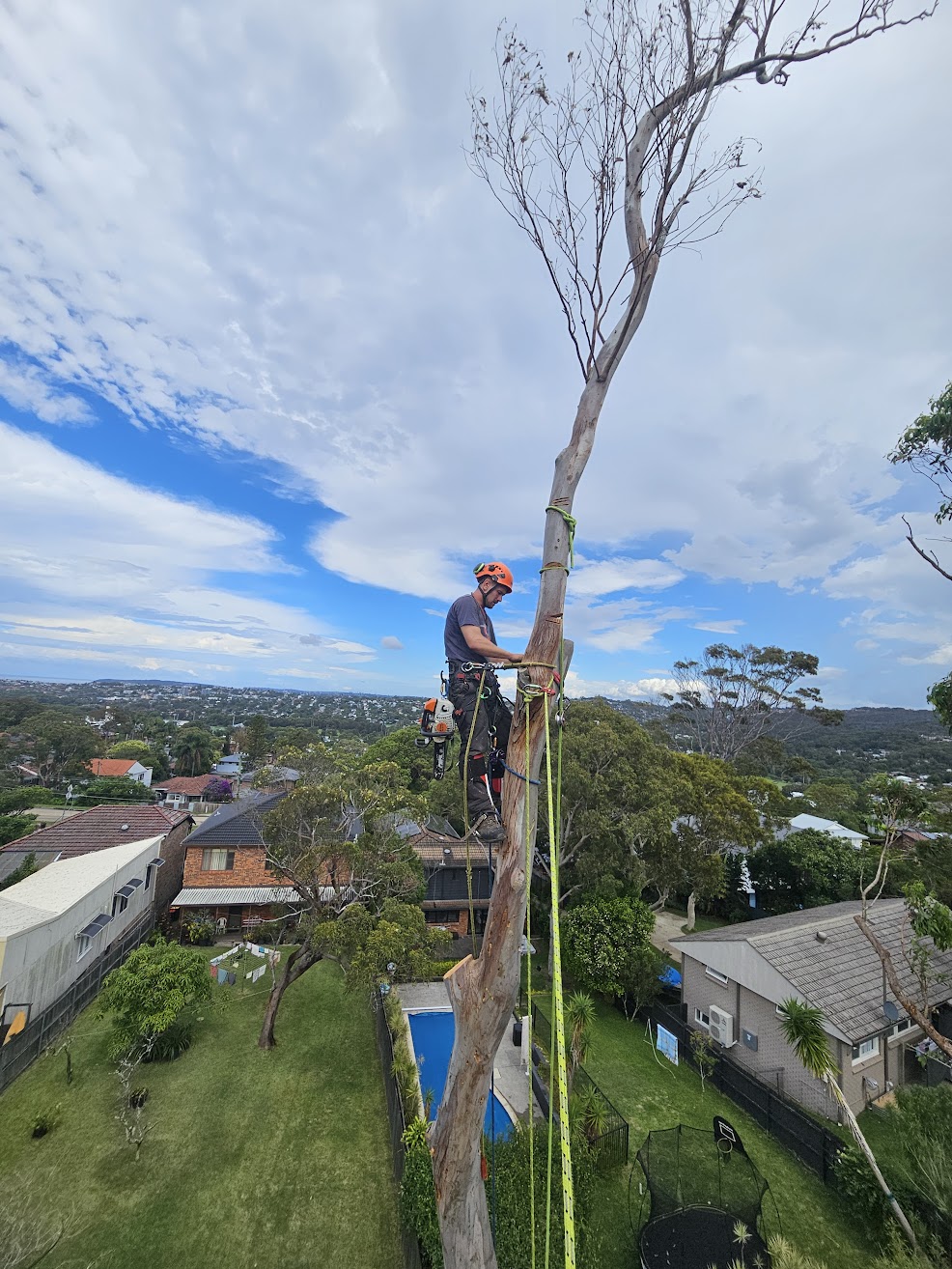
The Northern Beaches has some of the most challenging residential tree removal sites in Sydney. Steep sandstone blocks where machinery can't operate. Properties with no side access whatsoever — just a front door and a narrow gate that a chipper truck will never fit through. Cliff-edge homes where the backyard drops away behind the house. Pittwater waterfront properties accessible only by boat. Dense, established gardens where the nearest drop zone is someone else's roof.
If you've called a couple of tree services and been told "we can't do that one" or received a quote so high it seemed impossible to justify, the access is almost certainly why. Tight access is not a deal-breaker — but it does change the method, the equipment, the time required, and the cost of the job. This guide explains how arborists approach restricted-access tree removal on the Northern Beaches: what methods are used, what equipment gets deployed, and what you should expect to pay in 2026.
What Makes a Tree Removal "Tight Access"?
There is no fixed definition, but tight access generally means one or more of the following conditions apply:
- No vehicle access to the work zone. The chipper, truck, or any vehicle capable of handling timber cannot reach the tree's location. Material has to be carried, wheeled, or craned out rather than driven to a machine.
- Narrow gate or access path. The only external access to the backyard is a side gate under 1.2m wide, a pathway too narrow for any equipment, or a passage with low overhead clearance.
- Steep gradient. The working zone is on a slope too severe for machinery to operate safely — typically above about a 1-in-4 gradient for most tracked equipment, though this varies by machine.
- No safe drop zone. There is nowhere nearby to put timber sections as they are removed — a condition that effectively forces every section to be rigged, lowered precisely, and immediately moved from the area.
- Waterfront or island access only. The property can only be reached by water, meaning all equipment must be transported by barge, tinnie, or ferry.
Many Northern Beaches jobs involve a combination of these factors. A property in Avalon might have a 900mm side gate, a 1-in-3 slope in the backyard, and a large spotted gum overhanging the neighbour's garage. That's three access constraints working together, each of which pushes the job toward a more specialised — and more expensive — solution.
Why Northern Beaches Properties Have Unique Access Challenges
The Northern Beaches presents a specific combination of geography, housing stock, and vegetation that makes restricted-access jobs more common here than in other parts of Sydney.
The terrain. Much of the peninsula runs north–south along a sandstone ridge, with steep east- and west-facing slopes dropping to beaches, lagoons, and bays. Properties on Queenscliff Hill, the ridgelines above Narrabeen, the Pittwater foreshore at Church Point and Scotland Island, and the clifftop streets of Avalon and Bilgola all have significant gradient. Machinery that works fine on a flat Chatswood block can't operate safely at a 25-degree slope.
The housing stock. Much of the Northern Beaches was developed in the 1960s and 1970s on standard 600–900m² blocks that share boundaries tightly. Side setbacks are often minimal, gates are narrow, and the distance between houses leaves little room to manoeuvre machinery. Sandstone retaining walls — a near-universal feature of Northern Beaches landscaping — add obstacles and complicate the routing of timber out of a site.
The vegetation. The peninsula retains large amounts of established bushland, and many residential properties are surrounded by or contain significant native trees — angophoras, spotted gums, turpentines, banksias — that have grown to 15–25 metres over decades. These trees predate the houses in many cases and are now in positions that simply weren't anticipated when they were young. Removing a 20-metre angophora from a backyard you can barely fit through sideways is a fundamentally different job from removing the same tree in a paddock.
Waterfront and island properties. Scotland Island, Elvina Bay, Morning Bay, and the Pittwater foreshore at Newport and Church Point include properties with no road access at all. Every piece of equipment — and every piece of timber — travels by water. This adds a logistics layer that most tree companies don't handle and that affects both pricing and scheduling.
The Four Methods Used for Tight-Access Tree Removal
The method an arborist selects depends on the specific combination of constraints at the site. Most tight-access jobs use a combination of these approaches rather than a single method.
1. Rope Rigging by Climbing Arborist
This is the most commonly used method for restricted-access removal on the Northern Beaches and the one that works in the widest range of situations. A climbing arborist ascends the tree and systematically removes sections from the top down, attaching a lowering rope to each section before it is cut free. The rope is controlled from below using a friction device (typically a Port-A-Wrap or similar) that allows the ground crew to lower the section to precisely the landing zone they choose.
Good rope rigging technique can place a 200kg section of timber exactly where you need it — including onto a tarpaulin in the middle of a small garden bed — without damaging anything. It requires a suitable rigging point above the section being cut (usually a sturdy limb or the trunk above the cut), a clear rope path, and an adequate anchor point for the lowering device. For most trees in restricted spaces, this combination of conditions can be achieved even in tight situations.
The limit of rope rigging is load weight. The rigging system has a maximum safe working load, and very large sections of heavy timber — the base of a mature spotted gum, for example — may exceed what rigging can safely control. At that point, you need either a crane or a different approach to the lower trunk.
2. Spider Crane or Mini Crane
A spider crane is a compact, tracked lifting machine that can walk through a gate opening as narrow as 750–800mm, fold its outriggers to pass through obstacles, and operate on slopes up to 20–25 degrees. Once inside the work zone, it deploys its outriggers and operates as a conventional crane with a rated lifting capacity, giving the team precise control over where heavy sections go.
Spider cranes are increasingly common on the Northern Beaches for jobs where rope rigging alone can't control the loads safely, but where a conventional mobile crane positioned on the street can't reach the work zone. They are particularly useful on steep blocks, in enclosed backyards, and in situations where sections need to be lifted out over fences or retaining walls. The hire cost and mobilisation for a spider crane typically adds $1,500–$3,500 to a job, which is substantially less than a full mobile crane operation but more than rope rigging alone. See our guide to crane-assisted tree removal on the Northern Beaches for more detail on crane options.
3. Pack-Out by Hand or Power Barrow
For sites where no crane can reach and the volumes of timber are manageable, material is carried or wheeled out manually. Timber is bucked (cut) into carry-sized pieces on site and then removed piece by piece along whatever exit path exists — through a side gate, up a path, through the house if necessary.
This is slow, labour-intensive work. A crew of four carrying timber out of a steep backyard for three hours produces a small pile of chips and a lot of sore backs. It's the method of last resort in terms of efficiency — but it works, and it's the reason a capable arborist can get a tree out of a property even when nothing else will fit. Power barrows (electric-assist motorised wheelbarrows) help significantly on sloped terrain, allowing larger loads to be moved with less effort on gradients that would be difficult with a standard wheelbarrow.
The cost impact is primarily time: pack-out adds substantially to crew hours, which is why tight-access jobs with no alternative exit route carry a premium. Always ask for a breakdown of how the arborist plans to remove the timber — the answer tells you a lot about whether the quote reflects reality.
4. Street-Positioned Crane Reaching Over the Property
For very large trees in very restricted sites, a telescopic crane positioned on the street can sometimes reach over the house or fence line to lift sections directly to a truck. This is the same equipment used for standard crane removals, but the work is done with the crane positioned outside the property altogether — only the boom extends over. It requires a clear swing path, sufficient boom reach (which affects crane size and cost), and appropriate road occupancy permits. On Narrabeen and Newport properties near the main roads, this approach can sometimes be simpler than trying to get any equipment into the backyard at all.
What Tight-Access Tree Removal Costs in 2026
Access difficulty is one of the biggest variables in tree removal pricing. See our full tree removal cost guide for the Northern Beaches for standard pricing. For tight-access jobs specifically:
| Access type | Typical cost premium | Main cost driver |
|---|---|---|
| Narrow gate (900mm–1.2m), level ground | +20–40% | Pack-out labour |
| No side access, timber through house | +40–70% | Labour + site protection |
| Steep block (1-in-3 or steeper) | +30–60% | Crew time + safety rigging |
| Spider crane required | +$1,500–$3,500 | Equipment hire + mobilisation |
| Waterfront / barge access | +$600–$1,800 | Vessel hire + logistics |
These premiums are additive — a steep block with no side access and a spider crane requirement can easily push the total cost 100% above the baseline for the same tree on a flat, accessible site. That said, the premium reflects real additional cost: more crew hours, specialised equipment, and slower work. A quote that doesn't account for these factors is either wrong or being underwritten somewhere else.
How to Prepare Your Property for a Tight-Access Job
A few things you can do to help the job go smoothly:
Clear the access path. Remove pot plants, garden furniture, bikes, and anything else that narrows the route from the backyard to the street. Every centimetre counts when you're moving timber through a narrow passage.
Unlock gates before the crew arrives. This sounds obvious, but an arborist crew spending 20 minutes locating a key holder on the morning of a job adds time to the bill. Have the gates unlocked and any combination codes communicated in advance.
Protect your floors. If timber is coming through the house, lay down dust sheets or drop cloths over carpets and hardwood floors before the crew arrives. Good arborists will bring their own protection, but supplementing it with your own covers is worthwhile on valuable surfaces.
Tell the arborist about any constraints they can't see. Underground water lines, power conduits to sheds, irrigation systems, and drainage that isn't visible from the surface all affect where timber can land and where machinery can operate. If you know something is there, say so.
Discuss stump grinding access separately. On tight-access sites, stump grinding is often a separate visit — the stump grinder may need a different access configuration or may need to wait until the removal debris is cleared. Confirm this with your arborist before booking.
Tight-Access Suburb Profiles: Northern Beaches Hotspots
Some suburbs on the Northern Beaches produce a disproportionate share of tight-access jobs. If you're in one of these areas, expect access to come up in your arborist assessment:
Avalon and Bilgola. The steep valley runs between the Pacific Highway and the beachfront here produce some of the most technically challenging jobs on the peninsula. Many properties have no rear vehicle access, significant gradient from back to front, and large established angophoras and spotted gums that have been growing for 60+ years.
Newport and Pittwater foreshore. Waterfront properties require barge logistics for any job that requires more than what can be carried by hand. Scotland Island and the Pittwater basin properties have no road access at all, making every job a water logistics exercise.
Narrabeen and North Narrabeen lagoon-side. Properties backing onto the lagoon at North Narrabeen have limited rear access, and the terrain rises sharply west of Pacific Parade. These sites regularly combine steep gradients with no side access.
Manly and Fairlight. Older terrace-style properties with very narrow lots and no side access are common in the Manly–Fairlight corridor. Many of these jobs involve taking timber through the house as the only viable exit route.
Frenchs Forest and Belrose. The bushland blocks here are typically larger and have more room than beachside suburbs, but properties abutting the national park boundary often have trees growing on near-vertical terrain with no access from the reserve side at all.
Difficult access? Let's take a look.
We work across the Northern Beaches and regularly handle tight-access, steep-block, and waterfront jobs. Call or send us a photo and we'll tell you what's involved before you commit to anything.
Book a free site inspectionFrequently Asked Questions
How much extra does tight access add to tree removal costs on the Northern Beaches?
Tight access typically adds 30–80% to the base cost of tree removal, depending on how restricted the access is and what equipment is required. Jobs requiring a spider crane or significant hand pack-out can add $1,500–$3,500 on top of the removal cost. The main cost drivers are extra crew time and any specialised equipment hire needed to work around the constraints.
What do arborists use when a crane or chipper can't access the backyard?
Rope rigging by a climbing arborist is the most commonly used method — it works in tight spaces, requires no access for machinery, and can place heavy timber sections precisely where needed. Spider cranes (compact tracked cranes that fit through 800mm gates) are used when loads exceed what rope rigging can safely handle. Hand carry and power barrows cover the most restricted sites where no equipment can enter at all.
Can arborists remove a tree by taking timber through the inside of the house?
Yes — this is more common than most homeowners expect, particularly on terrace properties and cliff-edge homes on the Northern Beaches with no side access. Timber is cut into manageable pieces and carried through internal spaces to the front door. The arborist team will protect floor surfaces and door frames. It adds time and cost but is a legitimate and frequently used method for locked-in backyards.
What is the narrowest gate opening a spider crane can get through?
The most compact spider cranes can pass through gate openings as narrow as 750–800mm. Most standard Northern Beaches side gates (900mm–1.2m) are accessible. Where the opening is narrower or there are steps or level changes at the entry, a spider crane may not work — and the job reverts to rope rigging and hand-carry methods.
Does tight access mean I automatically need a spider crane?
No — most tight-access removals on the Northern Beaches use rope rigging and climbing arborists, without any crane. A crane becomes relevant when the tree is too large for rope rigging to control safely, when the tree is dead or unsafe to climb, or when a crane can access the site but rope rigging can't work within the space constraints. A site inspection determines which approach is right.
How do arborists remove timber when there's no vehicle access on a steep block?
Power barrows, temporary chutes, hand carry, and a chipper positioned as close to the exit as possible are the main options. On steep blocks near a main road, a street-positioned crane can sometimes lift chipped or cut timber over the fence to a truck, which is faster than multiple trips by hand. The approach depends on the specific slope, the volume of material, and the distance to the road.