Most tree removals don't need a crane. An experienced climbing arborist with good rope rigging can take down trees of almost any size, piece by piece, using controlled lowering techniques that keep timber well clear of structures and people below. It's the standard method for good reason — it's versatile, it works in tight spaces, and the cost stays manageable.
But there are situations where climbing just isn't the right call. A large tree sitting squarely over a tiled roof with no safe drop zone. A dead or structurally compromised tree where the internal decay makes climbing a serious risk to the arborist. A block so steep that a conventional chipper and rigging setup can't safely operate. A tree so large that the weight of individual sections would overwhelm what rope systems can safely control.
In those situations, crane-assisted tree removal is the appropriate method — not a premium upgrade, but the correct tool for the job. This guide explains when a crane is genuinely needed on the Northern Beaches, how the process works from start to finish, and what it costs in 2026.
What Is Crane-Assisted Tree Removal?
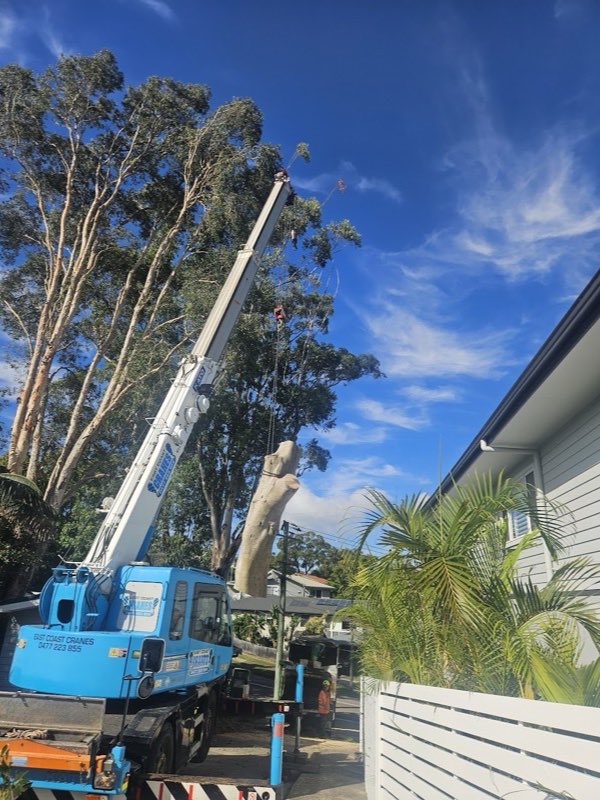
Crane-assisted tree removal involves using a mobile crane — positioned on the street, driveway, or adjacent property — to lift sections of a tree as they are cut, moving them clear of structures, fences and garden beds before they can fall. An arborist climbs or works at height to cut sections, which are attached to the crane's lifting line before being cut free. The crane operator then swings the load to a clear zone where the section is lowered to the ground and processed by the ground crew.
The key distinction from conventional removal is control. In a standard rigging setup, sections are lowered on ropes — which works well for most situations, but has limits in terms of load weight and the precision with which a load can be placed. A crane gives the team far greater control over where heavy sections go, and removes the arborist's need to be in a tree that may be structurally unsafe.
Several types of crane equipment are used for tree removal on the Northern Beaches depending on the site:
- Telescopic mobile cranes — positioned on the street, with a boom that can extend over houses to reach trees in backyards. The most common type for large crane jobs.
- Spider cranes / mini cranes — compact, tracked units that can walk through a standard gate (as narrow as 800mm on some models), operate on steep slopes, and work in tight spaces where a standard mobile crane can't go. Increasingly common on Northern Beaches properties with narrow access.
- Knuckleboom loader cranes — truck-mounted cranes primarily used for timber handling on site rather than lifting from height. Often part of a crane crew's equipment regardless of whether a mobile crane is used.
Selecting the right crane for the job is part of the arborist's planning process. It's one reason why a site inspection before quoting isn't optional — the equipment requirements can change the cost significantly.
When a Crane Is the Right Call
Understanding when crane removal is genuinely necessary (versus when an arborist is recommending it as a convenient premium) is useful when you're getting quotes. These are the scenarios where a crane is the correct method:
The tree is directly over a structure with no safe drop zone. When a large tree is positioned so that no section can be safely lowered without risk of landing on a roof, fence, pool, or neighbouring property, crane extraction is the right response. The crane lifts each section clear and swings it to a safe zone. This is one of the most common reasons for crane jobs on the Northern Beaches, where many homes sit in close proximity to large established trees.
The tree is dead or structurally unsound. Climbing a tree with advanced decay, extensive borer damage, or root failure is a serious safety risk. When internal rot has compromised the structural integrity of the trunk or major limbs, conventional climbing may not be safe. In these cases, the arborist works from an elevated work platform or a cherry picker while the crane handles the sections — or in some cases, the tree is felled in a controlled direction with crane assistance rather than dismantled in sections.
Limited or no access for conventional machinery. Northern Beaches properties are notoriously challenging: steep blocks, narrow gates, sandstone retaining walls, and dense landscaping can make it impossible to get a chipper close to the work zone. When the terrain makes conventional rigging and machinery impractical but the tree is too large for hand work, crane equipment changes what's possible. See our full guide to tight-access tree removal on the Northern Beaches for a breakdown of all the methods used when conventional access isn't available.
Time-critical situations. In some emergency tree removal scenarios — a tree that has partially failed after a storm, or one that poses an imminent hazard — a crane can dramatically reduce the time required to make the site safe. The speed of crane extraction, compared to the careful, section-by-section work of conventional rigging in a compromised tree, can be decisive when safety is urgent.
Steep blocks where rigging cannot be safely set up. Properties on the steep gullies and hillsides around Narrabeen, Newport, and the ridgelines above Dee Why often present terrain challenges that rule out conventional ground-based rigging. On a steep slope, the physics of lowering heavy timber sections safely become difficult. A spider crane's ability to work on gradients up to 20–25 degrees makes a significant difference in these situations.
Very large or very heavy sections. Rope rigging has practical weight limits. For very large eucalypts, spotted gums, or old-growth trees, the weight of individual sections can exceed what rope systems can safely handle, even with mechanical advantage. A crane's rated lifting capacity provides a level of load control that rope rigging cannot match at the upper end of the weight range.
How a Crane Tree Removal Works — Step by Step
A crane job involves considerably more coordination than a standard tree removal. Here's how a typical job progresses from planning to completion:
1. Site assessment and permit applications. Before any work can be booked, the site is assessed — access, overhead power lines, crane positioning options, load swing path, and landing zone are all evaluated. If the crane needs to be positioned on the street (very common on the Northern Beaches), a Road Occupancy Licence from Transport for NSW and a permit from Northern Beaches Council are required. Allow two to three weeks for these. Your arborist manages the permits, but the lead time affects scheduling.
2. Traffic control setup. On the morning of the job, a traffic control team establishes temporary no-parking zones, sets up barriers, and manages traffic flow around the crane position. This usually needs to be in place an hour before the crane arrives.
3. Crane mobilisation and rigging. The crane arrives and sets up outriggers to stabilise on the road surface. The arborist team rigs the crane line to the first section of the tree to be cut. Ground crew prepare the landing zone.
4. Systematic dismantling. The arborist (climbing, on a platform, or working from a cherry picker, depending on the tree's condition) cuts sections from the top down. Each section is attached to the crane line before being cut free. The crane operator lifts the load clear and swings it to the landing zone, where the ground crew detach it, process the timber, and prepare for the next lift.
5. Stump and root management. Once all timber is removed, the stump is either cut flush with the ground or ground out, depending on the scope of the job and whether a stump grinder can access the site. On steep or narrow-access properties, stump removal sometimes needs to be scheduled as a separate visit.
6. Site clearance. Timber is chipped, loaded, and removed. The site is raked and blown down. Crane outrigger pads are removed and the road is inspected for any surface damage before traffic control clears the zone.
What Does Crane-Assisted Tree Removal Cost on the Northern Beaches?
Crane jobs are more expensive than conventional removals, primarily because of the crane hire cost, permit fees, traffic control requirements, and the additional crew needed to coordinate the lift. The table below gives a realistic 2026 price range for different job types.
| Job type | Tree size | Typical cost range |
|---|---|---|
| Medium tree over structure | 10–15 m | $3,000 – $6,000 |
| Large tree, street crane required | 15–25 m | $6,000 – $12,000 |
| Very large / complex job | 25 m+ | $12,000 – $20,000+ |
| Spider crane (tight backyard access) | Any size | Add $1,500 – $3,500 |
The full cost guide for tree removal on the Northern Beaches covers standard removal pricing in more detail, including the factors that push costs up or down. For a crane job specifically, the main drivers are:
- Crane type and hire duration — a half-day of crane hire typically costs $1,500–$4,000 depending on the crane size and supplier. Spider cranes are often comparable to or slightly cheaper than large mobile cranes for smaller jobs.
- Permit fees and traffic control — traffic management for a lane closure on the Northern Beaches adds $600–$1,500 to most jobs. Council and ROL permit fees are additional.
- Crew size — crane jobs require more people: arborist, crane operator, traffic controllers, and ground crew. Typical crane removal crews are four to six people.
- Site accessibility — the harder the crane is to position and the more complex the swing path around power lines or other obstacles, the longer the job takes.
- Timber disposal — on tight sites where a chipper can't get close, timber may need to be hand-carried or craned out, adding to time and cost.
Be wary of quotes that seem significantly cheaper than these ranges. Crane work involves large lifting equipment, road occupancy, and serious safety obligations. Underpriced jobs often cut corners on permits, traffic control, or insurance.
Does a Crane Job Require a Council Permit?
Two separate approvals are relevant for most crane removals on the Northern Beaches:
Tree removal permit. Most significant trees on the Northern Beaches require a Development Application or an exemption assessment under Northern Beaches Council's tree management policy before removal, regardless of the method used. The crane is irrelevant to this approval — it's about the tree itself. See our guide to council tree removal permits on the Northern Beaches for the full process.
Road occupancy and traffic management. If the crane needs to be positioned on a public road — which is the case for most crane jobs where the driveway or property can't accommodate the equipment — you need a Road Occupancy Licence from Transport for NSW and a permit from Northern Beaches Council covering the temporary no-parking zone, lane closures, and any kerb-to-kerb occupation. These permits are managed by the arborist as part of the job. They take time to process, typically two to three weeks, and can be longer during busy periods. Getting them in early is critical to keeping your job on schedule.
If your job involves power line clearance on top of removal, there may be additional requirements for working near Ausgrid infrastructure. Your arborist will identify this during the site assessment.
Common Crane Jobs on the Northern Beaches
The Northern Beaches landscape creates a specific and recurring set of crane scenarios. If your situation matches one of these, a crane is likely the right method:
Large eucalypts and angophoras over rooflines in Newport, Avalon and Mona Vale. Many homes in these suburbs were built beneath existing bush and now have large eucalypts sitting squarely over roof ridges. When those trees become hazardous or need removal, there's simply no safe way to take them down without crane extraction of the upper sections.
Dead or storm-damaged trees on steep Narrabeen and Ingleside blocks. The steep ridgelines behind the lagoon produce some of the most challenging removal scenarios on the peninsula. Dead trees on a 1-in-3 gradient with nowhere to drop sections safely are a recurring job type for us.
Large pines in Dee Why, Brookvale and Manly. Radiata and Canary Island date palms — and tall monterey and stone pines — were planted extensively through the middle part of the peninsula. Many are now over 20 metres and surrounded by houses. Crane work is often the only viable method for the upper sections.
Overwater and cliff-edge removals. Properties on the Pittwater foreshore, the Manly Lagoon edge, and cliffside blocks at Collaroy and Narrabeen Bluff present situations where there's simply nowhere on the property for a section to land. The crane lifts sections out and swings them to a truck on the road — sometimes the only physically possible approach.
Post-storm emergency extractions. When a large tree has partially failed and is leaning on a structure after a storm, crane removal is often faster and safer than trying to cut it off a roof using conventional rigging. The crane stabilises the tree while sections are removed systematically, rather than working under an unpredictable load.
Need a crane removal quote?
We handle crane-assisted tree removal across the Northern Beaches, including permits, traffic management, and full site clearance. Call us for a site inspection and detailed quote.
Book a site inspectionFrequently Asked Questions
How much does crane-assisted tree removal cost on the Northern Beaches?
Crane-assisted tree removal typically costs $3,000–$6,000 for medium trees (10–15m) over structures, $6,000–$12,000 for large trees (15–25m), and $12,000–$20,000+ for very large or complex jobs. The crane itself generally adds $1,500–$4,000 to the base removal cost depending on the type of crane and the number of hours required. Getting a site-specific quote is essential — access, tree size, and positioning above structures all affect the price significantly.
When does a tree removal actually need a crane?
A crane is needed when a tree sits directly over a structure with no safe drop zone, when a tree is dead or structurally unsound and too dangerous to climb, when there is no safe rigging point to lower sections conventionally, when the block is too steep for machinery but the tree is too large for hand work, or when the weight of individual sections exceeds what rope rigging can safely control. Most removals don't need a crane — an experienced arborist will recommend one only when the site genuinely calls for it.
Do I need council permission to use a crane on the street?
Yes. If the crane needs to be positioned on a public road — which is common on the Northern Beaches — you need a Road Occupancy Licence from Transport for NSW and a permit from Northern Beaches Council. These cover lane closures, temporary no-parking zones, and traffic control. Your arborist handles all of this as part of the job. Allow two to three weeks for permit processing when planning a crane removal.
How long does a crane tree removal take?
Most crane-assisted tree removals are completed in a single day. A medium tree over a roof might take four to six hours from crane arrival to site clearance. Very large trees or jobs requiring multiple lifts can run to two days. The permit and logistics process — traffic control, no-parking zone setup, crane mobilisation — often takes longer than the removal itself. Planning ahead and getting permits in order early avoids delays.
Is crane removal safer than a climbing arborist?
For the specific scenarios where a crane is recommended, yes. When a tree is structurally unsound or dead, climbing it poses a real risk. When a tree sits over a building, crane-lift extraction removes the risk of sections falling onto the structure. However, crane work has its own risks — overhead power lines, load management, and ground conditions all need careful assessment. The safest outcome comes from matching the right method to the site.
Can a mobile crane access a tight Northern Beaches backyard?
It depends on the access and crane type. Many Northern Beaches properties have narrow side gates and steep blocks that a standard mobile crane cannot reach. Spider cranes — compact tracked units that walk through an 800mm gate opening and operate on steep slopes — are often the solution. For properties where no crane can reach the backyard, a street-positioned telescopic crane with sufficient reach may be the only option. A site inspection is the only way to determine what equipment will work.