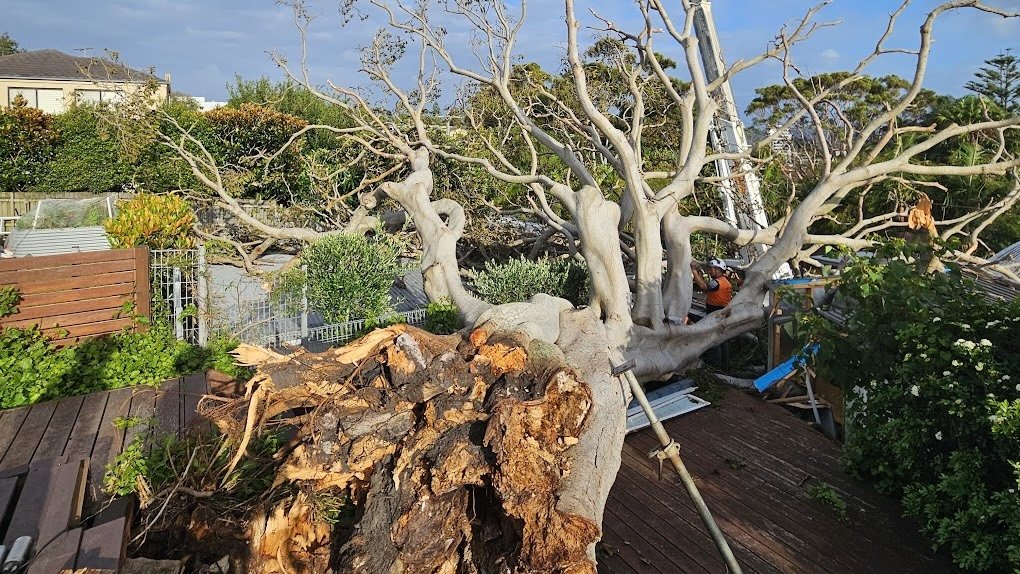
A large tree across your roof at 11pm. A eucalypt partially uprooted and leaning over the neighbour's fence after a nor'easterly. A dead Angophora split at the crotch, one half suspended over the driveway. Emergency tree removal on the Northern Beaches is something we deal with year-round — and the way these jobs unfold is different from a standard removal in almost every respect. Different risk profile, different urgency, different council rules, different cost, and a different process for claiming on insurance if there's damage involved.
This guide covers exactly what constitutes a tree emergency, what you should and shouldn't do while you're waiting for the arborist to arrive, what emergency tree work actually costs in 2026, how Northern Beaches Council's exemption rules work, and what you need to document for an insurance claim. The goal is to give you the information you need when you're in a stressful situation and need clear, practical answers quickly.
What Counts as a Tree Emergency — and What Can Wait
Not every hazardous or damaged tree is a same-night emergency. Understanding the difference helps you get the right level of response at the right cost.
Genuine emergencies — call immediately:
- A tree or large branch has made contact with a structure (roof, wall, outbuilding)
- A tree is touching live power lines — call Ausgrid on 13 13 65 first, then an arborist
- A tree has partially uprooted and is actively leaning or shifting
- A large tree has split and one half is suspended, supported only by the other half or a structure below
- A tree is blocking emergency vehicle access to your property
- A tree is directly threatening a person sheltering in a building
Urgent but not an overnight callout:
- A tree has lost significant branches in a storm but is still standing with no contact with structures
- A tree is leaning noticeably but appears stable and is not over a structure
- Dead branches have fallen in the garden — none on a structure, none near where people would stand
- A tree you've been watching for a while has deteriorated after recent weather
For the second category, most reputable Northern Beaches arborists will get to you within 24–72 hours. Treating it as an emergency callout when it isn't will cost you significantly more without improving safety outcomes.
If you're genuinely unsure, call your arborist and describe the situation. Most will give you an honest risk assessment over the phone, or ask for a photo. For background on the signs that a tree is approaching a hazardous state, see our guide on how to tell if a tree is dangerous.
What to Do While You Wait for the Arborist
The period between discovering the problem and the arborist arriving is when most additional injuries and damage occur. Follow these steps:
- Keep everyone away from the tree and the fall zone. Establish a clear perimeter well beyond where the tree or any part of it could reach if it moves further. A partially failed tree can shift without warning.
- If there's contact with power lines, treat the entire area as live. Do not touch the tree, any metal structures it's in contact with, or any water running away from the site. Call Ausgrid on 13 13 65 immediately. They prioritise these situations and will disconnect supply if required before an arborist can safely begin.
- If a tree has damaged a roof, do not enter the building until it has been assessed. Falling material, structural compromise, and electricity hazards are all possible. Call your insurer immediately to start the claim process and notify them you have an emergency arborist on the way.
- Photograph everything from a safe distance before any work begins. Wide shots showing the whole tree and its position relative to structures, plus close-ups of the damage and point of failure. This documentation is critical for your insurance claim.
- If there is an immediate threat to life, call 000 first, then the SES on 132 500, then an arborist. The SES handles storm-related hazards including trees and can provide temporary safety measures while you wait for qualified tree work.
Do not attempt to cut up or move the tree yourself. A tree that has failed under load can be under significant stored tension — cutting in the wrong place releases that tension suddenly and violently. This is how serious injuries happen. Leave the tree where it is until a qualified arborist assesses it.
What Happens When the Arborist Arrives
When our crew arrives at an emergency job on the Northern Beaches, the first task is a site assessment before any chainsaw starts. We're establishing: where is the load being held; what's the failure mode; what's the risk of the tree moving further during the work; what's the safest rigging and cutting sequence; and whether any power, gas or structure needs to be confirmed safe before proceeding.
For a tree on a roof, this typically means getting an arborist climbing to assess the contact point and the state of the roof beneath before any cutting begins — removing weight incorrectly can turn a resting branch into a damaging one. For a tree touching power lines, work cannot begin until Ausgrid has confirmed the line status or disconnected supply.
Once the assessment is done, the crew will work through the tree in a planned sequence — usually from the top down, with each section rigged and lowered rather than allowed to drop. The goal is to clear the immediate hazard and make the site safe, with full removal and stump grinding following as either the same job or a scheduled follow-up.
We carry $20 million public liability insurance and workers compensation on every job. If any further structural damage occurs during the removal — which is rare but can happen when a tree has already compromised a roof — this is covered. Always confirm insurance before any arborist begins work on an emergency job.
Emergency Tree Removal Costs on the Northern Beaches: 2026 Guide
Emergency tree removal costs more than the equivalent standard job. The premium reflects after-hours availability, the higher risk profile, and the often more complex rigging work required when a tree has already partially failed. As a 2026 guide for Northern Beaches properties:
| Scenario | Typical cost range (2026) |
|---|---|
| Fallen branch, no structure contact, during business hours | $350–$700 |
| Small tree on fence or shed, after hours | $700–$1,400 |
| Medium tree on roof (rigging required), during hours | $1,200–$2,500 |
| Medium tree on roof or structure, after hours | $1,800–$3,500 |
| Large tree (50cm+ diameter), complex rigging, power lines nearby | $2,500–$6,000+ |
| After-hours callout fee (added to job cost) | $200–$500 |
These ranges reflect Northern Beaches conditions specifically — difficult access on steep waterfront blocks, narrow streets in Manly, Freshwater and Curl Curl, and the prevalence of large native hardwoods that require more work per cubic metre of timber than soft-wooded species. Properties on Newport waterfront or Narrabeen lagoon-side blocks often have particularly complex access, which affects cost.
Full removal of the tree and stump grinding are typically quoted separately once the emergency is stabilised — it's not always practical or necessary to do the full job in a single emergency visit. For broader context on standard tree removal costs, see our tree removal cost guide for the Northern Beaches.
Council Permits and the Emergency Exemption
Northern Beaches Council protects many trees under the Local Environmental Plan, and normally requires a development application before any significant tree can be removed. Emergency removal is different — but it's important to understand how the exemption actually works, because getting this wrong can create problems after the fact.
The Council's exempt development rules allow removal of a tree that poses an imminent risk of serious harm to persons or property without a development application. This exemption applies in genuine emergencies — a tree on a structure, a partially uprooted tree actively threatening a building, a tree blocking emergency access. It does not extend to trees that are simply unhealthy, leaning slightly, or that you're concerned about based on general observation.
Even under the emergency exemption, Northern Beaches Council typically requires a Level 5 Arborist Risk Assessment report to justify the removal. This report documents the failure mode, the hazard level, and why immediate removal was necessary. It becomes the record that the removal was justified as an emergency. Your arborist will prepare this report as part of the job. For more detail on when arborist reports are required and what they cover, see our arborist reports guide.
If you remove a protected tree without the report and Council investigates — which can happen when neighbours report it, or when you later try to sell — the absence of documentation makes it very difficult to establish that the removal was justified. The report protects you.
For full detail on Northern Beaches Council's tree permit rules outside emergency situations, see our council tree permit guide.
Claiming on Insurance After Emergency Tree Work
Home insurance claims for storm and tree damage are one of the most common uses of emergency arborist reports on the Northern Beaches, particularly after east coast lows and significant storm events. Here's how the process typically works:
What's typically covered: Most home and contents policies cover removal of a tree that has caused physical damage to an insured structure — the roof, walls, fencing (sometimes), outbuildings. The key is that the tree must have made contact with and damaged a structure. A tree that fell in the garden and missed everything is usually not covered for removal costs, even if it was large.
What's not typically covered: Removal of a healthy tree that fell without hitting a structure. Removal of a pre-existing hazardous tree that was known about before the event (insurers may argue this constitutes a maintenance failure). Stump grinding and full disposal beyond clearing the immediate area.
What you need to claim:
- Photos of the scene before any work begins — the more comprehensive the better
- A written arborist report documenting the failure, the hazard, and the work performed
- Invoices for all work completed
- A report from a builder or roofing contractor for any structural damage
Do not agree to any tree work without getting a written quote and, if time permits, notifying your insurer first. Some insurers want to send their own assessor before work begins — calling them from the scene while waiting for the arborist is the safest approach.
Northern Beaches-Specific Challenges in Emergency Tree Work
Emergency tree work on the Northern Beaches has some specific complications that aren't as common in other parts of Sydney:
Large native hardwoods. The Northern Beaches has one of the highest densities of large native eucalypts, angophoras and spotted gums of any residential area in Sydney. These species are hard, heavy and unforgiving when they fail. A 60cm Angophora costata dropping a major limb onto a roof carries significantly more destructive energy than a similar-sized exotic softwood. The rigging and cutting work is more complex and more physically demanding, which affects both cost and the time required to clear the site safely.
Steep and difficult access. Waterfront properties in suburbs like Whale Beach, Bilgola and Palm Beach often have extremely steep access — vehicles can't get close, and all equipment and timber has to be carried up or down stairs. This adds time and cost to emergency jobs significantly.
Power infrastructure proximity. The Northern Beaches has substantial overhead powerline infrastructure, and many of the large trees in residential areas have grown up alongside these lines over decades. A tree that fails onto power lines creates a multi-agency response — Ausgrid, arborist and sometimes the SES — and work cannot begin until Ausgrid has confirmed it is safe to proceed.
Storm season timing. The Northern Beaches is exposed to both nor'easters and southerly busters, and east coast lows can bring extreme wind events with little warning. After major storm events, arborists across the Northern Beaches are inundated with emergency callouts simultaneously. If a tree on your property is showing hazard signs — see our guide on how to identify a dangerous tree — addressing it before storm season is significantly cheaper and less stressful than managing it in an emergency. We cover all of the Northern Beaches peninsula including Dee Why, Narrabeen, Newport and through to Palm Beach.
Emergency on the Northern Beaches? Call us now.
We respond to storm and hazard callouts across the Northern Beaches. Call 0452 030 077 to speak to a qualified arborist — 24/7 for genuine emergencies. We carry $20M public liability and can provide the arborist report your insurer and Council need.
Call 0452 030 077Frequently Asked Questions
How much does emergency tree removal cost on the Northern Beaches?
Emergency tree removal on the Northern Beaches typically costs 30–50% more than standard removal. As a 2026 guide: small fallen branches with no structure contact run $350–$700; a medium tree on a roof during business hours costs $1,200–$2,500; a large complex job (50cm+ diameter, power lines, after hours) can reach $6,000+. After-hours callout fees of $200–$500 apply on top of the job rate. Get a written quote once the arborist has assessed the site.
Does Northern Beaches Council require a permit for emergency tree removal?
An emergency exemption applies for trees posing imminent risk to life or property — no DA is required before the work. However, a Level 5 Arborist Tree Risk Assessment report is typically still required to document why the removal was necessary. Your arborist will prepare this as part of the job. Without it, the removal is harder to justify if Council investigates later.
What should I do while waiting for the emergency arborist to arrive?
Keep everyone well clear of the tree. Do not attempt to cut or move it yourself. If it's touching power lines, call Ausgrid (13 13 65) first. If it's on a structure, don't enter the building. Take photos from a safe distance before any work begins — you'll need these for your insurance claim. If there's an immediate threat to life, call 000 first, then the SES on 132 500.
Will home insurance cover emergency tree removal on the Northern Beaches?
Most policies cover removal costs when a tree has caused structural damage to an insured structure. They generally don't cover removal of a tree that fell without hitting anything, or a known hazardous tree that wasn't addressed before the event. Document everything thoroughly before work begins and notify your insurer as soon as possible.
What qualifies as a tree emergency versus a job that can wait?
A genuine emergency involves an active, immediate risk: a tree on a structure, touching power lines, actively leaning or shifting, or blocking emergency access. A tree that lost branches but is still standing, or is leaning but stable, is urgent but typically safe to schedule within 24–72 hours. If unsure, call and describe the situation — most arborists will give you an honest assessment before committing you to an emergency callout rate.
How quickly can you respond to a tree emergency on the Northern Beaches?
For genuine life-safety emergencies we aim for same-day response. During major storm events, response times extend as multiple jobs come in simultaneously — for hazardous but stable trees, 24–48 hours is realistic in the immediate aftermath of a large storm. If power lines are involved, Ausgrid must confirm safety before work can begin.