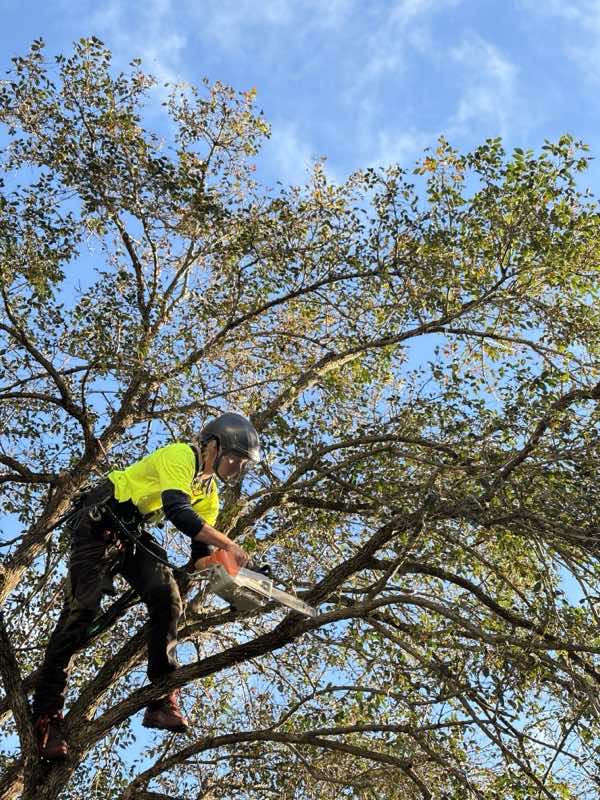
Crown reduction is one of the most misunderstood services in arboriculture. Ask ten people what it means and you'll get ten different answers — everything from "just trimming it back" to "cutting it in half." This guide explains what crown reduction actually involves, when it's the right intervention for trees on the Northern Beaches, how it differs from crown thinning and crown lifting, what permit you may need, and what it costs in 2026.
What Is Crown Reduction?
Crown reduction is the selective removal of branch tips from the outer canopy of a tree, cutting each branch back to a lateral branch of adequate size — typically at least one-third the diameter of the parent branch — so that the lateral can take over as the new growing tip. This distinguishes it from topping, which cuts branches straight across at an arbitrary height and leaves large stubs that die back, create decay pathways, and produce dense, weakly attached regrowth.
Done correctly, crown reduction:
- Reduces the overall height and/or spread of the canopy by 10–25% without removing the tree's form or its ability to compartmentalise wounds
- Follows Australian Standard AS 4373-2007 (Pruning of Amenity Trees), which requires cuts to be made to suitable growth points, not arbitrary stubs
- Is reversible in the sense that the tree retains living structure and continues to grow — future sessions can refine or maintain the target size
- Is distinct from removal: a tree that receives competent crown reduction continues to provide shade, habitat, visual screening, and property value
As part of our tree pruning service on the Northern Beaches, crown reduction is one of the most requested techniques — particularly for large-growing eucalypts and angophoras that have grown closer to structures than was anticipated when they were young, and for exotic ornamentals that have outgrown their garden position.
Crown Reduction vs Crown Thinning vs Crown Lifting
These three pruning types are often confused because all of them involve removing branches. The difference is in which branches come out and why.
| Technique | What it removes | Effect | Right when |
|---|---|---|---|
| Crown reduction | Outer branch tips, cutting back to laterals | Reduces overall height/spread while keeping the tree's shape | Tree is too large for its position; you want to keep it |
| Crown thinning | Selected inner and secondary branches across the canopy | Opens the canopy; same size, less density | Need more light and airflow; or reduce wind-sail effect |
| Crown lifting | Lower branches, from the base of the canopy upward | Raises the canopy base; clearance below | Need clearance over a path, driveway, fence, or structure |
In practice, a job often combines techniques — reducing the upper canopy and thinning the mid-canopy in the same visit, for example. These are not rigid categories but rather a vocabulary for communicating which part of the tree the work targets. An arborist will specify which technique applies and why in the quote.
When Does a Tree Need Crown Reduction?
The most common scenarios on the Northern Beaches are:
The tree has outgrown its position. A spotted gum or angophora planted 10 years ago may now be growing into the eaves, the power lines, or the neighbour's gutters. The choice is between staged crown reduction to hold it at an acceptable size long-term, or removal. For a healthy, structurally sound tree, reduction is usually the better outcome — cheaper over the lifetime of the property and better for the ecosystem.
View or light recovery. The Northern Beaches has some of the most valuable water views in Sydney. A tree that has grown to block a rooftop Pittwater view or shade out a north-facing garden is a common candidate for crown reduction — not removal. Done with appropriate permits and care, reduction recovers the light or view while keeping the tree as part of the landscape.
Structural risk management. A crown with over-extended, heavy lateral branches creates leverage loads that the root system, stem, or branch unions may not be able to sustain in a storm. Selective reduction of these branches — particularly long, laterally weighted ones with a narrow attachment angle — reduces the mechanical load on the tree structure. This is different from deadwooding, which removes dead material; reduction here is specifically about reducing the live load on over-extended living branches. Our guide to signs a tree is dangerous covers related structural hazard indicators.
Post-damage recovery. After a storm event or partial branch failure, a tree may have a structurally compromised crown that is best addressed by a targeted reduction of the affected sections, removing the leverage load and allowing the tree to re-compartmentalise correctly. See our storm damage guide for the broader picture of post-storm tree management.
What crown reduction is NOT the answer for: a tree that is dead, structurally failed, or whose root system has been compromised to the point where it cannot sustain continued growth. In those situations, reducing the crown may delay an inevitable removal while adding cost. An honest assessment will tell you which scenario you are in.
Crown Reduction and Council Permits on the Northern Beaches
Crown reduction involves removing live branches from protected trees — which means development consent is required in most residential situations on the Northern Beaches.
Under the Northern Beaches Development Control Plan, a tree requires consent before any pruning work if it is above the exempt size thresholds (typically 3 metres in height and 30 centimetres in trunk circumference measured at 1 metre above ground), unless the species is on the exempt list or the property triggers other exemptions. Crown reduction always removes live material, so the minor works exemptions that cover deadwooding and hazard branch removal generally do not apply here.
Exceptions include:
- Trees on your property that are below the DCP size thresholds
- Species exempted by the DCP (check the current Northern Beaches DCP Schedule before relying on this)
- Pruning up to 10% of the live canopy in a 12-month period on non-significant trees — check the specific DCP provisions, as thresholds and conditions vary
Our council permit guide covers the full permit framework. For crown reduction specifically, your arborist should confirm the permit position before any work is scheduled. As holders of an AQF Certificate III in Arboriculture and a current arborist report practice under AS 4970, we can prepare the supporting documentation for permit applications on your behalf.
How Crown Reduction Is Done
The work itself is technically demanding. A correctly executed crown reduction on a large tree involves:
- Pre-work inspection. Assessing the crown structure, identifying suitable lateral growth points throughout the canopy, confirming that each retained lateral is of sufficient diameter to sustain the branch load above it. This dictates where every cut goes — it is not a trim that begins at the top and works down.
- Sequencing cuts from the inside out. To avoid splitting, the branch is relieved before the final collar cut. On branches with significant weight, rigging is used to lower sections rather than letting them fall.
- Target size and shape. A good reduction preserves the natural form of the tree — the shape after reduction should look like a smaller version of the original. Flat tops, severe angles, and bare sections between growth points are signs of poor-quality work.
- Wound management. No dressing or sealant is applied to cut surfaces — this is outdated practice that was removed from AS 4373-2007. The tree's own compartmentalisation is the mechanism.
- Post-work review. The arborist should check the retained structure for any inadvertently damaged laterals and assess whether the overall form meets the target specification.
On large eucalypts and angophoras, this is typically a full climbing job — aerial work platforms (EWPs) can access much of the canopy but climbing allows the precise positioning needed for each cut. Our arborists work to Collaroy, Narrabeen, and across the Northern Beaches.
How Often Does a Tree Need Crown Reduction?
The answer depends heavily on species and growth rate. After an initial crown reduction, a typical schedule is:
| Species type | Typical interval after initial reduction | Notes |
|---|---|---|
| Eucalypts, angophoras | 5–8 years | Slower canopy regrowth after reduction; deadwooding may be needed in between |
| Exotic ornamentals (jacaranda, ash, plane) | 4–6 years | Moderate regrowth rate; crown form holds well after reduction |
| Lilli pillies, ficus, fast exotics | 2–4 years | High regrowth; may produce dense epicormic shoots requiring secondary thinning |
For the best result, ask your arborist for a written maintenance schedule at the time of the first job — an honest estimate of when the tree will reach the target size again and what work will be needed at that point. Our tree pruning cost guide covers the full range of maintenance services and their typical frequencies.
What Crown Reduction Costs on the Northern Beaches in 2026
Crown reduction is a skilled, time-intensive job — it takes longer than removal of the same tree because every cut requires positioning and judgement rather than working from the top down. The cost reflects the climbing time, the number of cuts, and the complexity of the crown structure.
| Tree size | Typical range | Notes |
|---|---|---|
| Small (under 5m) | $300–$600 | Often combined with other garden maintenance work |
| Medium (5–10m) | $500–$900 | Standard climbing set-up; 2–3 hrs on site |
| Large (10–20m) | $900–$1,800 | Full climbing; may need EWP for upper canopy access |
| Very large mature tree (>20m) | $1,800+ | Project work; council permit required; quote needed |
The permit application (if needed) is separate — preparation of supporting documentation for a DA typically costs $200–$400 depending on complexity. It is worth factoring this in when budgeting, as unapproved work on a protected tree can result in penalties far exceeding the job cost.
Multiple trees in a single visit are generally more cost-effective than individual jobs. We carry out crown reduction across the Northern Beaches as part of our tree pruning service — send photos for a no-obligation assessment and written quote.
Tree too big for its position?
Send us photos and we'll tell you whether crown reduction is the right answer, what permit you'll need, and what it will cost. Written quote, no pressure.
Book a free inspectionFrequently Asked Questions
What is the difference between crown reduction and topping a tree?
Crown reduction cuts each branch back to a lateral growth point — a side branch that can take over as the new growing tip. Topping cuts branches at an arbitrary height, leaving stubs that die back and create disease entry points. Topping is harmful and does not comply with AS 4373-2007. Crown reduction maintains the tree's form and long-term health; topping degrades both.
Will crown reduction harm my tree?
Correctly executed crown reduction — no more than 20–25% of the live canopy removed at one time, cuts made to adequate laterals — causes only short-term stress. The tree compartmentalises the wounds and resumes growth normally. Over-reduction (more than 30% at once) can deplete the tree's energy reserves and trigger unhealthy epicormic regrowth. A qualified arborist will stage the work appropriately for the specific tree and species.
Does crown reduction need a council permit on the Northern Beaches?
Yes for most protected trees in the Northern Beaches LGA — crown reduction removes live branches, which puts it outside the deadwooding and hazard exemptions. You may not need consent for small, unprotected trees below the DCP size thresholds. Your arborist should confirm the permit position before work starts. Proceeding without consent on a protected tree can result in significant penalties.
When is the best time for crown reduction on the Northern Beaches?
Late winter to early spring (July–September) is generally preferred — cooler temperatures reduce stress, wound compartmentalisation is active, and the growing season that follows rapidly hardens the new growth. For safety-related work, timing is secondary to getting the hazard addressed. For eucalypts and angophoras, avoid peak summer heat to reduce sunscorch risk on exposed wood.
How much does crown reduction cost on the Northern Beaches?
Approximately $300–$600 for small trees under 5m, $500–$900 for medium trees (5–10m), and $900–$1,800 for large trees. Very large mature trees are project work and need a site-specific quote. Permit preparation (if required) adds $200–$400. Multiple trees in one visit cost less per tree. Get a written, itemised quote before committing.
How often does a tree need crown reduction?
Eucalypts and angophoras typically need repeat reduction every 5–8 years. Exotic ornamentals every 4–6 years. Fast-growing species (lilli pillies, ficus) every 2–4 years. Your arborist should provide a written maintenance schedule at the time of the first job so you can plan ahead.