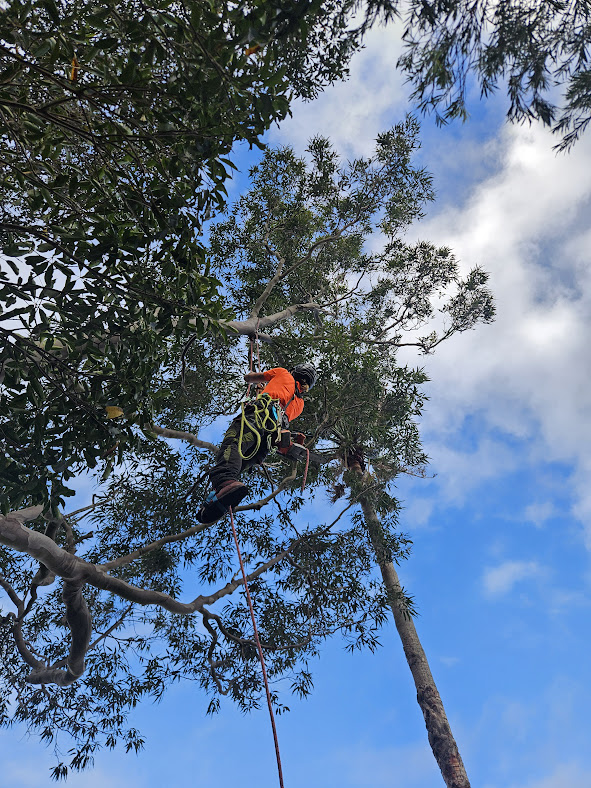
Tree pruning cost on the Northern Beaches is one of the most common questions we get — and one of the hardest to answer with a single number. A small lilly pilly in a front garden costs very little to shape up. A 15-metre Sydney Blue Gum overhanging a neighbour's fence on a steep Avalon block is an entirely different matter. Between those two jobs, the price can range from a few hundred dollars to several thousand.
This guide breaks down what you can actually expect to pay in 2026, the main factors that push the price up or down, what's included in a professional job, and what Northern Beaches Council requires before any significant pruning takes place. We're a local tree pruning service based in North Narrabeen — this is the same pricing context we use every day.
Tree Pruning Cost on the Northern Beaches: 2026 Price Ranges
The table below covers typical pricing for professional arborist pruning on the Northern Beaches. These are realistic 2026 figures for a qualified, insured arborist — not a handy-man rate, and not a crane job. All figures are indicative; your site visit quote will give you the accurate number.
| Tree size | Typical height | Price range (AUD) | Notes |
|---|---|---|---|
| Small | Under 5m | $280–$650 | Ornamentals, young natives, fruit trees |
| Medium | 5–10m | $650–$1,500 | Established garden trees, lilly pillys, small gums |
| Large | 10–15m | $1,400–$3,000 | Mature eucalypts, angophoras, large exotics |
| Very large | 15m+ | $2,800–$5,500+ | Large Sydney Blue Gums, tallowwoods, Moreton Bay figs |
| EWP hire (if needed) | — | +$350–$800 | Where climbing is not practical due to access or structure |
| Tight access loading | — | +$150–$600 | Narrow side gates, steep sites, pool surrounds, no chipper access |
If you have multiple trees to prune in one visit, the per-tree cost typically falls — mobilisation and setup costs are shared across the job. Ask about a combined quote if you have several trees that need attention at the same time.
What Affects Tree Pruning Cost on the Northern Beaches?
More than almost anywhere in Sydney, Northern Beaches properties introduce cost variables that don't exist in flat suburban blocks. Here's what actually moves the price:
Tree size and height
The single biggest variable. A taller tree takes more time to work through, requires more climbing or a higher elevated work platform, and produces more material to chip and remove. A 6-metre ornamental and a 14-metre angophora are genuinely different jobs even if the scope of work — say, deadwooding plus one clearance cut — sounds similar.
Access on Northern Beaches properties
Access is the second-biggest cost driver on this peninsula, and it's where Northern Beaches jobs consistently differ from inner-Sydney pricing. Common access constraints include:
- Narrow side gates: if the chipper truck can't get close, all material has to be hand-carried through the property
- Steep blocks: many Avalon, Newport and Pittwater-side properties have significant gradient, which slows work and limits equipment options
- Pool surrounds: debris management around a pool costs extra time and care
- Sandstone and retaining walls: heavy equipment cannot operate near unstable retaining structures
- Right-of-way constraints: on some properties, there's simply no direct access to the work area
When quoting, we assess access first. It's the thing most likely to cause a surprise if you get a quote over the phone without a site visit.
Type of pruning required
Not all pruning jobs are the same. The scope required significantly affects the time and cost:
- Deadwooding: removing dead, dying or diseased branches — often the most time-efficient type of pruning and very commonly needed on mature Northern Beaches trees
- Crown thinning: removing selected branches throughout the canopy to reduce density and improve airflow — typically 15–25% of live material removed
- Crown reduction: reducing the overall size of the canopy while maintaining its shape — takes more precise work than thinning
- Crown lifting: removing lower limbs to raise the clearance beneath the canopy — often required for driveway or pedestrian clearance
- Clearance pruning: removing branches overhanging structures, powerlines or neighbouring properties — scope varies widely
- Formative pruning: shaping young trees to develop good structure — relatively quick and inexpensive, but should be done early
Species
Some species are significantly harder to work in than others. Large-canopy eucalypts and angophoras require careful rigging to avoid damaging what's below. Moreton Bay figs and other large-spreading exotics often have complex branch structures that take time to navigate. Palms are a separate category — palm tree pruning is priced differently to broadleaf tree work.
Proximity to powerlines
Branches within three metres of overhead powerlines in NSW are subject to Ausgrid's electrical safety requirements. Depending on the situation, an Ausgrid inspector may need to attend or the lines may need to be temporarily isolated. This affects scheduling and can add cost. Your arborist will identify this during the site visit.
Council Permit Rules for Tree Pruning on the Northern Beaches
This section is frequently overlooked — most people know that tree removal requires a council permit, but pruning can too. Under Northern Beaches Development Control Plan (DCP) Part B13, development consent is required for pruning work on a tree that meets the size thresholds if:
- More than 30% of the live canopy is removed within a 12-month period
- A major structural limb is removed (typically a limb with a diameter of 100mm or more at the cut point)
- The pruning is so extensive it amounts to a removal in practice
The size thresholds that bring a tree under council control are: 5 metres or more in height, 5 metres or more canopy spread, or a trunk diameter of 300mm or more measured 1 metre above ground.
Pruning that falls under these triggers without consent is a breach of the DCP and can attract a penalty. On the other hand, minor deadwooding and hazard branch removal are generally exempt.
Our Northern Beaches council permit guide covers this in more detail. As a practical matter, we advise on permit requirements as part of every quoting process — so you don't have to work this out yourself.
What's Included in a Professional Tree Pruning Job?
Understanding what you're paying for makes it easier to compare quotes fairly. When you hire a qualified arborist like The Living Canopy for tree pruning on the Northern Beaches, a professional job includes:
- Pre-work assessment: a visual inspection to confirm the scope of work and identify any conditions that affect safety or approach
- Pruning to AS 4373-2007: all cuts made to the Australian Standard for Pruning of Amenity Trees — to branch collars and natural unions, removing no unnecessary live material
- Rigging where needed: controlled lowering of heavy sections to avoid damage to structures below
- On-site chipping: all pruned material is run through the chipper at your property
- Debris clearance: the site is left clean
What's typically not included unless agreed upfront: disposal of existing green waste not generated by the pruning job, soil treatments or fertilisation, and skip-bin hire (occasionally needed when chipping is not practical).
Tree Pruning vs Tree Lopping: Why It Matters for Cost
It's worth addressing this directly because lopping is still widely offered — and it's worth knowing why we don't do it.
Tree lopping means cutting branches at arbitrary mid-shaft points, leaving large open wounds that the tree cannot properly seal. The short-term price may be lower. The longer-term cost is almost always higher: lopped trees produce vigorous, weakly attached regrowth that becomes a hazard within a few years; the open wounds are entry points for decay fungi; and the overall structural integrity of the tree deteriorates over time. A tree that's been lopped once often costs far more to deal with five years later than it would have cost to prune properly the first time.
Pruning to AS 4373-2007, by contrast, makes precise cuts at natural growth points. The tree heals correctly, the structure is maintained, and the work typically doesn't need to be redone for several years.
When comparing quotes, a significantly lower price is often a signal that lopping — not arborist-standard pruning — is what's being offered. Check the qualifications: a qualified arborist holds at least an AQF Certificate III in Arboriculture. We also hold $20M public liability insurance and workers compensation as a minimum standard.
How Often Do Trees Need Pruning on the Northern Beaches?
A rough guide by tree type for the Northern Beaches context:
- Mature eucalypts and angophoras: deadwooding every 3–5 years is typically sufficient; structural pruning less frequently
- Ornamental garden trees: formative pruning every 2–3 years while young; less frequently once established
- Figs and fast-growing exotics: canopy management often needed every 2–3 years given growth rates
- Fruit trees: annual pruning for best production
- Native coastal species (banksias, grevilleas, westringias): light tip pruning after flowering; typically no structural arborist intervention needed
The best approach is an initial arborist assessment that establishes the current condition of your trees and a maintenance schedule from there — rather than reactive calls each time something gets out of hand.
Winter is a particularly good window for many pruning jobs on the Northern Beaches. Our winter pruning guide explains why and which species benefit most from cooler-season work.
How to Get an Accurate Pruning Quote
A quote without a site visit is rarely reliable for tree pruning. The variables — access, species, exact scope, height — are too significant to estimate accurately from a photo or a description. Here's what we'd suggest:
- Note the species if you know it, or take a clear photo of the leaves, bark and overall form
- Check access: can a vehicle and chipper get within 20 metres of the tree, or is access restricted?
- Consider council requirements: if the tree is large (5m+), a permit application may be needed before work starts — factor in 3–4 weeks for that process
- Get at least two written quotes from qualified arborists, and ask each to specify what's included and what AS standard they prune to
- Confirm insurance: ask for evidence of current $20M public liability cover and workers compensation before any work begins
We service Narrabeen, Dee Why and the full Northern Beaches peninsula. A free no-obligation site visit and written quote is the starting point for any job.
Get a free written tree pruning quote
We assess the tree on-site and give you a clear written price. No obligation, no surprises. Serving the full Northern Beaches from Manly to Palm Beach.
Request a free quoteFrequently Asked Questions
How much does tree pruning cost on the Northern Beaches?
Tree pruning on the Northern Beaches costs approximately $280–$650 for a small tree (under 5m), $650–$1,500 for a medium tree (5–10m), $1,400–$3,000 for a large tree (10–15m), and $2,800 or more for very large trees over 15m. Access difficulty, type of pruning required, and species all affect the final price. A site visit and written quote will give you the accurate figure for your property.
Do you need a council permit for tree pruning on the Northern Beaches?
It depends on the extent of the pruning and the tree. Under Northern Beaches DCP Part B13, any work that removes more than 30% of the live canopy in a 12-month period, or removes a major structural limb from a tree meeting the size thresholds, requires development consent. Minor deadwooding and hazard removal are generally exempt. Your arborist will advise on permit requirements as part of the quoting process — or see our council permit guide for the full detail.
How often should trees be pruned?
Most established trees need professional pruning every 3–5 years for general maintenance. Fast-growing species like figs may need attention every 2–3 years. Fruit trees are typically pruned annually. Young trees benefit from formative pruning in their first few years to develop good structure. Palms are maintained separately — fronds are removed throughout the year as they naturally die back.
What is the difference between tree pruning and tree lopping?
Tree pruning means removing branches to a natural union point following the AS 4373-2007 standard, leaving clean wounds the tree can seal and a balanced structure. Tree lopping cuts branches at arbitrary mid-shaft points, leaving large open wounds, structural weakness and vigorous but poorly attached regrowth. Lopping may be cheaper upfront but almost always costs more in the medium term. A qualified arborist will not lop trees.
What does professional tree pruning include?
A professional job includes a pre-work assessment, all cuts made to AS 4373-2007, rigging where required, on-site chipping of removed material, and full debris clearance. Your arborist should confirm all inclusions and exclusions in a written quote before work begins.
Can I prune my own tree on the Northern Beaches?
For small ornamental trees under 3–4 metres, ground-level pruning is practical provided you prune correctly (to branch collars, no stubs, no more than 20–25% of live canopy in a season). For anything taller or requiring climbing, a qualified arborist with the right equipment and insurance is the safe option. Council permit requirements also apply to DIY pruning on trees that meet the size thresholds.