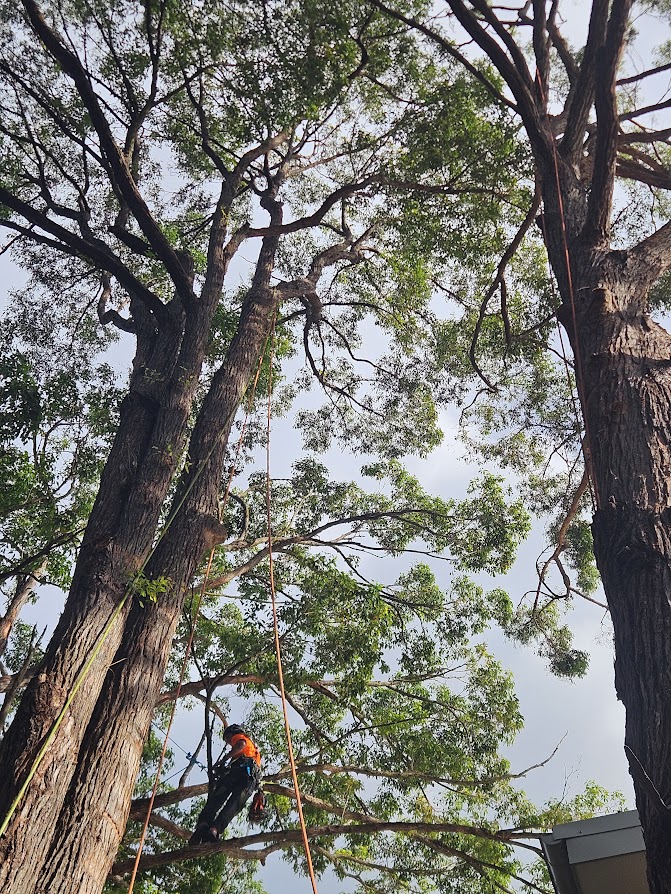
Deadwooding is one of the most commonly recommended arborist services on the Northern Beaches — and one of the least understood. Most homeowners know it involves removing dead branches, but the specifics of when it matters, what it actually changes for the tree, and what it costs are less clear. This guide explains what deadwooding trees on the Northern Beaches involves, why eucalypts and native species here need it more than most people realise, and what you should expect to pay in 2026.
What Is Deadwooding?
Deadwooding is the targeted removal of dead, dying, and structurally compromised branches from an otherwise living tree. The term refers specifically to this work — it does not include shaping the canopy, reducing the height, or clearing branches from structures or power lines. Those are separate pruning tasks that may be done at the same time, but deadwooding itself is purely about removing wood that the tree can no longer sustain and that poses a hazard or a disease pathway.
When a branch dies, the tree gradually walls it off — forming a barrier zone at the base of the dead branch to protect the healthy wood beneath. This process works well for small branches, but larger dead limbs can take years to wall off completely, and during that time they are vulnerable to fungal decay, insect colonisation, and failure under load. Deadwooding removes these branches before that process runs its course, targeting them at a collar cut that preserves the wall zone the tree has already started forming.
As part of our tree pruning service on the Northern Beaches, deadwooding is one of the most frequent requests we receive — particularly for mature eucalypts and angophoras that have accumulated years of natural dieback in their upper canopy.
Why Deadwooding Matters — Especially on the Northern Beaches
The Northern Beaches has a specific combination of factors that makes deadwooding more important here than in many other suburban contexts.
Eucalypt biology. Eucalypts and angophoras shed branches as a natural survival strategy. During drought or water stress, they drop entire limbs to reduce their water demand — this is normal behaviour, but it means that a mature spotted gum or angophora costata on a Northern Beaches block may carry 20–30% dead wood in its upper canopy without showing any outward sign of illness. Unlike exotic trees where dead wood is a symptom of disease, in eucalypts it is partly just the lifecycle of the species. That doesn't make the dead wood safe — it still needs to be managed.
Coastal exposure. Properties along the coast and in exposed positions are subject to higher wind loads than sheltered inland suburbs. Dead branches that might remain stable in a sheltered garden fail more readily when they are repeatedly loaded by onshore winds. Elevated properties — on the ridgelines above Avalon, Bilgola, and the headlands around Dee Why — are particularly prone to wind-driven branch failures.
Storm and drought cycles. The Northern Beaches experiences periodic drought years followed by intense wet seasons. Each drought cycle accelerates natural dieback in eucalypts and native trees; the subsequent growing season may partially mask the dead wood with new foliage on surrounding branches. An arborist inspection after a drought year typically reveals more dead wood loading than was visible the previous season.
Dense residential use. Many of the large native trees on the Northern Beaches sit directly over driveways, pools, decks, and outdoor entertaining areas. The consequence of a 20-kilogram dead branch failing over a structure or a person is not theoretical — it happens during storms, and occasionally on calm days when differential moisture causes sudden failure. Deadwooding manages that risk before the failure occurs rather than after.
Signs Your Tree Needs Deadwooding
From the ground, the most visible indicators are:
- Bare branches in a canopy that is otherwise leafed out. If sections of the crown show no foliage through spring and summer while adjacent branches are active, those sections are almost certainly dead.
- Hangers — partially detached branches suspended in the canopy. These are a specific deadwooding priority: a branch that has failed at its attachment point but is still caught in the canopy is under variable load each time the tree moves and can come down unpredictably. They are among the most common causes of sudden branch failure.
- Dead stubs from old pruning cuts. When branches are pruned incorrectly — cut too far from the trunk, leaving a stub — the stub dies and becomes a pathway for decay into the trunk. Deadwooding targets these stubs with a revised cut that allows the tree to wall off the wound properly.
- Bracket or shelf fungi on otherwise healthy limbs. Fungal growth on a branch or in the upper canopy indicates internal wood decay that may or may not be visible from outside. An arborist assessment helps determine whether the affected wood is structurally compromised.
- Bark that has fallen away exposing dry grey wood. Live wood retains bark firmly; bark that sloughs off large sections and exposes pale, dry sapwood is typically dead.
Not all of these indicators are visible from ground level. An arborist doing a walk-around inspection, particularly one who has climbed the tree before, will identify dead wood in the upper canopy that isn't apparent from below. Our guide to signs a tree is dangerous covers the full range of hazard indicators across both live and dead wood scenarios.
Deadwooding vs Pruning vs Tree Removal: The Spectrum
These three interventions address the same underlying question — what is the right way to manage this tree — but at different points on the scale of intervention.
| Intervention | What it does | Right when |
|---|---|---|
| Deadwooding | Removes dead/dying/failed branches only | Tree is healthy; dead wood is localised |
| General pruning | Deadwooding + shaping, thinning, clearance | Tree needs structural or cosmetic work too |
| Tree removal | Full removal of trunk and canopy | Tree is dead, irreparably damaged, or poses a risk that can't be managed |
The practical question an arborist answers during the site inspection is: is there enough healthy wood and root system to sustain this tree long-term, or has the dead wood loading reached a point where removal is the more sensible outcome? A tree with 20–30% dead wood in the upper canopy is a good candidate for deadwooding. A tree with 60–70% dead wood and signs of root failure is a better candidate for removal — retaining it through repeated deadwooding cycles may cost more and leave the underlying hazard unresolved. See our guide to dead tree removal on the Northern Beaches if that's the situation you're facing.
Does Deadwooding Require a Council Permit?
Minor deadwooding and hazard branch removal are generally exempt from Northern Beaches development consent requirements under the DCP. This covers the typical deadwooding scenario: removing dead, dying, or hazardous branches from a living tree where the work does not remove more than 30% of the live canopy in a 12-month period.
The exemption has limits worth knowing:
- If the tree is listed on the council's significant tree register, any work — including deadwooding — should be confirmed with council before proceeding, as significant trees have additional protections regardless of the scope of work.
- If a dead limb is also a structural limb (a major branch attachment at the main trunk), removing it may still require consent even though the branch is dead.
- If the property is in a bushfire-prone land category or a biodiversity overlay, additional constraints may apply.
For the majority of residential deadwooding on the Northern Beaches — a mature eucalypt with dead secondary branches and hangers — no permit is required. Our council permit guide covers the full picture of when consent is and isn't needed for tree work, and our arborists confirm the permit position as part of every assessment.
How Often Should Trees Be Deadwooded?
The answer depends on species, position, and local conditions — but for Northern Beaches eucalypts and angophoras in residential settings, a deadwooding inspection every three to five years is a reasonable baseline.
Higher frequency warranted when:
- The tree is in a coastal or exposed position subject to frequent onshore winds
- The property has recently come through a drought year — eucalypts shed significantly more wood in drought conditions and the dead wood load builds faster than the typical cycle
- The tree is over an area of high use: pool, deck, outdoor dining, driveway, or a child's play area
- There has been recent storm activity — post-storm is always a good time to have trees assessed, as storms create new hangers and partially failed branches that may not have fully detached
Standard frequency for lower-risk situations: A mature angophora or spotted gum in a position where a dropped branch would fall clear of structures and people — into a garden bed or open lawn — can reasonably be assessed on a four to five year cycle.
Our tree pruning cost guide covers the full range of maintenance services and their recommended frequencies for different tree types on the Northern Beaches.
What Deadwooding Costs on the Northern Beaches in 2026
Deadwooding is generally a lighter job than a full pruning, and costs reflect that. The main variables are tree height, volume of dead wood, access to the work zone, and whether the job requires a full climbing set-up or can be done partially from an EWP.
| Tree size | Typical cost range | Notes |
|---|---|---|
| Small (under 5m) | $200–$400 | Often done as part of a broader pruning visit |
| Medium (5–10m) | $350–$700 | Standard climb; volume of dead wood is the key variable |
| Large (10–20m) | $700–$1,500 | Full climbing set-up; may require EWP for upper canopy |
| Multiple trees, one visit | Discount per tree | Travel and set-up cost is shared across the job |
Deadwooding is almost always more cost-effective than waiting for a branch to fail and repairing the damage. A single large dead limb dropped on a roof, fence, or pool enclosure typically costs more to repair than several seasons of routine deadwooding — and that calculation doesn't include the consequences if someone is underneath when it falls.
We carry out tree removal and maintenance work across the Northern Beaches, including dedicated deadwooding visits for residential properties with large native trees. Call or send photos for a no-obligation assessment and written quote.
Overdue for a deadwooding inspection?
Send us photos of your trees or call to book a site inspection. We'll give you a written quote and a straight assessment of what needs attention and what can wait.
Book a free inspectionFrequently Asked Questions
What is deadwooding and how does it differ from general pruning?
Deadwooding is the targeted removal of dead, dying, and structurally compromised branches from a living tree — it does not include shaping, thinning, or clearance pruning. General pruning may include deadwooding alongside other work. Deadwooding alone is a lighter, faster job focused purely on hazard and tree health rather than appearance or size management.
How do I know if a tree needs deadwooding?
Look for bare branches in an otherwise active canopy, hanging or partially detached branches caught in the tree, dead stubs from old pruning cuts, fungal growth on otherwise healthy wood, and bark separating from secondary limbs. Eucalypts and angophoras on the Northern Beaches carry significant dead wood naturally and often need assessment even when they look healthy from a distance. An arborist inspection every three to five years is the most reliable approach.
Is deadwooding worth the cost?
Yes for most mature trees in residential positions. A deadwooding job every three to five years costs significantly less than repairing damage from a single large branch failure. Dead wood is also a disease pathway — bracket fungi on a dead limb can spread into healthy wood over time if not removed. For trees over pools, decks, or driveways, regular deadwooding is straightforward risk management.
Does deadwooding require a council permit on the Northern Beaches?
Minor deadwooding is generally exempt from Northern Beaches development consent. Exceptions apply for significant or heritage-listed trees, and for any removal of major structural limbs even if dead. Your arborist will confirm the permit position during the site inspection. Our full council permit guide covers the details.
How often should trees be deadwooded?
Every three to five years for mature eucalypts and angophoras in standard residential positions. More frequently for trees in coastal or exposed locations, trees over high-use areas, and after drought years or major storm events. Post-storm is always a good time to inspect, as storms create new hangers that may not have fully separated from the canopy.
What does tree deadwooding cost on the Northern Beaches?
Approximately $200–$400 for small trees, $350–$700 for medium trees, and $700–$1,500 for large mature eucalypts. Multiple trees in a single visit cost less per tree as travel and set-up is shared. The volume of dead wood and the need for an EWP rather than climbing are the main cost variables. Always get a written quote before proceeding.