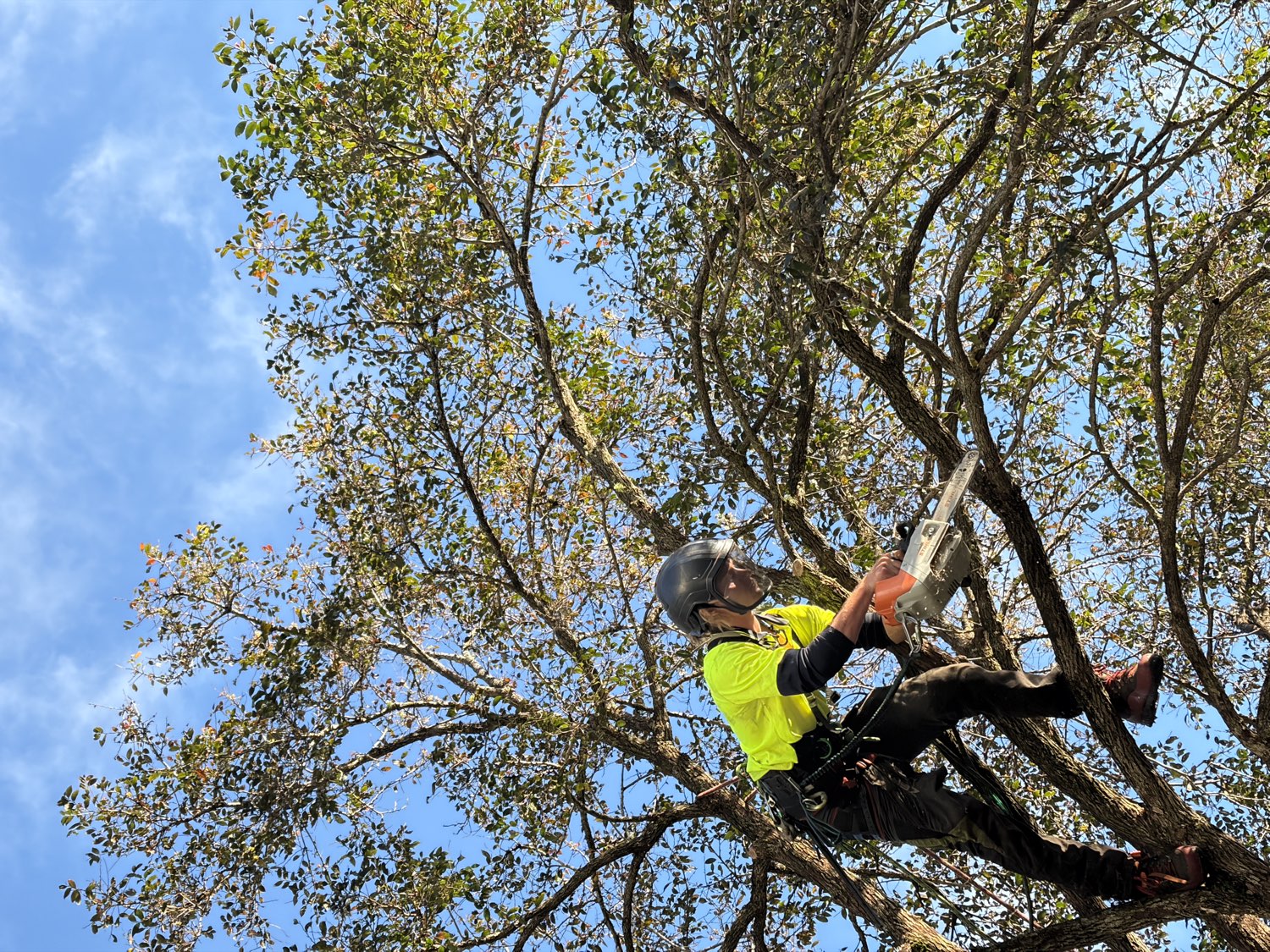
A neighbour's tree overhanging your property is one of the most common tree-related problems we deal with on the Northern Beaches — and also one of the most misunderstood. Most homeowners know they have some right to deal with overhanging branches, but the specifics matter enormously here: the legal framework is more nuanced than most guides let on, Northern Beaches Council's tree protection rules apply even on your own side of the fence, and getting it wrong can mean a significant fine or a damaged relationship with a neighbour that lasts for years.
This guide covers exactly what NSW law allows, what you can't do without a permit or court order, which trees most commonly cause problems on the Northern Beaches, and the practical role a qualified arborist plays — from a straightforward pruning job to preparing evidence for the Land and Environment Court.
What NSW Law Actually Says
The key legislation is the Trees (Disputes Between Neighbours) Act 2006 (NSW), which establishes the legal framework for resolving tree disputes between private landowners. It covers two distinct situations:
- Trees causing damage or injury: If a neighbour's tree has caused, is causing, or is likely to cause damage to your property or injury to a person on your land, you can apply to the NSW Land and Environment Court for an order requiring the tree owner to carry out work or pay compensation.
- Trees severely obstructing sunlight or views: Under Part 2A of the Act, you may also apply where a tree severely obstructs your enjoyment of sunlight or a view — though the threshold for "severe" is deliberately high, and the court must balance the amenity value of the tree against the impact on you.
Crucially, Northern Beaches Council cannot act as a referee in a dispute between neighbours. The council's role is limited to enforcing its own permit and tree protection rules — it does not have authority to order a private landowner to deal with their tree on your behalf. If your neighbour refuses to act, the Land and Environment Court is the only authority that can order them to do so.
Your Self-Help Rights — What You Can Do Without Asking
NSW common law gives you a "self-help" right to prune branches (and roots) that encroach over your property boundary, without needing your neighbour's permission or a court order. But this right comes with important conditions:
- You can only prune back to the boundary. You cannot cross onto your neighbour's land without their permission, even to make the job safer or easier.
- You pay for it. The cost of self-help pruning is yours unless the court orders otherwise.
- The cut material belongs to the tree owner. You must offer the branches back to your neighbour. You cannot keep the timber or compost it without their agreement.
- You must not damage the tree. Your pruning must not cause unreasonable damage to the long-term health or structure of the tree. This is where things can go wrong quickly if someone with a chainsaw and good intentions removes too much in the wrong places.
In practice, self-help pruning should always be carried out by a qualified arborist working to AS 4373-2007 (Pruning of Amenity Trees). A professional will make clean cuts at the right points, avoid leaving stubs that invite disease, and won't inadvertently destabilise the tree — which would expose you to liability.
The Permit Trap Most Homeowners Don't Know About
Here is the piece of the puzzle that catches people out on the Northern Beaches: even self-help pruning requires a council permit if the tree is protected under Northern Beaches Council's Development Control Plan (DCP).
Northern Beaches Council protects trees above certain size thresholds — broadly, any tree with a trunk circumference of 100 cm or more measured at 1 metre above ground, any tree over 5 metres in height in certain situations, and any species on the council's significant tree register regardless of size. Many of the large Angophoras, Sydney Blue Gums, brush box trees and paperbarks that commonly cause boundary disputes on the Northern Beaches fall comfortably within these criteria.
Removing even a single significant branch from a protected tree — on your side of the fence, from your own property — without the required permit can result in a fine of up to $1.1 million for a corporation or $110,000 for an individual under the Local Land Services Act and Environmental Planning and Assessment Act. The council takes tree protection seriously, and it does not matter that the tree belongs to your neighbour.
Before any pruning takes place, check the tree's status. Our Northern Beaches council tree permit guide explains how the exemptions work and what triggers a permit requirement. Alternatively, read our detailed blog post on when you need a permit to remove or prune a tree on the Northern Beaches.
Trees That Commonly Cause Boundary Disputes on the Northern Beaches
Not all neighbour tree disputes are equal. Some trees cause overhanging problems easily resolved with a single annual prune; others are species with growth habits that make boundary management genuinely difficult, or have such high heritage significance that substantial pruning is off the table regardless of inconvenience.
| Tree | Common problem | Usually protected? |
|---|---|---|
| Angophora costata (Sydney Red Gum) | Wide canopy overhang, limb drop, leaf and bark litter | Almost always — significant size and listed species |
| Sydney Blue Gum (Eucalyptus saligna) | Tall canopy, overhanging branches, leaf drop into pools | Usually yes above minimum size |
| Brush Box (Lophostemon confertus) | Dense shading canopy, bark drop, root intrusion near paths | Often — common street and garden tree, frequently large |
| Cocos palm (Syagrus romanzoffiana) | Fronds over fence, fruit mess, nesting rats, fruit bats | Generally not — weed species, usually exempt |
| Paperbark (Melaleuca quinquenervia) | Spreading canopy, bark debris, roots in drainage | Often protected at significant size |
| Moreton Bay Fig (Ficus macrophylla) | Enormous canopy, aggressive surface roots, structural damage | Almost always — usually heritage-significant trees |
For context on how big and deep-rooted the most common Northern Beaches native trees can grow — and what their canopy spread typically means for neighbouring properties — see our guide to common trees on the Northern Beaches and how to care for them.
What a Qualified Arborist Can Do
Most people think of an arborist as someone who climbs trees and cuts branches. In a boundary dispute context, the role is considerably broader — and having a qualified arborist involved early often prevents disputes from escalating at all.
Assessment and Documentation
A qualified arborist can assess the overhanging tree objectively: its species, size, health, structural condition, proximity to structures, and the appropriate pruning response. This assessment can be written up as a formal arborist report — which you may need if you're pursuing a council permit application, lodging a formal dispute, or simply want a professional record that a risk was identified and communicated to the tree owner.
Permit Application Support
If the tree is protected and pruning requires council approval, an arborist can prepare the tree management plan and supporting documentation for the permit application, giving it the best chance of being approved in a reasonable timeframe.
The Actual Pruning Work
Where work is approved, a certified arborist will carry out the pruning to Australian Standard AS 4373-2007 — using proper pruning cuts at branch collars, removing the correct amount of canopy without destabilising the tree, and leaving the tree in better structural condition than a back-yard cleanup job would. This protects you legally and ensures the tree isn't damaged in a way that creates future liability.
Communication With the Neighbour
Sometimes having an independent professional involved shifts the dynamic entirely. Many boundary disputes we've been called to have been resolved after an arborist visited, spoke with both parties, and explained what was feasible, what was protected, and what the reasonable course of action looked like. A third-party professional opinion often de-escalates a situation that direct conversations have inflamed.
The Land and Environment Court Path
If your neighbour refuses to engage and informal resolution has failed, the NSW Land and Environment Court is the formal pathway. Here's what that process actually involves:
- Document the problem. Photographs, dates, any written correspondence with your neighbour, and a professional arborist report documenting the tree's condition and the risk it poses.
- Attempt mediation. The Act requires you to make a genuine attempt to resolve the issue directly with your neighbour before the court will hear the matter. Keep written records of these attempts.
- Lodge an application. Applications are made to the Land and Environment Court's Class 2 jurisdiction. There is a filing fee. The court will list the matter for an on-site inspection.
- Court-appointed arborist inspection. The court typically appoints its own arborist or relies on the arborist reports submitted by both parties. This is why having a credible, detailed report prepared by a qualified arborist is essential — the court's decision will be heavily influenced by the professional evidence before it.
- The order. If the court finds in your favour, it can order the tree owner to carry out specific work, or order them to pay for work you arrange, or in extreme cases order removal.
The court process is not quick. Most applications take several months from lodgement to hearing. If a tree poses an immediate risk to life or property — not just an inconvenience — and your neighbour is uncontactable or unresponsive, the appropriate step is to call an arborist and then contact emergency services if warranted. Our emergency tree work service is available when a tree presents an urgent risk.
Liability — Who Pays If a Branch Falls?
This is the question most homeowners have but rarely ask directly. In NSW, a tree owner is not automatically liable for every branch that falls from their tree — the legal test is negligence. To succeed in a negligence claim, you need to show that the tree owner knew (or ought to have known) that the tree was dangerous, and failed to take reasonable steps to address it.
This is why creating a paper trail matters so much. If you've written to your neighbour documenting a tree health concern — better yet, had a qualified arborist produce a written report identifying structural problems and recommending action — and your neighbour has failed to act on it, the evidence of negligence is clear. Without that documentation, "I told them about it" is hard to prove after the fact.
If you're concerned a neighbour's tree is structurally compromised and could fail, read our guide to how to tell if a tree is dangerous — the same signs that make a tree on your own land hazardous apply equally to trees across the fence.
Your own home insurance may cover damage caused by a neighbour's tree, but insurers will often seek to recover costs from the tree owner. Having documented the risk ahead of time strengthens that claim.
A Practical Step-by-Step Guide
If you're dealing with a neighbour's overhanging tree right now, here is the sequence that produces the best outcomes:
- Confirm the tree is on the neighbour's land — not straddling the boundary, not on council land. A straddling tree is jointly owned and requires a different approach.
- Check whether it's a protected tree under Northern Beaches Council's DCP before doing anything. Even casual pruning of a protected tree is a council permit matter.
- Have a direct, calm conversation with your neighbour first. Many disputes end here. Be specific about what the problem is and what outcome you're looking for.
- If the tree is potentially dangerous, call a qualified arborist for an assessment before doing anything else. If there's a structural risk, you want that documented in writing and the neighbour made aware of it formally.
- Apply for a permit if pruning is the solution and the tree is protected. Your arborist can help prepare the application.
- Arrange the work with your arborist. For straightforward overhanging branch removal, most jobs take half a day and are far less disruptive than a disputed relationship with the people next door.
- If your neighbour refuses to cooperate and the tree poses a genuine risk or is causing damage, engage a solicitor and the Land and Environment Court process. Your arborist report is your primary evidence.
Need an arborist assessment or report for a tree dispute?
We provide detailed arborist reports across the Northern Beaches — suitable for council permit applications and Land and Environment Court proceedings. We also carry out the pruning work once approvals are in place.
Learn about arborist reportsKey Northern Beaches Suburbs Where This Comes Up Most
Neighbour tree disputes are most common in established suburbs with mature tree canopy and smaller block sizes — exactly the profile of much of the Northern Beaches. Suburbs like Manly, Collaroy and Dee Why have some of the densest residential tree cover on the Beaches, and the combination of large heritage-listed trees and closely packed properties means boundary issues are a fact of life. In leafier suburbs further north — Avalon, Bilgola, Bayview, and the Pittwater fringe — the trees tend to be larger and more protected, which makes professional management even more important.
Wherever you are on the Northern Beaches, the fundamentals are the same: check what's protected, talk to your neighbour, get a qualified arborist involved early, and document everything.
Frequently Asked Questions
Can I cut overhanging branches from my neighbour's tree in NSW?
Yes — NSW law gives you a 'self-help' right to prune branches that overhang your property back to the boundary line, without needing your neighbour's permission or a court order. However, you must do so at your own cost, you cannot enter the neighbour's land without permission, and you cannot keep the cut material (it belongs to the tree owner). Critically, you still need to comply with Northern Beaches Council's Development Control Plan — if the tree is on the council's protected tree register, you may need a permit even to prune from your own side of the fence. And the pruning must not damage the long-term health or structural integrity of the tree.
Do I need a council permit to prune a neighbour's overhanging tree on the Northern Beaches?
Possibly, yes. Northern Beaches Council's DCP protects trees above certain size thresholds — typically any tree with a trunk circumference of 100 cm or more measured at 1 metre above ground, or any listed species regardless of size. If the overhanging tree meets those criteria, you need a council-approved permit before any pruning takes place, even work you carry out on your own side of the boundary. A qualified arborist can check the tree's status before any work begins.
Who is liable if my neighbour's tree falls and damages my property?
In NSW, a tree owner can be found liable for damage caused by their tree if it can be shown they knew (or should have known) the tree was dangerous and failed to act on it. Simply owning a tree does not make you automatically liable for every branch that falls — the test is negligence. This is why getting a written arborist report documenting the condition of a potentially dangerous neighbour's tree is important: it creates a formal record that the tree owner was made aware of the risk.
What is an arborist report and why do I need one for a tree dispute?
An arborist report is a written assessment by a qualified arborist documenting the tree's species, size, health, structural condition and risk rating. If your dispute progresses to the NSW Land and Environment Court, the court requires an arborist report as evidence before it will make any order. Without one, the court will not act. A report also serves as formal notice to the tree owner that a risk has been identified.
What trees commonly cause neighbour disputes on the Northern Beaches?
The most common trees are large Angophoras and Sydney Blue Gums with wide-spreading canopies and a natural tendency to shed heavy limbs; Brush Box, which develops large shading crowns; Cocos palms, whose fronds and fruit cause persistent mess; and large figs with aggressive root systems. Many of these species are protected under Northern Beaches DCP, which complicates the self-help pruning right.
Can Northern Beaches Council force my neighbour to deal with their tree?
No. Northern Beaches Council explicitly states it does not have the authority to act in disputes between private landowners over trees. If your neighbour refuses to address a dangerous or damaging tree and informal resolution has failed, the appropriate pathway is the NSW Land and Environment Court under the Trees (Disputes Between Neighbours) Act 2006. An arborist report is required to support your application.